
Real Money Pokies Apps for Android in Australia
The phrase itself does a lot of work. “Real money pokies” signals stakes for cash; “Android” sets the device; “Australia” sets the reader. Put the three together and you get a search from someone who has decided what they want to play and where they want to play it, and who wants to know which app to download. The honest answer is that no app offered through normal Australian channels does what the search asks for, and what is offered outside those channels is a specific kind of risk with a specific paper trail behind it. This page works through that, in the order someone making the decision needs it.
Data current as of 2 November 2026; verified against the ACMA’s published enforcement record and the Interactive Gambling Act 2001.
Table of Contents
- How Android pokies apps actually present themselves
- What Australian law actually prohibits
- What the ACMA has been doing about it
- What Australian-licensed gaming actually looks like
- What an Android real-money app typically asks of a phone
- Free pokies apps versus real-money apps
- What the ACMA has done about specific brands
- Brand-by-brand notes
- Reading the comparison
- Keeping real-money pokies in perspective
- Frequently Asked Questions
How Android pokies apps actually present themselves
Most search results for this term resolve to one of three things, and recognising which one you are looking at is the first step. A free-to-download app from the Google Play Store that plays pokies for in-app credits or virtual coins only — those exist in volume, run ads, and never pay out anything because there is no money in the pot. A “real money” app offered through the same Play Store or as a direct APK from a casino site — those are the subject of this page, and the ones the ACMA has been acting against for years. And the third, a web-based casino that loads in a phone browser with a mobile-first layout and calls itself an “app” in its marketing — that is a website, not an application, and the distinction matters once you look at what each one asks of the phone.
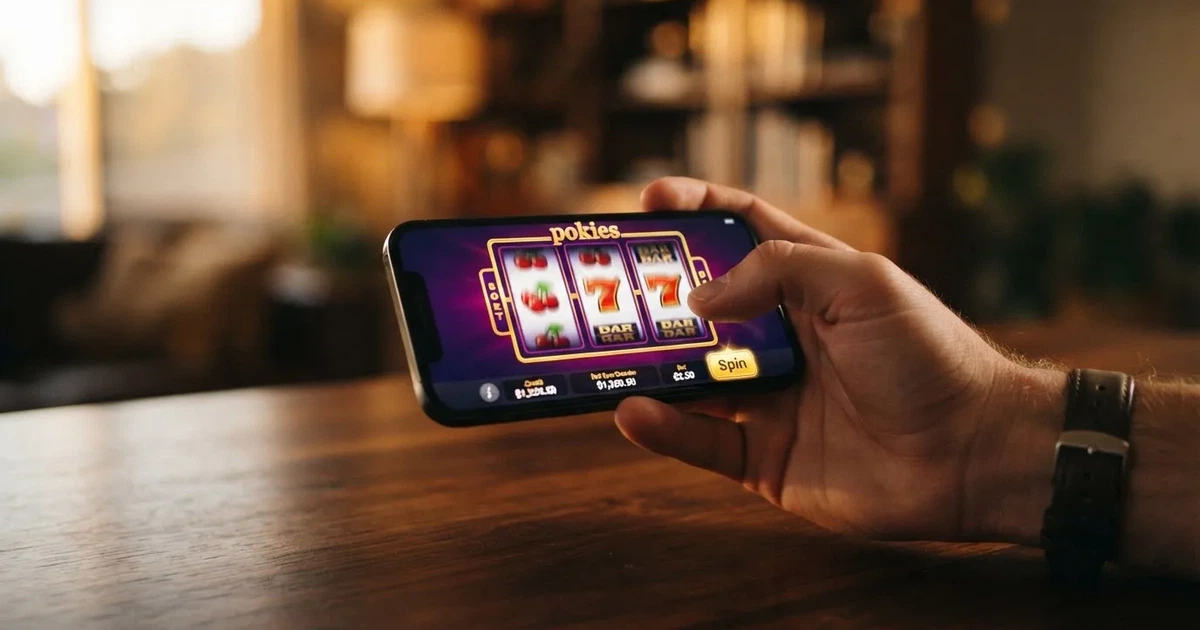
The behavioural shape of a real-money pokies app on Android is recognisable regardless of the brand on the splash screen. Sign-up demands an email address, a mobile number and a date of birth; the cashier asks for a deposit method before the first spin; and the games themselves are vertical-screen reels with a single spin button, autoplay, and a balance ticker at the top of the screen. A touchscreen is a sensible interface for the format — a tap to set the stake, a tap to spin, a tap to collect — and that is the engineering reason the offshore industry leans on it. The legal question is separate, and the legal question is the one that decides whether an Australian should hand one a deposit.
The mechanics of a touchscreen pokies session
What a real-money pokie app does on the screen is a stripped-down version of what a physical poker machine does in a club. Each spin costs whatever stake the player sets, from a few cents up to the maximum the title allows. The reels resolve and any winning combination is added to the balance. Return-to-player is built into the game’s mathematics, and at the Australian legal minimum of 85 to 90 per cent depending on the state, the machine keeps between ten and fifteen cents of every dollar wagered over the long run — that is the house edge, and it is the same edge whether the reels are turning in a Sydney pub or on a phone screen in a Brisbane kitchen.
Two pieces of UI engineering explain why apps lean into the format. A vertical layout means the spin button sits under the thumb, which shortens the interval between spins from roughly ten seconds on a horizontal layout to something closer to five. And session timers, balance tickers and “bonus buy” shortcuts are easier to fit on a phone than on a desktop, which is why an app tends to nudge a player towards faster decisions and longer sessions than the same title loaded in a browser. None of that is unique to offshore apps — licensed Australian poker machines in clubs use the same mathematics — but the offshore app adds one thing the club machine does not, which is that nothing about its design has been looked at by an Australian regulator.
Why “free” Aristocrat-style apps look so similar to real-money ones
A second layer of confusion comes from the free Aristocrat-style pokies apps that turn up at the top of the same search results. Aristocrat Leisure is an Australian slot maker whose titles — Buffalo, Big Red, Queen of the Nile — appear in clubs across the country, and “Aristocrat pokies” has become shorthand for the games themselves rather than for any single product. Free apps using those themes are not licensed by Aristocrat; the brand is reproduced because the games are recognisable, and what the apps actually sell is ad impressions and the occasional in-app purchase. The real-money versions share the reel layouts and the bonus features because the genre is the genre, and a player who has spent time on a club machine in Sydney or Melbourne will find the buttons in roughly the same place.

This is the part where the marketing does the most work. A free app with Aristocrat-styled reels is harmless in the legal sense — it does not pay out, so it is not an interactive gambling service, and the ACMA’s prohibition does not touch it. The moment a sister product claims to pay real money, it is offering a service the IGA prohibits, and it is operating from a licence issued by a jurisdiction the ACMA does not recognise for serving Australians. The two products are easy to confuse because they are made to look alike, and the confusion is the point.
See also The real-money pokies app pitched at Australians in 2026.
What Australian law actually prohibits
The shape of the prohibition is precise, and the precision matters because it decides what counts as a real offer rather than a marketing one. The Interactive Gambling Act 2001, tightened by the Interactive Gambling Amendment Act 2017, makes it an offence to provide certain interactive gambling services to a person physically in Australia. Online casino games — table games, slots, online pokies, live dealer — are in the prohibited list. Wagering on a sporting event or a race placed before the event, lotteries, and keno are not, and those are the only products an Australian-licensed operator can offer over the internet.
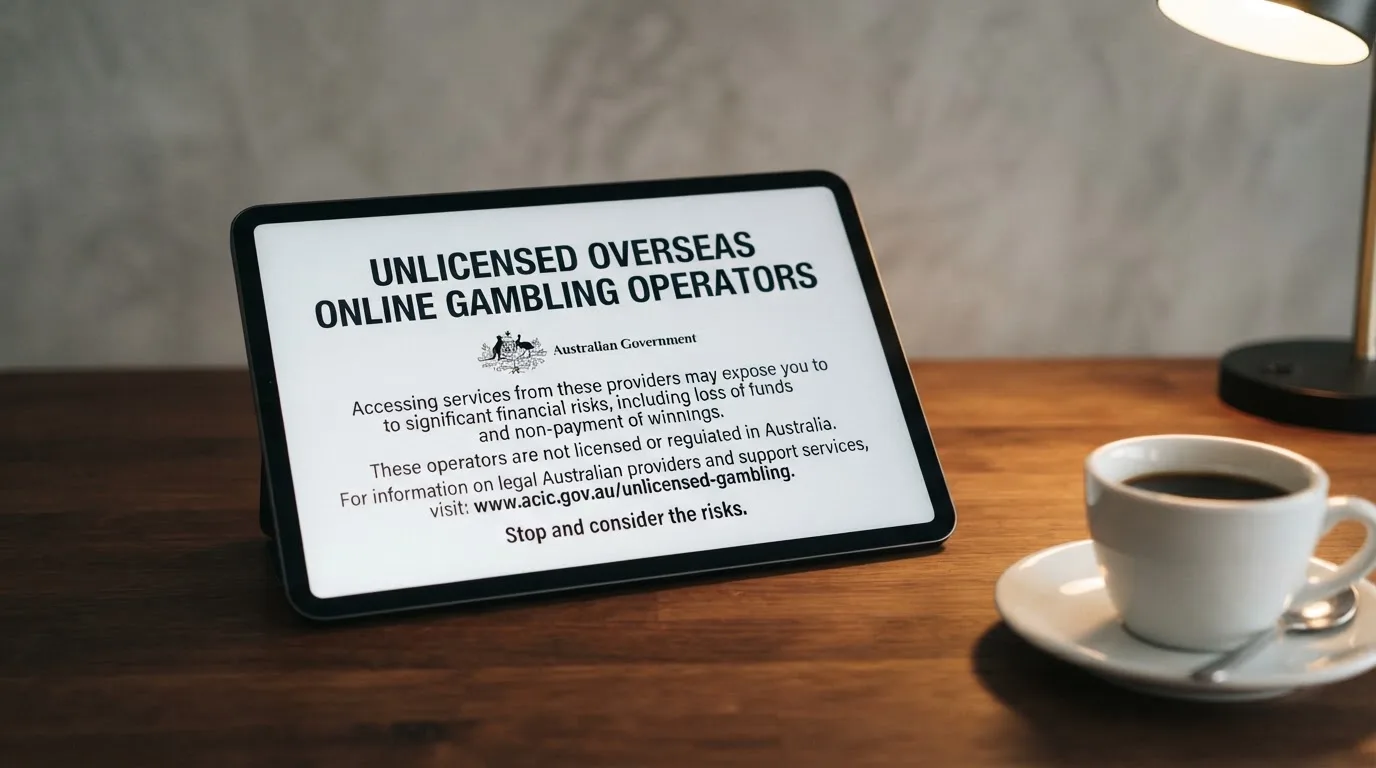
What that means on a phone is that an app offering real-money pokies to an Android user in Australia is, by definition, doing what the IGA prohibits. The offshore licence it displays — Curaçao, Anjouan, the Kahnawake Gaming Commission, occasionally Malta — is a real document issued by a real regulator, but it is not an Australian licence and does not bring the operator within the IGA’s safe harbour. The Australian Communications and Media Authority has been enforcing this since 2017, and the enforcement record is long enough that it is worth knowing what it looks like.
The Interactive Gambling Act in plain terms
Two provisions carry most of the weight. Section 5 of the IGA sets out what a “prohibited interactive gambling service” is, and a real-money online pokie offered to a person in Australia falls inside it. Section 15 makes it a civil penalty — and in some cases a criminal offence — to provide such a service, with the penalty running against the provider. The Australian individual who downloads an offshore app and plays it is not personally prosecuted, because the IGA targets the supply side; the penalty is the operator’s problem, not the punter’s. What the punter loses is the protection that comes with a licensed product.
That protection is the second half of the law that an offshore app cannot provide. A bet placed with an Australian-licensed operator can be complained about to the regulator if something goes wrong, and the operator is bound by Australian consumer law on top of its licence conditions. An offshore operator is bound by the rules of the licence it displays, and the complaint path runs through whatever alternative-dispute body that licence uses. A refusal to pay out, a closed account with a balance in it, an unexplained change to bonus terms — all of those are real-world outcomes with offshore operators, and the practical consequence is that the Australian punter has nowhere to take them.
Why the Northern Territory matters
A quirk of the Australian system is that the bulk of licensed online bookmakers are licensed in the Northern Territory, even though the Territory has barely any staff to do the regulating. According to the ABC’s reporting in April 2026, the Northern Territory Racing and Wagering Commission oversees 52 online bookmakers — Sportsbet, Bet365, Ladbrokes among them — and does so with no full-time staff, meeting once a month in Darwin. The licence exists for tax reasons; the operators are based where they are because the Territory’s regime suits their corporate structure, and the regulator rubber-stamps applications that satisfy the formal requirements. What that regime licenses is wagering on races and sport, not online casino games, and the NTRWC’s lighter hand on bookmakers does not extend to anything else.
The reason this matters for a pokies search is that “Australian licensed” is not a phrase that travels to casino games. An Australian-licensed operator may offer sports and racing, and the apps those operators build handle those products; they do not offer real-money pokies, because no Australian regulator will issue a licence for the product. A player who lands on a marketing page that claims “100% Australian licensed” for an online casino is reading something that is at best confused and at worst deliberately misleading.
BetStop and the credit-card ban
Two consumer-protection measures sit on top of the IGA, and both are tied to Australian-licensed wagering, so both are bypassed by an offshore app. BetStop — the National Self-Exclusion Register, live since August 2023 — lets a person exclude themselves from every Australian-licensed online and phone wagering service in one registration. It binds only the operators it covers, and an offshore casino is not connected to it, so a self-excluded Australian can still open and play an offshore account. From 11 June 2024, credit cards, credit-related products and digital currency are banned as payment for licensed online wagering, with penalties of up to A$247,500 for operators who breach the rule. Legal deposit routes for licensed wagering are debit card, bank transfer, PayID/Osko and BPAY. An offshore app that takes a credit card or a crypto deposit is taking a payment the Australian rules forbid for the licensed product, and taking it precisely because the operator is outside the licensed system.
The Interactive Gambling Amendment (Gambling Reform) Bill 2026, which passed Parliament on 19 August 2026, layers further advertising and inducement restrictions on top of this. Its advertising and inducement measures commence on 1 January 2027, which puts them squarely into next year rather than this one. As of 2026, the prohibitions that already exist carry the enforcement load, and the new measures are not yet in force.
What the ACMA has been doing about it
The Australian Communications and Media Authority’s enforcement has two parts: formal warnings under the IGA, which put the operator on notice and create a paper trail, and blocking requests to internet service providers, which take the site off Australian DNS resolvers. As of the round reported on 26 June 2026, the ACMA had asked ISPs to block 1,751 illegal gambling and affiliate marketing websites since the first blocking request in November 2019, and more than 230 unlicensed gambling services had voluntarily left the Australian market since enforcement was strengthened in 2017. That second number is the one to remember: the ACMA’s paper is a partial list of sites it blocked, and the larger number is of sites that pulled out when they saw the round coming.
The June 2026 round alone added twelve more domains: 7Signs, ChromaBet, Donbet, Duospin, Freshbet, Slots Gem, Jacks Club, Lucky Start, Pointsbetz, Spinrise, Vinyl Casino and Wildsino. Each is an offshore casino or affiliate marketing page targeting Australian customers; each was operating in breach of the IGA. None of the names will mean anything to a reader who has not already been searching for them, which is itself informative — these are sites whose entire business model depends on being findable by exactly the search this page ranks for.
How fast the blocking adds up
These figures show the scope of the enforcement activity, derived from two numbers in the official record: the running total of 1,751 blocked sites since November 2019, and the twelve added in the most recent round. The pace is roughly two to three hundred new blocks a year over a six-and-a-bit-year window, with the rate lifting as the ACMA’s blocking infrastructure matured. The headline figure is the cumulative total, which by mid-2026 sits just shy of two thousand domains. The condition that goes with it is that the count includes affiliate marketing sites alongside the casino domains themselves, so a single operator can account for several entries. Read as a band rather than a single number, the ACMA has been adding between forty and sixty new blocked domains every month it runs a blocking round, with some months carrying none and the heavy rounds like the one reported on 26 June 2026 running well into double figures.
What the pace tells a reader is that the ACMA’s enforcement is not theoretical. A site that is operating today can be on a block list next month, and a balance left on the site when the block lands is, in practice, gone. That is what “outside the Australian rules” means in concrete terms: the operator is in the IGA’s sights, and the reader’s protection is the paper trail rather than any standing in Australian law.
The formal warnings the ACMA publishes
The second arm of the ACMA’s work is the formal warning, a written notice under the IGA that names the operator and the brand and gives the operator a chance to stop. Each warning published on the ACMA website is a public document, and the warnings cited below are taken from those publications. What they have in common is the operator, not the brand — many offshore groups run several casino skins under one holding company, and the ACMA names the holding company rather than the marketing brand.
March 2026: Pulsup Ltd over Rocketplay. May 2022: Dama N.V. covering Bambet, Dazard, Level Up, Rocketplay, Wild Tornado and Cobra Casinos. March 2025: Dama N.V. over Woo Casino. May 2025: Dama N.V. over Spirit Casino. July 2025: Bamboo Media over Ignition Casino, and Consolutetish S.R.L. over National Casino and Bizzo Casino — Bizzo having already been the subject of a 2022 warning to TechSolutions (CY) Group Limited and TechSolutions Group N.V. February 2025: EOD Code SRL over Instant Casino. April 2026: Ryker B.V. over Jackbit and CasinOK. April 2025: Sterplay Holding Ltd over Casino Intense. Hollycorn N.V. over Sky Crown and Blue Leo, in a warning published in September 2022.
These are the brands this page reviews further down. What the list shows is that the warnings have been running since at least 2022 and have not slowed; the ACMA is naming new operators in 2026 as well as catching up with older ones. The compliance pattern is that an operator who receives a formal warning either pulls out of Australia or carries on and risks a blocking round, and both outcomes are visible in the record.
What Australian-licensed gaming actually looks like
The other side of the picture is what Australia does license, because that is what a reader comparing options is choosing against. Land-based poker machines — “pokies” — are legal and heavily regulated in every state and territory except for the pubs and clubs of Western Australia, which banned them when Crown Perth opened in 1985. New South Wales had 87,298 gaming machines outside casinos across 2,195 venues as of June 2023, with player losses of A$8.18 billion in 2022–23. Queensland had 21,122 machines in 351 venues in October 2023; Victoria had 26,380 outside Crown Casino in 488 venues in 2021–22 under a 30,000-machine statewide limit. The numbers are big enough that the size of the legal market is not in dispute — in 2020–21 Australians bet almost A$150 billion through gaming machines and lost A$12.18 billion on them.
The legal market’s design is what makes it a different proposition from an offshore app. Every state and territory regulates its own machine specifications, and the minimum return-to-player varies: 85 per cent in New South Wales, the Northern Territory, Queensland and (generally) Victoria — 87 per cent at Crown Melbourne itself — 87 per cent in the ACT and Tasmania, 87.5 per cent in South Australia, and 90 per cent in Western Australia. Those are floors, not averages: many machines return more than the floor, but none can return less. The machine in front of a player in a Sydney club has been tested against that floor by an Australian regulator, and the math is on the regulator’s website. An offshore app displays an RTP from the developer’s own testing lab, and the testing lab is one the Australian regulator does not recognise.
Tasmania’s mandatory pre-commitment cards
The reform worth knowing about is the one that was supposed to land first and was delayed. Tasmania passed legislation in November 2021 ending Federal Group’s monopoly on poker machines — that monopoly had run since 1968 — and moved oversight of the machines to the Tasmanian Liquor and Gaming Commission. The same reform package included mandatory pre-commitment cards, the first of their kind in Australia, which would require a player to set a loss limit before sitting down at a machine. The cards were due to be in place by 2024 and have been pushed back to late 2025, which means that as of 2026 the cards are either just landing or still on the way. The reform is the shape of what consumer protection in Australian gaming looks like at the serious end — a binding, machine-level limit on what a player can lose — and it is the contrast with an offshore app that asks for a credit card and offers no limit at all.
Why the online version is the part that is missing
The product that is not licensed anywhere in Australia is the one this search asks for. Online pokies — the online version of those machines — are prohibited for people in Australia, just as online casino games, online table games and live dealer games are. The land-based machines are licensed and regulated state by state; the online versions are simply not in the licensing system. A reader who wants to play pokies legally in Australia has the choice of going to a venue or staying home and not playing. The middle option — playing at home on a phone, legally — does not exist in this product category, and the offshore apps filling the gap are filling a gap the law has decided to leave open.
Real Money Pokies Apps for Android in Australia — More on this topic at casino offshore hub.
What an Android real-money app typically asks of a phone
Sideloading a real-money pokies app onto an Android phone — that is, installing it as an APK from a source other than the Play Store — is the route every offshore casino offers, because the Play Store itself does not carry real-money casino apps for Australian distribution. What the app asks for, once installed, is the part that is worth knowing before a deposit goes through.
A typical install flow begins with the casino sending an APK link by email or SMS, the player enabling “install from unknown sources” in Android settings, the app installing outside the Play Store’s sandbox, and the first launch prompting for a sign-up. The sign-up collects an email, a mobile number and a date of birth — enough to confirm the player is over 18, which the IGA’s provisions and the offshore operators’ own terms both require. The next step is a deposit at the cashier, which in 2026 most often runs through a crypto wallet, an e-voucher like Neosurf or Flexepin, or a card processed through an intermediary that is not itself the casino’s bank.
The permissions the app asks for on Android go further than the gameplay requires. Location access is asked for in most cases, ostensibly to confirm the player is in a permitted jurisdiction, which in practice means anywhere except Australia — the casino wants to be able to say it blocked an Australian player, in the event the ACMA comes asking. Camera and microphone permissions are common, usually justified for KYC purposes: when a withdrawal is requested, the player is asked to photograph an ID document and sometimes a selfie. Notification access lets the casino push bonus offers, which is the operator’s main re-engagement channel. Storage access lets the app cache game assets and store local settings. None of these permissions is unusual on its own; what is unusual is the combination, and what is unusual is that the app is asking for them outside the Play Store’s review process, which would otherwise check whether each permission is justified by the app’s stated function.
What “KYC” actually means in this context
Know-your-customer checks are standard at any licensed gambling operator, and the offshore operators have copied the same procedures. The player uploads an ID, the operator runs it against sanctions lists and PEP databases, and the account is verified. The difference at an offshore operator is what happens when the check fails or is delayed. At an Australian-licensed bookmaker, the worst-case outcome is that the account is restricted until the documents are produced; at an offshore casino, the worst case is that a balance is held pending the check, the check drags on, and the player has no Australian regulator to escalate to. The KYC framework is the same; the recourse when it goes wrong is not.
Why the app asks for the phone number
The mobile number is the second piece of the sign-up that matters more than it looks. It is what the casino uses to send SMS verification codes, password reset links and bonus offers; it is also what the casino uses to contact the player if the account is frozen. The phone number is, in practice, the most reliable identifier a player has given the operator, because email addresses can be changed and crypto wallets are pseudonymous. For an Australian player this means the casino can keep reaching them even after they have tried to close the account, and the offers that arrive by SMS are not subject to the advertising restrictions the 2026 reform will bring in next year.
Free pokies apps versus real-money apps
The free pokies apps at the top of the Play Store results are a separate product from the real-money offers, and the distinction is worth drawing out because it is the one that survives the IGA without trouble. A free app plays for virtual coins, runs ads between sessions, and may offer in-app purchases to remove ads or unlock extra titles. No money is paid in, no money is paid out, and the operator’s business model is the audience it sells to advertisers. The games themselves can use Aristocrat-style themes and Aristocrat-derived mechanics without licensing the brand, because slot machine game mechanics are not protected in the way a song or a film would be.
The reason the marketing overlaps is that the free apps want to be found by the same searches as the real-money offers. A player searching “free Aristocrat pokies for Android” and a player searching “real money pokies Android Australia” are adjacent in the search results, and the apps that rank for one also rank for the other. The free app’s pitch is essentially “try the games for free”, and the implicit message is that a sister app exists for those who want to play for money. The sister app is the one the ACMA acts against, and the free app is the one that the ACMA’s enforcement does not reach.
How the free Aristocrat-style apps monetise
The economics of a free pokies app are straightforward. The player installs the app, plays for virtual coins that the app refreshes every few hours or whenever the player watches a rewarded video, and sees display ads and occasional interstitials. The operator’s revenue is the eCPM the ads earn, multiplied by the number of sessions. In-app purchases — coin top-ups at A$1.99 to A$9.99 — are a smaller revenue line; most players do not pay, and the operator makes most of its money from the ad stack. None of this is regulated by the ACMA, because no gambling service is being provided.
For a player, the risk is the time spent and the ad exposure, both of which are real but are not the kind of risk a real-money punter faces. For the operator of the real-money sister app, the free app is a customer acquisition funnel: a player who has spent a hundred hours on the free version is a more valuable real-money player than a cold install, and the conversion mechanic is “if you want to win real money, here’s our other app”. The funnel is the reason the two products are marketed together.
What the ACMA has done about specific brands
The brands reviewed here are not a ranking and not a recommendation. Each is included because the ACMA itself has issued a formal warning naming it, which is the criterion the research used to populate this section, and because each is the kind of brand a reader searching for this information is likely to encounter. The list is in the order the ACMA warnings give: the most recent first, then the older warnings.
What follows is a table of the brands, the ACMA action against each, the operator named in the warning, and what the research shows about how each operator handles the subject. The table is the comparison; the prose beside it explains what each row means.
ACMA enforcement actions against offshore brands
| Brand | ACMA action and date | Operator named by the ACMA | Subject support |
|---|---|---|---|
| RocketPlay | Formal warning, March 2026 | Pulsup Ltd | No data |
| Jackbit | Formal warning, April 2026 | Ryker B.V. | No data |
| Casino Intense | Formal warning, April 2025 | Sterplay Holding Ltd | Listed only on third-party pages |
| Instant Casino | Formal warning, February 2025 | EOD Code SRL | No data |
| Ignition Casino | Formal warning, July 2025 | Bamboo Media | No data |
| Spirit Casino | Formal warning, May 2025 | Dama N.V. | No data |
| Woo Casino | Formal warning, March 2025 | Dama N.V. | No data |
| National Casino | Formal warning, July 2025 | Consolutetish S.R.L. | Listed only on third-party pages |
| Bizzo Casino | Formal warning, July 2025; earlier 2022 | Consolutetish S.R.L.; TechSolutions | No data |
| Level Up Casino | Formal warning, May 2022 | Dama N.V. | Listed only on third-party pages |
| Sky Crown | Formal warning, September 2022 | Hollycorn N.V. | No data |
What it shows is a long tail of named operators, a small set of holding companies appearing more than once, and a category of brands that have left no usable trace in the listings the research consulted. The recurring operators are the structural finding: Dama N.V. alone accounts for five of the eleven brands reviewed here, including one — RocketPlay — that received a fresh warning in March 2026 after the May 2022 warning to the same holding company. The pattern is consistent with an offshore group rotating brands while keeping the same corporate structure, which is exactly what the IGA’s enforcement makes harder to do in the Australian market.
How to read this comparison
The table is not a ranking and not a recommendation; it is a record of what the ACMA has published. The “subject support” column reflects what the research found in the listings it consulted, and a “no data” entry means the research found no usable trace, which is itself a finding. The brands are presented in the order of the most recent ACMA action, so the freshest warnings sit at the top.
A reader using the table should treat each row as evidence of a specific decision: at some point, the ACMA judged that the named operator was providing a prohibited interactive gambling service to people in Australia, and put that judgement on the public record. The brand on the splash screen of the app may have changed since the warning, and the operator may have shifted its corporate structure, but the warning itself has not gone away.
Brand-by-brand notes
Each of the brands below is the subject of a published ACMA formal warning. The reviews are short, factual, and built around what the ACMA’s own publication says, plus what the research found in the listings it consulted.
RocketPlay
The ACMA issued a formal warning to Pulsup Ltd in March 2026 over Rocketplay. The same brand was the subject of an earlier warning to Dama N.V. in May 2022, which covered six brands under the same holding company. The 2026 warning is the freshest in the ACMA’s published list as of 2026, and the brand’s presence in the warnings twice over is the structural fact worth noting. The research found no usable trace of subject support in the listings it consulted, so the column is empty.
What the second warning shows is that moving a brand between operators does not move it out of the ACMA’s sight. Dama N.V. was warned in 2022; Pulsup Ltd, which operates the same site under a different holding entity, was warned in 2026; the brand name stayed the same.
Level Up Casino
Level Up Casino is one of the six brands covered by the May 2022 ACMA warning to Dama N.V., alongside Bambet, Dazard, Rocketplay, Wild Tornado and Cobra Casinos. The research found Level Up listed on third-party pages including BGaming’s site, which is what the listings-only entry reflects: the brand is mentioned in industry directories, but the research did not find any verifiable record of how the operator treats the subject this page covers.
The brand is four years past its warning as of 2026, and the question of whether it still targets Australia is one the research cannot answer. The warning stands; the brand’s current Australian availability is not documented.
Woo Casino
Woo Casino received a fresh formal warning in March 2025, again to Dama N.V. The 2025 warning is the second time the holding company has appeared in the ACMA’s published record, which makes Dama N.V. the most-warned operator in the Australian offshore space. No subject-support data was found for Woo Casino in the research.
The judgment here is straightforward: a brand whose holding company has been warned twice in four years is, by definition, not slowing down. The warning is a public document, and the operator has had three years between the May 2022 warning and the March 2025 warning to change its Australian-facing operations. It has not.
Spirit Casino
Spirit Casino received a formal warning in May 2025, also to Dama N.V. The warning postdates the Woo Casino warning by two months and the May 2022 round by three years. No subject-support data was found.
A second Dama N.V. warning in 2025 reinforces the structural finding: the holding company has been on the ACMA’s radar continuously since 2022, and the ACMA is still finding new brands under the same operator to warn about.
National Casino
National Casino received a formal warning in July 2025 to Consolutetish S.R.L. The research found the brand listed on third-party pages, including Wikipedia’s entry on gambling in Australia. The “listings-only” qualifier means the research saw the name mentioned in directories, not that it found verifiable data on how the operator handles the subject.
Consolutetish S.R.L. is a new name in the ACMA’s published warnings — it had not appeared in earlier rounds — and the July 2025 warning is its first. Whether it becomes a recurring operator the way Dama N.V. has is a question for later rounds.
Bizzo Casino
Bizzo Casino received a formal warning in July 2025 to Consolutetish S.R.L., the same operator as National Casino. The brand had been the subject of an earlier formal warning to TechSolutions (CY) Group Limited and TechSolutions Group N.V. in 2022. Two warnings under two different holding companies within three years puts Bizzo in the same structural pattern as RocketPlay. No subject-support data was found.
The holding-company rotation here is informative. TechSolutions was warned in 2022; the brand appears to have moved to Consolutetish S.R.L. by 2025; the ACMA followed the brand to the new operator and warned it again. The pattern is the IGA’s structural problem: an offshore group can reincorporate faster than the ACMA can name it, and the brand survives the reorganisation.
Ignition Casino
Ignition Casino received a formal warning in July 2025 to Bamboo Media, which is a separate operator from the Dama N.V. and Consolutetish S.R.L. groups. The warning is Bamboo Media’s first in the ACMA’s published record. No subject-support data was found.
Bamboo Media operating Ignition Casino from a non-Australian jurisdiction and offering it to Australians is the structural shape of every entry in this section. The warning tells the operator to stop; the operator’s response is the variable the ACMA’s blocking rounds later test.
Instant Casino
Instant Casino received a formal warning in February 2025 to EOD Code SRL. The warning pre-dates the Dama N.V. and Consolutetish S.R.L. round by several months and is one of the ACMA’s earlier 2025 actions. No subject-support data was found.
The February 2025 timing puts Instant Casino at the front of a year in which the ACMA’s pace of formal warnings visibly increased.
Jackbit
Jackbit received a formal warning in April 2026 to Ryker B.V., alongside CasinOK. The April 2026 warning is fresh as of 2026 and sits in the same month as a flurry of warnings across different operators. No subject-support data was found.
Ryker B.V. naming two brands in one warning is the structural tell. The ACMA names the operator once and the brands under it; one warning covers both skins.
Casino Intense
Casino Intense received a formal warning in April 2025 to Sterplay Holding Ltd. The research found the brand listed on third-party pages including ABC reporting, the ACMA’s own site, and Crown Melbourne’s site — the listings-only entry reflects that the brand appears in directories rather than that the research found verifiable data on subject support. The ABC and ACMA references reflect the brand’s appearance in coverage of Australian gambling; the Crown Melbourne reference is incidental, the result of an algorithm matching the words, and does not mean Crown Melbourne offers Casino Intense.
Sky Crown
Sky Crown is the subject of an ACMA formal warning to Hollycorn N.V., published in September 2022. The same warning covered Blue Leo. The 2022 timing puts Sky Crown at the older end of the published warnings. No subject-support data was found.
Hollycorn N.V. is a separate operator from the Dama N.V., Consolutetish S.R.L. and Sterplay Holding groups, and the 2022 warning is its only published action in the research.
Reading the comparison
What the eleven entries in this section have in common is more important than what differentiates them. Each is an offshore casino offering real-money pokies and other casino games to Australian residents, in breach of the Interactive Gambling Act 2001, and each has been named in a formal warning by the ACMA. The holding companies repeat — Dama N.V. five times, Consolutetish S.R.L. twice, the rest once — which is itself the structural finding the table records.
The differentiation across the eleven is mostly timing. RocketPlay’s March 2026 warning is the freshest in the record; Hollycorn N.V.’s September 2022 warning to Sky Crown is the oldest. The reader-facing question is not which of the eleven is the safest, because none is licensed to serve Australia at all, but how the ACMA’s enforcement record treats the operator behind the brand.
Keeping real-money pokies in perspective
A page about real-money pokies for Android in Australia is, in the end, a page about a product that is not legally available to the reader. The responsible-gaming material below is not a perfunctory sign-off; it is the rest of the story.
The land-based market that does exist in Australia is large — A$12.18 billion in losses on gaming machines in 2020-21, against nearly A$150 billion wagered — and the social cost of that market is the reason the online version is prohibited. The Western Australia decision to keep pubs and clubs pokies-free since 1985 is the clearest expression of the policy. Crown Perth, the single venue allowed to operate them, has grown its machine count from about 200 in 1985 to roughly 2,500 — every one approved by the state’s Gaming and Wagering Commission. The size of the legal market is the reason the prohibition on the online version exists.
Help services that work regardless of where someone plays
The National Gambling Helpline on 1800 858 858 is free, runs 24/7, and offers chat at Gambling Help Online. Both services are run by the Australian Government’s responsible-gaming framework and are available to anyone in Australia, whether the gambling is at a club, at a casino, or on an offshore app. BetStop, the National Self-Exclusion Register, binds only Australian-licensed wagering services, which means an offshore account is not covered by it, but registering with BetStop does block the licensed channels and is a meaningful step for someone trying to cut down.
The services that work regardless of jurisdiction are the ones to use first. A self-exclusion that binds only licensed wagering is a partial measure; the helpline and the chat service are not.
What to do if an offshore app has a player’s money
A player who has a balance on an offshore app that has been blocked has, in practical terms, lost the money. The site is on the ACMA’s block list, the operator is outside Australian jurisdiction, and the recourse available through the operator’s own complaint process is the only recourse available at all. This is not a hypothetical outcome — it is what blocking means, and it is one of the costs of playing offshore. The H2 Gambling Capital 2025 estimate puts losses to illegal sites at about A$3.9 billion a year in Australia, with the share of gambling going through legal channels falling from 74 per cent in 2021 to 64 per cent. The illegal market is not small, and the losses the ACMA’s enforcement does not recover are real money.
Why the page does not recommend an operator
The brands reviewed above are presented because the ACMA has named them in formal warnings. None is recommended. Recommending an offshore casino to an Australian reader would mean recommending a product that is prohibited under the Interactive Gambling Act 2001, which is the opposite of what an honest page about Australian gambling should do. The review section is a record of what has been published, not a buyer’s guide.
Frequently Asked Questions
Can a real-money pokies app actually be downloaded through the Google Play Store in Australia?
No. Google Play’s gambling app policy does not allow real-money casino apps to be distributed to Australian users. Real-money pokies apps reach Australian phones only as direct APKs from the casino, sideloaded after the player enables installs from unknown sources. The Play Store versions you find under similar names are free-to-play apps using Aristocrat-style themes; they pay out virtual coins, not cash.
Is sideloading a real-money pokies APK onto an Android phone something Australians can legally do?
The Interactive Gambling Act 2001 targets the provider, not the player, so there is no prosecution risk for the individual. The practical problem is that the operator is unlicensed in Australia, which means no Australian consumer protection, no complaints body, and no recourse if a withdrawal is refused. The ACMA can block the site, and a balance on the site at that point is, in practice, lost.
How does a free Aristocrat-style pokies app differ from one that claims real-money play?
Free apps pay out virtual coins, monetise through ads, and are not interactive gambling services under the IGA. Real-money versions take deposits, pay out cash, and are prohibited for Australian users. They look similar because the genre is the genre — same reel layouts, same bonus features — but the legal status is completely different. Aristocrat itself does not license its brand to either kind of app; the themes are reproduced because the games are recognisable.
What permissions does a real-money pokies app typically ask for on an Android phone?
The standard set is location access, camera and microphone access for KYC, notification access for bonus messaging, and storage access for caching. None is unusual on its own, but the combination is broader than most apps need, and the install is happening outside the Play Store’s review process. KYC checks themselves are standard; the recourse when a check goes wrong at an offshore operator is the part that is not standard.
Why would an app be advertised as “download for Android” rather than just playable in a browser?
Because an installed app can keep sending notifications, run in the background, and access phone features a website cannot. A web-based casino that markets itself as an “app” is a website, and the marketing is shorthand for the mobile-first layout rather than for an installed application. Real-money offers from offshore operators generally push the install because the installed app is more effective at re-engagement than a browser tab.
What should someone check before trusting an app’s claim to pay real money on Android?
The first check is whether the operator holds an Australian licence for the product being offered — and the answer is no, because no Australian licence covers online pokies. The second is whether the operator is on the ACMA’s list of formal warnings or blocking rounds. The third is whether the deposit route the cashier offers is one of the routes banned for licensed wagering: a credit card or crypto deposit is a strong signal the operator is outside the Australian system, because licensed wagering cannot legally take those payment methods.