
High roller casino bonuses in Australia, and the law that decides what a punter can actually claim
A reader who searches for a high roller casino with a bonus in Australia is asking for something the country does not provide. The Interactive Gambling Act 2001 prohibits offering online casino games and online pokies to anyone in Australia, and no state or territory issues a licence for it. Every site that markets itself to an Australian punter as a high-roller casino, with a deposit match and a VIP host attached, is doing so from outside the country and outside the Australian consumer-protection framework. The page below treats that as the starting point, not the punchline: the legal ground, the ACMA enforcement record, how the money would actually move, what a bonus term does to a real balance, where the mobile experience fits, which titles the offshore sites push hardest, and the eleven operators the regulator itself has named in formal warnings — each one shown for what it is and what the page can verify.

Data current as of 29 October 2026 and checked against the Australian Communications and Media Authority’s published register of formal warnings and blocking requests.
Table of Contents
- Responsible gambling for a high-stakes player in Australia
- Payments and payout speed for high-roller casino play
- High-roller bonuses and the arithmetic behind the offer
- The mobile and app experience of a high-roller casino
- High-roller slots, pokies and live tables
- Eleven operators the ACMA has named in formal warnings
- What an Australian high-roller actually has access to
- Tax, payments and the rest of the legal frame
- Frequently asked questions
Responsible gambling for a high-stakes player in Australia
Player wellbeing is where this page starts rather than ends, because the protective scaffolding that exists in Australia is built for wagering on races and sport, not for casino play. BetStop, the National Self-Exclusion Register, has been live since August 2023 and binds Australian-licensed online and phone wagering services; an offshore casino is not connected to it, so registering on BetStop will not stop a player opening or topping up an account at a site the ACMA has named. The register is still worth the five minutes it takes: it covers licensed bookmakers, it covers licensed telephone betting, and it stops the marketing that licensed operators send.
The National Gambling Helpline on 1800 858 858 is free, runs around the clock, and the chat service at Gambling Help Online is staffed by counsellors rather than salespeople. For a reader who has decided to keep playing on offshore sites, the same tools still help — they just do not close the account from the operator’s end.
The harder limits are the bank-level ones. Westpac’s gambling block works at card level: it refuses authorisation on transactions registered under the merchant category code for betting and casino gambling on eligible personal credit and debit cards. ANZ’s gambling transaction block, activated in the ANZ app, also blocks gambling transactions made through a digital wallet such as Apple Pay on an eligible card, not just the physical card; once it is turned on, removing it requires a 48-hour waiting period. Commonwealth Bank lets customers apply a gambling lock to eligible cards via the CommBank app, with the same caveat the others carry: the bank states it cannot guarantee every gambling-related purchase will be stopped, and some non-gambling purchases may be blocked in error. These card-side blocks do not stop a bank transfer or a PayID payment, but they do fence off the credit-funded path.
The sober summary for a high-stakes punter: the protective infrastructure exists in Australia, it is designed around licensed wagering, and a player who steps onto an offshore casino is choosing to leave most of it behind. The BetStop registration, the helpline, and a card-level gambling block together cover most of what an Australian reader can control; the rest of the page is about why that distinction matters before any of the eleven operators below are even considered.
See also High Cashback Casino Bonuses for Australian Readers.
Payments and payout speed for high-roller casino play
A high-roller bonus is, mechanically, an instruction about how money moves. The deposit method, the wagering turnover, the maximum cashout, and the speed of the settlement into an Australian bank account are what determine whether the offer is worth the claim — and at an offshore casino, none of these move through the Australian consumer framework.

The deposit rails an Australian punter is most likely to meet are PayID and Osko, BPAY, Apple Pay and Google Pay on a debit card, and the major bank-issued cards themselves. PayID sits on Australia’s New Payments Platform, which went live for the public on 13 February 2018 and is owned by New Payments Platform Australia Ltd, a non-profit whose thirteen shareholders include the Reserve Bank of Australia and the major banks. A transfer to a PayID arrives in under a minute through Osko, twenty-four hours a day including weekends, whether the payment is addressed to a BSB and account number or to a PayID itself; the recipient’s registered name shows on screen before the transfer is sent, and Australian Payments Plus warns that being asked to send money to a PayID on an illegal gambling site almost certainly means a scam site. By April 2025, more than 25 million PayID identifiers had been registered on the platform, and instant transfers are available at over 100 Australian financial institutions. Participants in the platform must keep monthly outages to under two minutes; in 2021 the ACCC authorised merging NPP Australia with BPAY and eftpos into the single holding company now called Australian Payments Plus, which is also the operator of PayID and Osko.
BPAY is the older bill-payment rail, launched on 18 November 1997 and available in the online banking of over 140 Australian institutions. The payer enters the Biller Code and the Customer Reference Number printed on the bill; it is owned equally, through parent company Cardlink Services Limited, by ANZ, Commonwealth Bank, National Australia Bank and Westpac. For an Australian punter, BPAY is the rail most often used to fund a licensed wagering account with a debit card or bank transfer rather than a credit card — which is one of the reasons it is worth naming here, and one of the reasons it does not appear as a payment option on an offshore casino’s cashier.
The credit-card question is the one that decides the rest. Under the Interactive Gambling Act 2001 as amended in 2023, Australian-licensed online wagering services cannot accept payment by credit card or other credit-related products, a restriction that constrains gambling use of linked digital wallets such as Apple Pay on a credit-funded card. The rule’s effect on the offshore market is more indirect: it does not stop a Visa or Mastercard debit transaction, and it does not stop a credit-funded transaction at an unlicensed site that does not perform an Australian credit check, but it does stop the licensed bookmaker from accepting it. For a punter weighing a high-roller bonus at an offshore site, the practical question is whether the deposit rail on offer is one the bank will permit at all — and the answer, for credit cards and for credit-linked wallets, is no on the licensed side and quietly yes on the unlicensed side.
American Express sits slightly outside this frame. Unlike Visa and Mastercard’s four-party network, Amex traditionally issues cards and processes transactions itself as a three-party scheme, and the Reserve Bank of Australia’s July 2025 review proposes removing surcharges only on eftpos, Mastercard and Visa transactions, leaving American Express outside the scope of the proposed surcharge ban. Amex’s higher merchant fee is the reason it is more often accepted at higher-ticket retailers than at offshore casino cashiers, and the reason it is rarely the rail a punter is steered toward on a high-roller bonus page.
Mobile wallets are the rail Australian punters increasingly meet first. By the end of 2025, Apple Pay, Google Pay and Samsung Pay transactions collectively accounted for around 45 per cent of all card payments in Australia by number. Apple does not charge fees to consumers for using Apple Pay in stores, online or in apps; any surcharge is the merchant’s own card-processing fee. Apple also states that transaction limits and PIN requirements for Apple Pay purchases are set by the card issuer or merchant, not by Apple itself. The wallet’s behaviour at the cashier, then, is the issuer’s behaviour at the cashier — which on a credit-funded card on a licensed wagering service means the deposit is rejected.
The settlement speed question is the one that decides whether a high-roller payout actually arrives. Withdrawals from an offshore casino typically travel back through the same PayID or bank-transfer rail the deposit came in on, but the rail is not the bottleneck; the operator’s internal processing queue is. An offshore site has no obligation to honour any advertised withdrawal window, no Australian complaints body to escalate to if it stalls, and no guarantee that a balance can be withdrawn at all if the ACMA has the site blocked with funds on the account. AUSTRAC’s threshold-transaction-report rule, which requires reporting of transfers of A$10,000 or more, applies only to physical cash; ordinary electronic bank transfers are not subject to that per-transaction reporting requirement, regardless of the amount sent, so the high-stakes payout itself does not trip a reporting line at the bank. The bank’s own transaction-monitoring rules still apply, but a clean PayID or Osko transfer between Australian-domiciled accounts is processed in seconds once the operator releases it.
The clear-eyed summary: the rails are fast, the operators are not subject to Australian settlement rules, and the punter has no recourse if a withdrawal stalls. That is the practical shape of “fast payouts” at an offshore high-roller casino.
High-roller bonuses and the arithmetic behind the offer
A high-roller casino bonus is a marketing claim shaped into a turnover requirement. The headline figure — a 100 per cent match up to a five-figure deposit, a wad of free spins, a VIP host on day one — is the part the punter sees; the part that decides whether it is worth anything is the wagering multiple, the maximum cashout, the eligible games, and the time window.
The mechanic is straightforward and worth stating once. A bonus carries a wagering factor, usually between thirty and fifty times the bonus amount for a high-roller offer. To clear a $1,000 bonus at a forty-times factor, the punter has to place $40,000 of qualifying bets before any of the bonus balance converts to withdrawable cash; depending on the game weighting, slots usually count one hundred per cent and table games may count ten or twenty per cent, which is why the offer terms always state the eligible-game list. The maximum cashout caps how much of the bonus-derived winnings the punter can actually withdraw, and the time window — typically seven to thirty days — is what forces the betting volume to happen. Free spins carry their own wagering factor on whatever they win, separate from the deposit bonus.
The marketing word the bonus page reaches for is “free”. The arithmetic reads differently. Required turnover = bonus × wagering factor; with the inputs above, a $1,000 bonus at forty times means $40,000 of qualifying bets. Spins = turnover ÷ stake-per-spin; at $1 a spin on a slot weighted at one hundred per cent, that is 40,000 spins. Play time = spins × five-second interval ÷ 3,600, which works out to roughly fifty-six hours of continuous play. That is the realistic clearing time before any of the bonus balance converts, on the assumption only the bonus amount is wagered and the bonus is the entire focus of the session.
What the bonus is worth as an expected loss is the other half. Expected loss = required turnover × (1 − RTP); on a 96 per cent slot, that is $40,000 × 0.04, or $1,600. The bonus’s real cost to the player, in other words, is the size of the bonus plus the expected house-edge loss on the turnover the bonus forces — and the bonus is the smaller of the two figures on a high-roller offer. That is the standard the headline number has to clear before the bonus is worth claiming.
The plain comparison to draw: a $500 bonus at forty times costs roughly $800 in expected house-edge loss on the turnover before anything converts, on top of the bankroll the punter committed to clear it. A $5,000 bonus at the same multiple costs roughly $8,000 in expected loss before anything converts, on top of the bankroll committed. The bigger the headline, the bigger the turnover, and the bigger the house-edge bill on the path to clearing it.
The terms the punter should read before claiming are the wagering multiple, the eligible-game list, the maximum cashout, the time window, and the rule on what happens when a withdrawal is requested before the bonus has cleared. None of these can be checked against an Australian register, because none of these offers are made under an Australian licence; the only place to verify them is the operator’s own bonus terms page, and the only enforcement behind them is the offshore licence the operator displays, which is not an Australian one.
The bonus is not free. It is a turnover commitment priced into a house-edge bill, sold as a gift.
The mobile and app experience of a high-roller casino
The phone-screen experience is the one most Australian punters meet first, and the one the offshore operators design for. A high-roller casino’s mobile site is built to load quickly, hold a session over a coffee, and let the punter fire the deposit-and-bonus flow in three taps; the desktop browser is the fallback rather than the destination.
The mechanics on the phone are the same as on desktop, but the friction points are different. A mobile browser session inherits the device’s autofill, the bank’s mobile app is one swipe away, and a PayID deposit can be triggered without leaving the casino’s cashier page. Apple Pay and Google Pay integrate at the wallet layer, and the same issuer-side limits apply — a credit-funded Apple Pay transaction at a licensed Australian wagering service is rejected, while a debit-funded wallet on the same device flows through. The mobile wallet experience is the smoothest the punter will get, and it is also the one most exposed to the bank-side gambling blocks Westpac, ANZ and Commonwealth Bank offer.
The app question is the one that decides whether the casino gets a permanent home screen icon. Most offshore high-roller casinos do not list on the Australian App Store and are not available through Google Play for the Australian region; the path is the mobile browser or, less commonly, an APK sideload from the operator’s own page. The browser experience is the realistic one, and it is good enough — the HTML5 sites are built mobile-first and the live-dealer tables scale to the screen. What an app would add is push notifications and biometric login; what a browser session gives up is the deeper home-screen integration, and most high-roller players treat the browser version as the default.
The honest framing: the mobile experience is the best part of the product, because that is where the operators have spent the engineering budget. It does not change the legal position the rest of this page describes.
High roller casino bonuses in Australia, and the law that decides what… — More on this topic at casino offshore hub.
High-roller slots, pokies and live tables
The gameplay shelf is the one the marketing leans hardest on, and the one with the least Australian-specific data behind it. The titles that recur on offshore high-roller lobbies are the high-volatility slots, the live-dealer variants of blackjack, roulette and baccarat, and the game-show formats the live providers have built around wheel-spinning mechanics. The bet ranges on these tables start at the size a casual punter would find uncomfortable, which is the feature the bonus page sells.
The volatility framing is the part that needs stating plainly. A high-volatility slot pays less often and pays more when it does; the long run still favours the house, but the variance is what makes a session feel like a high-roller session at all. The hit-rate, the bonus-buy mechanic, the maximum-multiplier ceiling — none of these are described by any Australian regulator, because none of these games are licensed in Australia. The RTP and volatility figures that exist for any specific title are published by the game studio, usually in the paytable, and they are not verified by an Australian authority. A punter weighing whether a high-volatility title is worth the bonus turnover has to take the studio’s word for the numbers.
The live-dealer tables are the half of the product most often marketed as “high-roller”. The minimum bets on the dedicated tables start in the hundreds of dollars per hand, the maximums run into the thousands, and the providers behind them — Evolution and Pragmatic Play Live, with a handful of studio-side competitors — run the same software for every offshore operator that licenses it. The studio branding is identical across sites; what changes is the operator’s name on the cashier. For a punter choosing between two sites on the live-dealer experience alone, there is nothing to choose, because the experience is the same product on both.
The catalogue depth is the one place offshore high-roller casinos genuinely compete. The bigger the operator, the more providers it can license from, and the longer the game list behind the lobby. That catalogue depth is also the most expensive part of the product for the operator to maintain, which is why the newest titles appear first on the bigger sites and trickle down to the smaller ones months later. It is the one structural advantage the offshore market offers over the licensed Australian wagering market, which carries slots only in their physical pokies-machine form at licensed venues.
Eleven operators the ACMA has named in formal warnings
The ranking below is not a recommendation and not a shortlist of places to play. The eleven brands are listed because the Australian Communications and Media Authority has issued a formal warning over each of them, under the Interactive Gambling Act 2001, for offering online casino games or online pokies to Australians. Each one is shown for the operator the ACMA named, the date of the warning, the licence the site displays, and what the page can verify about the subject support. None of them is a place a reader should sign up to.
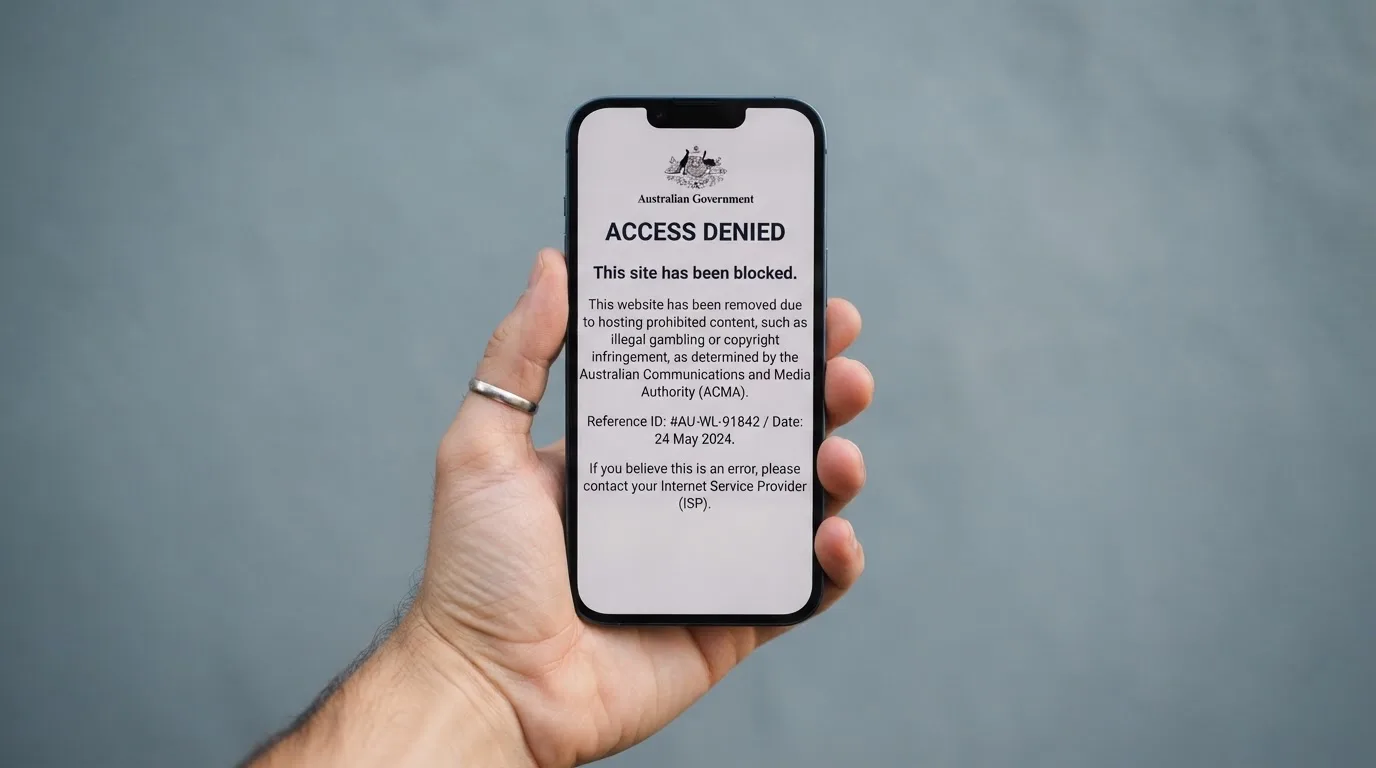
The blocking rate the ACMA has run over the last several years is the context the operator table sits inside. As of June 2026, the ACMA had asked Australian internet service providers to block 1,751 illegal gambling and affiliate marketing websites since the first blocking request in November 2019. The blocking rate over that window is roughly 1,751 divided by the 79 months between November 2019 and June 2026, which works out to a band of roughly 22 blocked sites per month on average — though the actual monthly rate has been uneven, with some months running several times that figure and others quiet. The rate is the ACMA’s enforcement tempo, not a prediction of what happens to a specific site, and a blocked site is one a punter with a balance on it cannot reach without a workaround. More than 230 unlicensed gambling services have left the Australian market since enforcement was strengthened in 2017, according to the same ACMA tally, which is the broader figure the blocking rate sits inside.
| Brand | ACMA action and date | Operator named by the ACMA | Subject support |
|---|---|---|---|
| RocketPlay | Formal warning, March 2026 | Pulsup Ltd (RocketPlay) | — |
| Level Up Casino | Formal warning, May 2022 | Dama N.V. | — |
| Woo Casino | Formal warning, March 2025 | Dama N.V. | — |
| Spirit Casino | Formal warning, May 2025 | Dama N.V. | — |
| National Casino | Formal warning, July 2025 | Consolutetish S.R.L. | — |
| Bizzo Casino | Formal warning, July 2025 (and 2022 to TechSolutions) | Consolutetish S.R.L. | — |
| Ignition Casino | Formal warning, July 2025 | Bamboo Media | — |
| Instant Casino | Formal warning, February 2025 | EOD Code SRL | — |
| Jackbit | Formal warning, April 2026 | Ryker B.V. | — |
| Casino Intense | Formal warning, April 2025 | Sterplay Holding Ltd | — |
| Sky Crown | Formal warning, September 2022 | Hollycorn N.V. | — |
The subject-support column carries an em dash across the table because the research inputs gave the page no verified fact for any of these brands on the payment or operator-specific question the column would answer. Affiliate-listing pages mentioned several of the names, but those are marketing copy rather than independent confirmation, and the page does not pass them off as facts.
RocketPlay
Pulsup Ltd was named by the ACMA in March 2026 over Rocketplay.com.au; an earlier Dama N.V. warning in May 2022 covered the same brand under its previous corporate wrapper. The site displays an offshore licence, which is not an Australian one because no Australian jurisdiction issues one. The page can verify the ACMA action and the operator name; what it cannot verify is any claim the site’s marketing makes about bonuses or VIP terms, because no Australian register audits them. A punter drawn to RocketPlay by a high-roller offer is choosing to play at a site the regulator has named twice in four years.
Level Up Casino
Dama N.V. was named by the ACMA in May 2022 over Level Up Casino as part of a six-brand warning that also covered Bambet, Dazard, Rocketplay, Wild Tornado and Cobra Casinos. The site displays a Curaçao-issued licence, which is the wrapper most of the Dama N.V. portfolio runs under. The marketing claim is a high-roller welcome package; the ACMA record is a formal warning over the same product the marketing sells. That is the gap a reader should weigh before signing up.
Woo Casino
Dama N.V. was named by the ACMA in March 2025 over Woo Casino, two and a half years after the original 2022 warning that covered its sister brands. The site is still operating under the same Dama N.V. corporate wrapper and the same offshore licence. A punter reading the bonus page and the ACMA record side by side is the only consumer protection this product offers, because no Australian consumer-protection body sits behind either.
Spirit Casino
Dama N.V. was named by the ACMA in May 2025 over Spirit Casino, two months after the Woo Casino warning and three years after the original 2022 action. Spirit is a newer brand in the same Dama N.V. portfolio and runs the same high-roller marketing template. The pattern the ACMA has named twice — once in 2022 over the older brands and again in 2025 over the newer ones — is the only data point the page can verify about the operator’s conduct.
National Casino
Consolutetish S.R.L. was named by the ACMA in July 2025 over National Casino, alongside Bizzo Casino, in a single warning round. The site is one of the better-known names in the offshore market and the same brand the ACMA has acted against before under a different corporate wrapper. The marketing emphasises a multi-tier VIP programme; the ACMA record emphasises a formal warning under the IGA. Both are true; only one of them is enforced by an Australian authority.
Bizzo Casino
Consolutetish S.R.L. was named by the ACMA in July 2025 over Bizzo Casino, and TechSolutions (CY) Group Limited and TechSolutions Group N.V. were named over the same brand in 2022. The two warnings, three years apart, are the ACMA record on Bizzo. The site markets reload bonuses and a tournament schedule; the regulator’s record is two formal warnings over the same product the marketing sells. The brand has cycled corporate wrappers between the two warnings, which is the only structural fact the page can verify beyond the ACMA’s own publications.
Ignition Casino
Bamboo Media was named by the ACMA in July 2025 over Ignition Casino, alongside the National Casino and Bizzo Casino warnings. Ignition is a poker-and-casino brand that markets itself heavily to Australian traffic, which is part of why the ACMA action matters: the warning is over the casino product, not over the poker product. The site is not available from Australia on an Australian-licensed basis, because no Australian jurisdiction licenses it; the offshore licence it displays is the only authorisation it carries.
Instant Casino
EOD Code SRL was named by the ACMA in February 2025 over Instant Casino. The site has been one of the more aggressive high-roller marketers in 2025 and 2026, with a deposit-match offer sized for four-figure deposits. Affiliate pages mention PayID and ecoPayz as deposit options; the ACMA record is a formal warning over the casino offering itself. The brand has no Australian consumer-protection framework behind it, and the warnings list is the closest the page gets to one.
Jackbit
Ryker B.V. was named by the ACMA in April 2026 over Jackbit and CasinOK, in a single warning round. Jackbit is a crypto-friendly casino that markets high-roller limits and a sportsbook under one account; the ACMA warning is over the casino product. The crypto-friendly framing is the one to note for an Australian punter: the IGA’s credit-card ban does not touch crypto, but the AUSTRAC reporting rules around exchanges do, and an Australian player funding an account in cryptocurrency is operating outside both the licensed wagering framework and the typical consumer-protection net.
Casino Intense
Sterplay Holding Ltd was named by the ACMA in April 2025 over Casino Intense. The site is a smaller brand in the offshore high-roller market and runs the same marketing template as the bigger names — deposit match, free spins, VIP tiers. The ACMA warning is the page’s only verifiable data point about the operator’s conduct in Australia, because no Australian register audits the bonus terms the marketing sells.
Sky Crown
Hollycorn N.V. was named by the ACMA in a formal warning over Sky Crown and Blue Leo Casino, published in September 2022. The warning is the oldest in the table and the corporate wrapper has remained stable since. Hollycorn N.V. operates a portfolio of offshore brands that share the same platform and the same licence; the ACMA action is over the Sky Crown and Blue Leo fronts rather than over the corporate wrapper itself, which is the structural fact the warning text carries.
What an Australian high-roller actually has access to
The Interactive Gambling Act 2001, strengthened by the Interactive Gambling Amendment Act 2017, makes it an offence to provide online casino games, online pokies or in-play betting to a person physically in Australia; no state or territory issues a licence for it. What is licensable is wagering on races and sport placed before the event, lotteries and keno. The Northern Territory Racing and Wagering Commission regulates 52 of Australia’s online bookmakers — including Sportsbet, Bet365 and Ladbrokes — licensed in the Territory for tax reasons; the commission has no full-time staff and meets once a month in Darwin.
The Interactive Gambling Amendment (Gambling Reform) Bill 2026 passed Parliament on 19 August 2026, with its advertising and inducement measures commencing on 1 January 2027. That is a law with a start date, not yet in force on a page read in 2026, and it does not legalise online casino play; it tightens the rules around inducements at the licensed wagering services that already exist.
The enforcement side is the ACMA’s domain: investigations, formal warnings, and blocking requests to Australian internet service providers. The individual player is not prosecuted under the IGA — the Act targets the provider — but an offshore site gives no Australian consumer protection, no complaints body, and no recourse if a withdrawal is refused. H2 Gambling Capital’s 2025 report estimates that Australians lose about A$3.9 billion a year to illegal gambling sites, and that the share of gambling going through legal channels fell from 74 per cent in 2021 to 64 per cent. That 10-point fall is the macro shape of the offshore market the rest of this page describes at the operator level.
The player-protection side is where the legal landscape meets the punter’s actual options. BetStop binds Australian-licensed services only; it will not exclude a player from an offshore site. The 1800 858 858 helpline and Gambling Help Online are the counselling paths. The bank-level gambling blocks at Westpac, ANZ and Commonwealth Bank fence off credit-funded gambling and wallet-linked gambling on eligible cards, but they do not stop a bank transfer or a PayID payment to an offshore site. A punter who chooses to play on an offshore casino is choosing to step outside the protective scaffolding the licensed Australian market offers, and the gap between the two is what most of this page is about.
The realistic shortlist for a high-stakes player who reads this from Australia is not the eleven operators above. It is the licensed pokies venues and land-based casinos in the reader’s state or territory, where the high-roller tables run in person, the cash settles on the floor, and the consumer-protection framework is an Australian one. Crown Melbourne, Crown Perth, The Star Sydney, The Star Gold Coast, and the smaller licensed venues carry the high-roller product the offshore sites market, in a setting that sits inside the law.
Tax, payments and the rest of the legal frame
Gambling winnings of a recreational player are not assessable income under section 6-5 of the Income Tax Assessment Act 1997, and losses are not deductible, unless the person carries on a business of gambling. That is the default framing the ATO applies, and it is the framing that applies to almost every Australian punter. The AUSTRAC threshold-transaction-report rule, requiring reporting of transfers of A$10,000 or more, applies only to physical cash; ordinary electronic bank transfers are not subject to that per-transaction reporting requirement, regardless of the amount sent, so a high-roller PayID payout does not trip a reporting line at the bank.
The payments side is the one that decides what the punter can actually do. Under the IGA as amended in 2023, Australian-licensed online wagering services cannot accept payment by credit card or other credit-related products; the ban also constrains gambling use of linked digital wallets like Apple Pay on a credit-funded card. Legal deposit routes for licensed wagering are debit card, bank transfer, PayID/Osko and BPAY. The credit-card ban’s effective date for operators was 11 June 2024, with penalties up to $247,500 for operators that breach it. A site asking an Australian for a credit card or a crypto deposit is operating outside the Australian rules — which is the standard the offshore market fails by default.
The tax framing is the one place the high-roller claim and the legal landscape come together cleanly. A punter playing at a licensed Australian venue has the consumer-protection framework behind them and the ATO’s recreational-winnings rule applying; a punter playing at an offshore site has neither. The bank transfer still arrives, the wallet still settles, the bonus still credits — and the legal scaffolding that an Australian reader expects is simply absent.
Frequently asked questions
What deposit level typically qualifies a player as a high roller at a casino?
The offshore market tends to draw the high-roller line at four-figure deposits, with VIP tiers starting around A$1,000 to A$2,000 and the largest bonuses gated behind five-figure top-ups. Land-based Australian venues set their own thresholds and do not publish them. The deposit figure alone does not make the player a high roller; the consistent wagering volume behind it does.
Do high-roller bonuses usually come with higher wagering requirements?
Yes. A standard deposit bonus might carry a thirty-five-times wagering factor; a high-roller offer typically sits between forty and fifty times the bonus, sometimes higher. The bonus is bigger, the turnover commitment is bigger, and the house-edge bill on the path to clearing it is bigger, in roughly the same proportion.
Is it legal for an online casino to offer high-roller bonuses to Australians?
No. The Interactive Gambling Act 2001 prohibits offering online casino games and online pokies to anyone physically in Australia, and no state or territory licences them. A site offering a high-roller bonus to an Australian is operating outside that prohibition; the ACMA’s formal-warning record is the regulator’s response.
Can high-roller status be reached through a PayID deposit?
The deposit rail does not determine the tier the operator assigns; the operator’s own VIP criteria do, usually based on deposit volume, wagering volume, or both. PayID is fast and convenient, but it is not a shortcut to VIP status. A punter funding an account at an offshore site through PayID is still playing at an unlicensed site.
Are high-roller tables or limits offered at licensed Australian land-based casinos?
Yes. Crown Melbourne, Crown Perth, The Star Sydney, The Star Gold Coast and other licensed venues carry dedicated high-roller rooms with table limits well above the standard floor. These are in-person products, and the limits are set by the venue rather than published in advance.
What should a high-spending player check before trusting a casino site?
Whether the site is licensed in Australia (no online casino is), whether the ACMA has issued a formal warning over it, whether the bonus terms are written in plain English and verified by an independent register, and whether the withdrawal rail is one an Australian bank will release funds to without delay. None of the eleven operators above pass the first of those four checks.