Online casino payment methods for Australian players: the actual rails, the actual rules
 Available in US
The shortest accurate answer to “what are the best online casino payment methods for Aussies” is that the product those payment methods would buy is itself unlawful to supply to a person in Australia. Online casino games — slots, roulette, blackjack, live dealer tables — cannot be licensed anywhere in this country, which means every offshore casino accepting Australian dollars is operating against the Interactive Gambling Act 2001 and has been for years. The Australian Communications and Media Authority keeps a public ledger of the formal warnings it has issued, and reading that ledger is a better starting point than any “best methods” list. The rest of this page works through what the law actually forbids, what the ACMA has actually done, which payment rails Australian banks run, and which deposit and withdrawal options a reader looking for lawful gambling — licensed wagering, lotteries, keno, or land-based venues — can actually use.
Current as of 24 September 2026. Cross-checked against the ACMA’s published list of formal warnings and blocking actions, plus regulator pages for AUSTRAC, BetStop and the Reserve Bank of Australia.
Table of Contents
- Why the question runs into the law
- What the ACMA has actually done
- What player protection actually exists in Australia
- Crypto deposits and what “anonymity” actually gets a player
- The Australian payment rails and what they actually do for a player
- A blocking-rate lens on the enforcement record
- The ACMA’s published record on eleven named brands
- The eleven brands, in the order the ACMA named them
- What the law reform on the horizon actually does
- What an Australian reader can actually do
- Frequently asked questions
Why the question runs into the law
There is no Australian-issued online casino licence to point at. The Interactive Gambling Act 2001, tightened by the 2017 amendments, makes it an offence to provide online casino games, online pokies or in-play betting to a person physically in Australia. State and territory regulators can license wagering on races and sport placed before the event, lotteries and keno, but no jurisdiction — not New South Wales, not Victoria, not the Northern Territory — can license an online casino or an online pokie. The few operators that still allow an Australian account in from an offshore licence are running outside the Australian rules, even when their own footer shows a Curaçao or Anjouan number.

A reader typing “best online casino payment methods for Aussies” usually wants a shortlist of casinos they can deposit at and get paid out from. The honest answer is that no such shortlist exists for this product. The honest next answer is to show why that is, what the ACMA is doing about it, and which rails an Australian can use for the gambling that is actually lawful — sports and racing wagering, lotteries, keno, and licensed pokies and table games at a physical venue.
The rest of this page accepts that constraint as the starting point and works outward from it.
What the ACMA has actually done
The ACMA’s enforcement is cumulative and public. The numbers as published give a sense of scale. Since the first blocking request in November 2019, a running total of 1,751 illegal gambling and affiliate marketing websites had been blocked by mid-2026, and more than 230 unlicensed services had left the Australian market since enforcement was strengthened in 2017. A more recent round, reported in June 2026, asked Australian internet service providers to block another twelve names in one go: 7Signs, ChromaBet, Donbet, Duospin, Freshbet, Slots Gem, Jacks Club, Lucky Start, Pointsbetz, Spinrise, Vinyl Casino and Wildsino. Blocking is the blunt instrument; the slower one is the formal warning, which names the operator on the record and is what the table later in this page draws on.
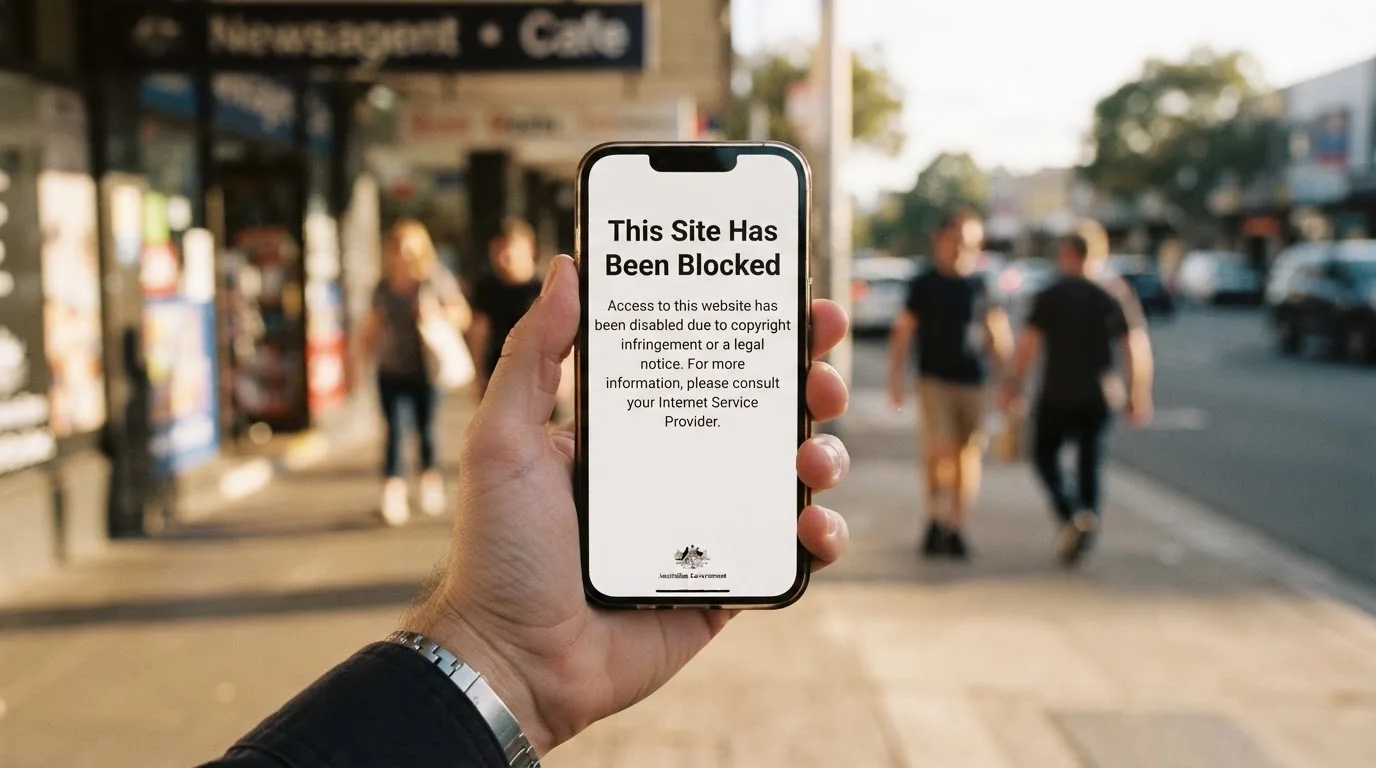
A formal warning under the Interactive Gambling Act is not a ticket. It puts the operator on notice, usually after the ACMA has reasonable grounds to believe an illegal interactive gambling service is being provided to Australians. The operator has a chance to respond. The visible result is that the warning is published on the ACMA’s website with the brand, the legal entity behind it, the date, and usually a summary of what the ACMA says was being provided. Reading the list back is the most reliable way to know which brands the regulator has actually turned its attention to.
The eleven brands covered later on this page are not a “top eleven to play at”. They are eleven names that have featured in those published warnings.
What player protection actually exists in Australia
For an Australian playing at a locally licensed sports or racing bookmaker, the safeguards are real. The National Self-Exclusion Register, called BetStop and live since August 2023, binds every Australian-licensed online and phone wagering service, so a self-exclusion registered once is honoured across all of them. BetStop does not see offshore casinos, and an offshore site is under no obligation to honour the register even if a punter notifies them personally.
For anyone whose gambling has stopped being fun, the National Gambling Helpline on 1800 858 858 is free, around the clock, and the same service runs a chat at Gambling Help Online. Bank-level gambling blocks give a second, more frictionless layer. Westpac refuses authorisation of any transaction tagged under the merchant category code for betting and casino gambling on eligible personal credit and debit cards, with the cardholder setting the block through banking. ANZ runs the equivalent block through its app, and ANZ’s block also stops the same card being used for gambling through a digital wallet such as Apple Pay — not only through the physical card. Removing ANZ’s block once set requires a 48-hour cooling-off, and the bank itself flags that some gambling transactions may slip through and a small number of non-gambling transactions may be blocked in error. Commonwealth Bank runs a similar gambling lock on eligible cards through its CommBank app, with the same caveat from the bank that not every gambling charge can be guaranteed to be stopped.
An offshore casino is not on any of these rails. A self-exclusion does not follow across, a bank block does not catch every channel, and there is no Australian complaints body to escalate to if a withdrawal is refused.
Crypto deposits and what “anonymity” actually gets a player
Cryptocurrency is heavily advertised by offshore casinos as a private deposit method. The privacy it provides is narrower than the marketing suggests, and the legal status in Australia is narrower still.
The Interactive Gambling Act 2001 as amended makes digital currency an unlawful payment method for any Australian-licensed interactive wagering service, alongside credit cards and credit-related products. That ban sits on the licensed side; on the unlicensed side, no rule other than the site’s own terms is enforced, which is why crypto deposits still land at offshore casinos. What the technology does for the depositor is break the link between the bank account and the casino. What it does not do is make the transaction anonymous on the blockchain it lives on. Bitcoin and the major public-chain tokens are pseudonymous, not anonymous. Every transfer is permanently recorded; chain analytics firms trace flows routinely, and Australian exchanges that handle Australian dollars on- and off-ramps are themselves AUSTRAC-regulated reporting entities.
The practical reading is that crypto at an offshore casino swaps a familiar paper trail for a permanent public one. The same rule on every other rail — that an Australian consumer has no recourse if a withdrawal stalls — applies equally. If anything, the recourse is thinner, because there is no Australian bank sitting between the player and the operator to intervene through its chargeback or dispute processes.
The Australian payment rails and what they actually do for a player
The names a reader sees at the deposit page of an Australian-licensed bookmaker — PayID, Osko, BPAY, eftpos, debit card — are not exotic. They are the same rails the rest of the country’s economy runs on. Knowing each one is the point.
PayID and Osko
PayID is an address. A customer of a participating bank registers a PayID — usually a phone number, email or ABN — in their banking app, and the bank’s records point that PayID back to a BSB and account number. When somebody pays that PayID, the money goes to the right account without the payer typing the BSB and number. Paying into a PayID shows the registered name of the account holder on the confirmation screen before the transfer is sent, which is the control — if a casino site asks an Australian to send money to a PayID that does not match the operator’s name on its own terms page, that mismatch is the most useful piece of information the player will see on that page. Australia Payments Plus, which runs PayID, says the same thing more bluntly: being asked to transfer money to a PayID on an illegal gambling site almost certainly means a scam site.
Osko is the delivery mechanism. It is the instant-payments service that runs on the New Payments Platform, the public-facing Australian payments infrastructure that became accessible in February 2018 and is owned by New Payments Platform Australia Ltd, whose shareholders include the Reserve Bank of Australia and the major banks. With Osko, a bank transfer between participating banks arrives in under a minute, twenty-four hours a day including weekends — addressed to either a BSB and account number or a PayID. By April 2025 more than twenty-five million PayIDs were registered, and over a hundred Australian financial institutions offer PayID-based instant transfers.
The same speed that makes Osko convenient for paying a tradie makes it convenient for gambling — instantly. The platform’s monthly outages are capped, by rule, at no more than two minutes, which is part of why the experience is reliable. The capability is general; the question is who the consumer is sending the money to.
BPAY
BPAY is a bill-payment service that lives inside Australian online banking. The payer enters a Biller Code and the Customer Reference Number printed on the bill, and the money is debited from the payer’s account and credited to the biller. It has been running since 1997, is available in the online banking of more than 140 banks and financial institutions and is used by over 95,000 businesses. BPAY is run by Australian Payments Plus, the same parent that runs PayID and Osko, and is owned equally by ANZ, Commonwealth Bank, National Australia Bank and Westpac.
Because BPAY is built around billers rather than account-to-account transfers, it is more useful for paying registered businesses — utilities, councils, telcos — than for moving money into a gambling account quickly. Where it does show up at a licensed wagering operator, it is one route among several rather than the headline option.
Debit cards, eftpos, Visa and Mastercard
Debit cards are the deposit rail at most Australian-licensed wagering services. eftpos is the domestic debit scheme; Visa and Mastercard debit cards route through their international networks. All three are subject to the same banking-side gambling block controls. Eftpos is also among the networks the Reserve Bank of Australia proposed in its July 2025 review to take surcharges off altogether — a separate conversation from gambling, but a useful bit of background on what the cards cost at the till.
Credit cards and credit-related products are a different story. Under the Interactive Gambling Act as amended in 2023, an Australian-licensed wagering operator cannot accept them. That ban is what constrains gambling use of linked digital wallets such as Apple Pay on a credit card. Apple itself does not charge customers for using Apple Pay; any surcharge at the merchant is the merchant’s own card-processing fee. Wallet limits and PIN behaviour are set by the card issuer and the merchant, not by Apple. By the end of 2025 Apple Pay, Google Pay and Samsung Pay together accounted for around 45% of all card payments in Australia by number, so a network-level ban covers a large slice of how Australians actually tap and pay.
American Express
American Express stands outside the credit card ban discussion for a particular reason. AmEx issues and processes its own transactions in a three-party model, unlike Visa or Mastercard’s four-party network. In its July 2025 review of merchant card payment costs, the Reserve Bank proposed removing surcharges only on eftpos, Mastercard and Visa transactions, leaving American Express outside the proposed surcharge ban. From a player’s point of view that means American Express is its own island of fees, more expensive at the merchant end than the rest, and not on the list of cards an Australian-licensed wagering service will accept under the credit ban in any case.
Bank transfer outside Osko
A regular bank transfer still works. Routing it by BSB and account number rather than by PayID, the transfer sits inside the standard settlement windows rather than Osko’s near-instant path, which can be hours and a working day or two at weekends. The AUSTRAC reporting threshold for transfers of A$10,000 or more applies only to physical cash, so an ordinary electronic transfer of any size is not reported per transaction under the threshold rule. That is a frequently misunderstood point: the A$10,000 rule is a cash rule, and it does not draw a bank transfer above it onto a report.
Where the offshore casino sits in all of this
An offshore casino accepts, in practice, whatever it can route: Visa, Mastercard, AmEx, a few e-wallets, a handful of cryptocurrencies, sometimes an international bank transfer. None of that creates an Australian-law relationship between the player and the operator. The bank-side gambling blocks sit on the customer’s card, which is part of why a card deposit at an offshore site is more likely to be declined than a deposit at a licensed wagering service. When the deposit does land, there is no Australian chargeback route that follows, no EDR to escalate to, and no guarantee that the operator will not simply decline a withdrawal.
A blocking-rate lens on the enforcement record
The ACMA’s blocking round in June 2026 took a fresh request to Australian ISPs. The running total of 1,751 blocked sites includes the affiliates and mirror sites used to be found around the brands the regulator has already moved against, not just the brand sites themselves. The arithmetic of interest is the rate rather than the headline number.
The total of 1,751 blocked sites spans from November 2019 to the published tally in June 2026, which is roughly eighty months. That puts the running rate of blocked additions in the low double digits per month averaged across that period — somewhere between 20 and 22 blocked sites a month as a sustained average, with some months heavier and some lighter. The June 2026 round alone added twelve names in one reporting period, which puts a single heavy week comfortably above the monthly average. The result is best read as a band: the typical month has averaged a steady flow of newly blocked domains, and the regulator reserves heavier rounds for moments when a cluster of related operators is named at once. The rate, rather than the count, is what tells the reader how reactive the regime is — and it is reactive enough that a brand appearing on a published warning is rarely the last version of its address.
The ACMA’s published record on eleven named brands
The table below lists eleven brands by the formal warnings the ACMA has issued over them. The page’s angle runs through what an Australian reader can and cannot tell from the rest of a typical review of these brands — reviews that, in practice, exist to route an Australian reader to a deposit page. The lawful thing to do with a brand named here is not to play at it. The useful thing is to know it has been named and why.
| Brand | ACMA action and date | Operator named by the ACMA | Subject support |
|---|---|---|---|
| RocketPlay | Formal warning, March 2026 (earlier Dama N.V., May 2022) | Pulsup Ltd (2026) | listings-only (Gambling Insider) |
| Level Up Casino | Formal warning, May 2022 | Dama N.V. | listings-only (Westpac) |
| Woo Casino | Formal warning, March 2025 | Dama N.V. | — |
| Spirit Casino | Formal warning, May 2025 | Dama N.V. | — |
| National Casino | Formal warning, July 2025 | Consolutetish S.R.L. | listings-only (acma.gov.au, austrac.gov.au, betstop.gov.au) |
| Bizzo Casino | Formal warning, July 2025 (earlier TechSolutions, 2022) | Consolutetish S.R.L. (2025) | listings-only (Gambling Insider) |
| Ignition Casino | Formal warning, July 2025 | Bamboo Media | — |
| Instant Casino | Formal warning, February 2025 | EOD Code SRL | listings-only (ecoPayz, PayID) |
| Jackbit | Formal warning, April 2026 | Ryker B.V. | — |
| Casino Intense | Formal warning, April 2025 | Sterplay Holding Ltd | listings-only (austrac.gov.au, betstop.gov.au, Gambling Insider) |
| Sky Crown | Formal warning, September 2022 | Hollycorn N.V. | — |
Reading the table top to bottom gives a sense of how the warning cadence has built up. The earliest entry is Sky Crown in September 2022 and Level Up Casino, Bizzo Casino and RocketPlay in May 2022. The most recent warnings sit in 2026 — RocketPlay again under a new operator in March, and Jackbit under Ryker B.V. in April. Re-warning a brand under a new corporate entity is one of the patterns the ACMA’s list exposes; Dama N.V. alone appears four times here, in 2022 and twice in 2025, with the same brand sometimes surfacing under a successor operator later.
None of these licenses is an Australian licence. None could be, for this product. The footer licence they display is an offshore one, and offshore licences do not give a player in Australia the protections that come with an Australian-issued bookmaker licence.
The eleven brands, in the order the ACMA named them
RocketPlay
The ACMA issued a formal warning to Pulsup Ltd over RocketPlay in March 2026. The same brand had earlier drawn a warning in May 2022 to a different operator, Dama N.V., which sat at the top of a six-brand batch covering Bambet, Dazard, Level Up, Wild Tornado and Cobra Casino alongside RocketPlay. A brand drawing two warnings under two operators, two operators apart, is the pattern that emerges across this list more than once. Any review of RocketPlay’s payment methods — credit card, a couple of e-wallets, a few coins — traces through offshore routes only, because there is no Australian-licensed counterpart for Australian readers to deposit through. The right reading of “RocketPlay payment methods” is that there is no Australian-payment-rail way into the product at all.
Level Up Casino
Level Up Casino’s warning sits in the May 2022 batch to Dama N.V., which named six brands in one go. Level Up’s operator record is a single warning, and the page-side picture of it is the same as RocketPlay’s: an offshore brand whose deposit options sit on non-Australian rails. There is no Australian-licensed route, no AUSTRAC-relevant reporting tie to a player’s bank, and no BetStop coverage to fall back on if a punter self-excludes. The reason it is named here is precisely that the regulator has had to publish a warning over it for Australian-facing operations.
Woo Casino
Woo Casino was the subject of a formal warning to Dama N.V. in March 2025, two and a half years after the original Dama N.V. batch in 2022. A repeat warning for the same operator under the same set of names is a reminder that the underlying operation is the same one the ACMA warned about before, even when the brand lineup around it changes. There is no Australian rail for it.
Spirit Casino
Spirit Casino drew its formal warning to Dama N.V. in May 2025, two months after Woo Casino. The same operator, the same regulator, the same pattern. Reading the dates alongside each other — March 2025, May 2025, then July 2025 in the cases below — shows a cluster of warnings from a single quarter rather than evenly spread activity. A reader should read that as a regulator working through its open list in batches.
National Casino
National Casino’s formal warning was issued in July 2025 to Consolutetish S.R.L. The same operator drew the same month a second warning for a sister brand. The “subject support” line under National Casino carries three regulators or registers: the ACMA itself, AUSTRAC, and BetStop. That mix is unusual — most of the table either carries none or carries a single offshore-side listing aggregator. National Casino’s footprint in Australian-facing listings, particularly the regulator and the self-exclusion register, is the reason that row reads the way it does.
Bizzo Casino
Bizzo Casino’s warning to Consolutetish S.R.L. came in July 2025, the same month as National Casino’s. The brand had already been the subject of a 2022 formal warning to TechSolutions (CY) Group Limited and TechSolutions Group N.V., which makes Bizzo Casino a re-warning rather than a first warning. The same regulatory line on every row applies: no Australian licence, no AUSTRAC tie-in to the player, no BetStop coverage on the offshore side.
Ignition Casino
Ignition Casino drew its warning over Bamboo Media in July 2025. Bamboo Media also ran Ignition-affiliated operations across the same quarter, and the ACMA named it accordingly. The brand is one of the more recognisable names to Australian readers because its marketing has been persistent across Australian-facing affiliate pages; the ACMA naming is the regulatory counterweight to that.
Instant Casino
Instant Casino was the subject of a formal warning to EOD Code SRL in February 2025. The “subject support” line lists two pieces of infrastructure — an e-wallet aggregator and PayID itself — because the marketing around Instant Casino in affiliate pages tends to lean on both. The presence of PayID in a brand’s list of advertised payment methods, where PayID is the rail run by Australian Payments Plus, is exactly the mismatched-marketing moment that the PayID’s own warning about scam sites anticipates.
Jackbit
Jackbit drew a formal warning to Ryker B.V. in April 2026. It sits in the same broad record as Instant Casino in being run by an offshore operator with a marketing list built around crypto. The “subject support” row is blank, because no aggregate listing page in the consulted set covered it. The ACMA’s warning is the record that matters.
Casino Intense
Casino Intense was the subject of a formal warning to Sterplay Holding Ltd in April 2025. The “subject support” row lists AUSTRAC, BetStop and an affiliate-aggregator listing, which signals that the brand keeps a presence on Australian-facing aggregator pages — but the underlying operator is on the published warning list, which is what readers in Australia should weigh above any aggregator page.
Sky Crown
Sky Crown draws the earliest formal warning in the table, in September 2022 to Hollycorn N.V. Hollycorn was also the operator behind a Blue Leo-related warning cited on the same ACMA page. The brand sits in the older half of the table; the regulatory record does not.
What the law reform on the horizon actually does
The Interactive Gambling Amendment (Gambling Reform) Bill 2026 passed Parliament on 19 August 2026, and the advertising-and-inducement measures within it commence on 1 January 2027. The reform is real and is law, but the relevant measures are not yet in force on a 2026 page. From the operator’s marketing side, that means tighter rules on bonuses, on inducements and on the way offshore and licensed brands advertise to Australians are coming, but they do not change the underlying ban on online casino games in the meantime. The next best thing for a reader trying to plan around the rule is to read the regime that is already in force and assume the regulator’s enforcement direction continues.
What an Australian reader can actually do
The lawful gambling options for an Australian who wants to play today are not online casino games. They are the wagering, lottery and keno services licensed under Australian law — placed before the event for sports and racing, with debit card, PayID/Osko and BPAY as the deposit options. They are land-based clubs, hotels and casinos in each state, where pokies and table games are licensed. They are lottery and keno products run by state-level operators. For online slots and table games in the Australian home, there is no lawful product.
For the player who needs a control, BetStop is the right self-exclusion path — once registered across the licensed wagering services, it is binding across all of them. The banking-side gambling blocks — Westpac’s card-level gambling block, ANZ’s app-based lock that follows the card across Apple Pay, Commonwealth Bank’s app-based lock — give a layer above the register, and a 48-hour cooling-off is built into ANZ’s removal flow so that turning the block off is not impulsive. The National Gambling Helpline on 1800 858 858 is a free call at any time, with chat at Gambling Help Online for the people who find typing easier than speaking.
For a reader asking about online casino payment methods and finding this page, the answer is not a deposit method. It is that the deposit page they were heading to is for a product no Australian licence can authorise, and the payment methods that work everywhere else in the Australian economy — PayID, Osko, BPAY, debit card — are not on that page because the operator is not on the Australian rails.
Frequently asked questions
What payment methods are commonly advertised by online casinos targeting Australians?
The standard list reads much like any offshore casino: Visa, Mastercard, American Express, a handful of e-wallets such as ecoPayz and Neteller, bank transfer, and a few cryptocurrencies — usually Bitcoin, Ethereum and Litecoin. None of these are advertised to an Australian reader because the operator holds an Australian licence. The interactive gambling ban in this country runs against the product, not the payment method, so the operator is offshore and the rails are offshore too. A PayID or Osko option on an Australian-facing page is the unusual case, and is itself flagged as a warning sign by Australia Payments Plus.
How does an Osko transfer compare with a card payment for speed?
Both are fast. An Osko transfer between participating banks clears in under a minute, twenty-four hours a day, whether the customer is paying into a BSB and account number or a PayID. A debit-card transaction at an Australian merchant is also near-instant at the point of sale, with settlement running on a separate cycle overnight. The practical difference is that a card payment runs through a card network with the merchant’s acquiring bank in the middle, and a card-side gambling block on the customer’s account will refuse authorisation before the money moves. An Osko transfer arrives instantly because the New Payments Platform runs a real-time settlement path; once the transfer is sent, the bank-side gambling block that exists for card transactions does not stop it.
Is it legal for an online casino to process payments from players in Australia?
It is not legal for the operator to provide online casino games to a person in Australia, and a payment processor enabling those transactions is exposed as well. The Interactive Gambling Act 2001 makes the supply the offence, not the play; the individual player is not prosecuted, but the operator and any Australian-facing payment facilitator handling Australian customers risk formal warning, blocking action and penalties of up to A$247,500 per offence for breaches of the credit-ban provisions. The enforcement side is the ACMA’s published record of formal warnings over the operators named in the table above, plus the running tally of blocked sites.
Are cryptocurrency payments harder to trace than a bank transfer?
They are pseudonymous on the blockchain rather than anonymous, and in that sense they are easier, not harder, to trace than a paper-trail bank transfer. Every Bitcoin transaction is permanently recorded on the public ledger, and the on- and off-ramps Australian customers use — the exchanges converting Australian dollars into crypto and back — are themselves AUSTRAC-regulated reporting entities. Chain-analytics firms trace flows routinely, and the link between a PayID or BSB transfer and the player’s name is the same one that exists for any other Australian dollar transfer. The real privacy gain from crypto at an offshore casino is the severance of the bank’s own record; the player has more privacy from the bank and less from the chain.
What makes a casino payment method secure rather than just fast?
Speed is a feature the marketing copy leads with; security is about who has recourse if something goes wrong. The Australian-licensed wagering operator sits under Australian consumer law, with bank-side gambling blocks, an AUSTRAC regime applicable to the operator and player funds held under Australian rules. An offshore casino, however fast, sits under none of those. Two flags to weigh: whether the operator is on BetStop (a licensed operator is), and whether the deposit rail the player would use is an Australian-issued card or wallet (which a licensed operator accepts) rather than an offshore e-wallet that has to off-ramp the player’s winnings through its own rails. A deposit that settles in an instant is the small win; a withdrawal that actually lands is the larger one.
Does PayID offer any extra protection compared with a BSB and account number?
Yes, in one specific way. Paying into a PayID shows the registered name of the account holder on the confirmation screen before the transfer is sent. Typing a BSB and account number does not. The protection is the name check: if the operator’s terms page has one name and the PayID the deposit instruction asks for has another, the player sees the mismatch before pressing confirm. Australia Payments Plus itself says that being asked to transfer money to a PayID on an illegal gambling site almost certainly means a scam site. The protection is not in the rail; it is in the moment of choosing who to send to.
Created by the ”Casino Offshore Hub” editorial team.