
Apple Pay at Australian-facing online casinos in 2026: the prohibitions, the warnings, and what a deposit really moves
The honest answer to whether an Australian resident can use Apple Pay at an online casino is short and the rest of this page unpacks it. Online casino games and online pokies are prohibited interactive gambling services under the Interactive Gambling Act 2001, so no operator may lawfully offer them to a person physically in Australia — and an offshore site that does is the kind of operator the ACMA has spent seven years blocking, warning and chasing out of the market. Apple Pay, in that picture, is the rail the deposit runs on, not the thing that determines whether the casino is allowed to be there.

Current as of 30 October 2026; the ACMA register and operator self-disclosure verified against the ACMA’s formal-warning register and operator terms pages as published on that date.
Table of Contents
- What Apple Pay actually does at an offshore casino site
- The legal frame an Australian punter walks into
- What the ACMA record actually shows
- The bank-side filter an Australian punter can already switch on
- What a A$10 deposit at an offshore casino actually moves
- The set of brands the ACMA has warned over
- How to read an Apple Pay casino comparison if you read one anyway
- What a player should do before a A$10 deposit
- The promotion and inducement horizon
- The tax and money side
- What a player can and cannot recover from an offshore site
- Where this leaves a comparison
- Frequently asked questions
What Apple Pay actually does at an offshore casino site
A Apple Pay deposit at one of these sites looks indistinguishable from paying at a checkout. The punter opens the cashier, picks Apple Pay, confirms the card already loaded into the wallet, authorises with Face ID or the device passcode, and the merchant receives a card-funded payment routed through Visa, Mastercard or American Express. That last point matters: Apple Pay is not a payment network, it is a tokenisation layer sitting in front of one. Remove it and the deposit runs as an ordinary card transaction on the same rails.

Apple does not charge consumers a fee for using Apple Pay in stores, online or in apps, and any surcharge a player meets at a cashier is the merchant’s own processing cost passed through, not a line item Apple adds. Apple also states that transaction limits and PIN requirements for Apple Pay purchases are set by the card issuer or merchant, which is why a A$10 minimum at one cashier can sit beside a A$30 minimum at another without either side touching Apple’s terms. The wallet is silent on what counts as the underlying transaction; the card behind it carries the policy.
This is also where the speed claim meets reality. By the end of 2025 Apple Pay, Google Pay and Samsung Pay transactions collectively accounted for around 45% of all card payments in Australia by number, so the deposit itself lands fast. The thing that does not move at wallet speed is everything else: the casino still has to run its own identity checks, fraud screening and anti-money-laundering review before it credits the account, and on the way out the same applies to a withdrawal. A Apple Pay deposit clearing in seconds and a Apple Pay withdrawal taking one to three business days after the casino approves it are the same product at two different ends.
The legal frame an Australian punter walks into
The Interactive Gambling Act 2001, strengthened by the Interactive Gambling Amendment Act 2017, makes it an offence to provide online casino games, online pokies or in-play betting to a person in Australia. No state or territory licences them. What is licensable is wagering on races and sport placed before the event, lotteries and keno — in practice licensed by the Northern Territory through the Northern Territory Racing and Wagering Commission, a part-time body that regulates 52 online bookmakers (Sportsbet, Bet365 and Ladbrokes among them) and meets once a month in Darwin. The picture for online casino is, by design, empty: there is no Australian licence a casino can show a player that would cover pokies or table games online.
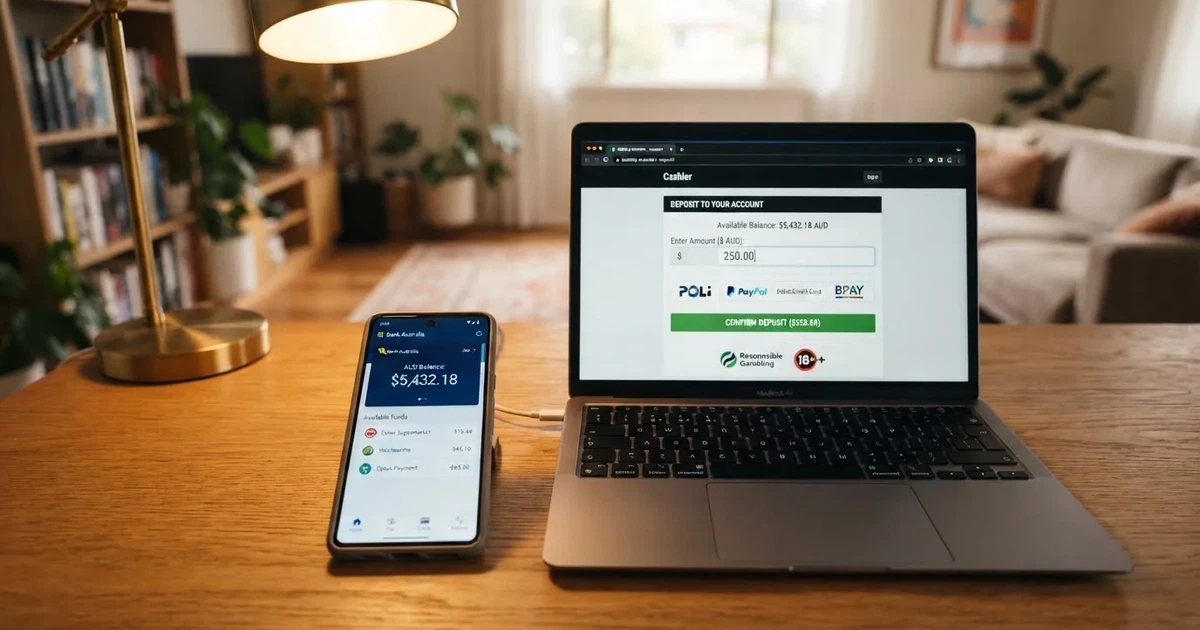
The 2023 amendments extended the prohibition to credit cards and credit-related products as a payment method for licensed online wagering, a restriction the ACMA enforces with penalties up to A$247,500 per offence for operators. Debit card, bank transfer, PayID/Osko and BPAY are the legal deposit rails at a licensed bookmaker. An offshore casino asking an Australian for a credit card or a crypto deposit is operating outside the Australian rules from the cashier step onwards. The Interactive Gambling Amendment (Gambling Reform) Bill 2026 passed Parliament on 19 August 2026 and its advertising and inducement measures commence on 1 January 2027 — law on the books with a future start date, not in force today.
The enforcement arm is the ACMA, the Australian Communications and Media Authority. It investigates, issues formal warnings under section 313 of the Act, and directs Australian internet service providers to block illegal sites. The individual player is not the target — the IGA names the provider — but the player is also the one left holding a balance at a site the regulator has just blocked. Offshore operators are not connected to BetStop, the National Self-Exclusion Register that went live in August 2023, because BetStop binds only Australian-licensed online and phone wagering services. There is no Australian complaints body an Australian can take an offshore casino to when a withdrawal stalls.
What the ACMA record actually shows
The blocking list is the regulator’s main lever and it is the one an Australian player can read in their own language. The ACMA asks ISPs to block illegal sites, and the cumulative count tells the story: according to the ACMA as reported in June 2026, a total of 1,751 illegal gambling and affiliate marketing websites had been blocked since the first blocking request in November 2019, and more than 230 unlicensed gambling services had left the Australian market since enforcement was strengthened in 2017. A single round reported on 26 June 2026 added 12 names: 7Signs, ChromaBet, Donbet, Duospin, Freshbet, Slots Gem, Jacks Club, Lucky Start, Pointsbetz.com, Spinrise, Vinyl Casino and Wildsino. Most of those names cycle through; the underlying operator behind them is what the formal warnings name.
H2 Gambling Capital’s 2025 report estimates that Australians lose about A$3.9 billion a year to illegal gambling sites, and that the share of gambling going through legal channels fell from 74% in 2021 to 64%. Those two figures together describe the market the ACMA is trying to compress: a flow of money out of the country into sites no Australian regulator can touch, and a slow contraction of the legal share. The blocking total of 1,751 is what compression looks like in cumulative terms. Worked as a band, the ACMA’s blocking programme has removed sites at a pace somewhere between 250 and 300 a year since 2019, depending on which stretch of the timeline you take — a useful rule of thumb for how many names a punter might expect to see in a fresh ACMA round. The number is not a target and it is not a forecast; it is the running rate a reader can hold in their head when the next 12-name round lands.
Formal warnings are the ACMA’s other lever and the one a comparison page can actually list. The regulator publishes each one naming the operator behind the brand and the date. Across the brands this page reviews, the timeline reads like this:
- May 2022: Dama N.V. warned over six casino brands — Bambet, Dazard, Level Up, Rocketplay, Wild Tornado and Cobra Casinos.
- September 2022: Hollycorn N.V. warned over Sky Crown and Blue Leo.
- March 2025: Dama N.V. warned over Woo Casino.
- May 2025: Dama N.V. warned over Spirit Casino.
- February 2025: EOD Code SRL warned over Instant Casino.
- April 2025: Sterplay Holding Ltd warned over Casino Intense.
- July 2025: Bamboo Media warned over Ignition Casino; Consolutetish S.R.L. warned over National Casino and Bizzo Casino. Bizzo Casino had already been the subject of a 2022 formal warning to TechSolutions (CY) Group Limited and TechSolutions Group N.V., so the July 2025 letter is the second piece of paper with the brand’s name on it.
- April 2026: Ryker B.V. warned over Jackbit and CasinOK.
- March 2026: Pulsup Ltd warned over Rocketplay.com.au. The brand is the same name as the 2022 Dama N.V. warning, with a different operator behind it.
A formal warning is not a prosecution. It is a written notice that puts the operator on notice that the ACMA considers the service prohibited; an investigation can follow, but the warning itself is the regulator’s preferred lower-cost tool before escalation. What the timeline shows is that the ACMA is willing to come back to the same parent company more than once — Dama N.V. carries warnings in 2022, 2025 and again in 2025 — and that the same brand can reappear under a new operator once the previous one has been warned off.
The bank-side filter an Australian punter can already switch on
Three of the four major Australian banks offer a card-level gambling block that also covers Apple Pay, because the wallet sits in front of a card and the block operates at the merchant category code underneath.
Westpac’s gambling block refuses authorisation of transactions registered under the merchant category code ‘Betting/Casino Gambling’ on eligible personal credit and debit cards, and once it is on it stays on until the customer turns it off. ANZ’s gambling transaction block, activated in the ANZ app, also blocks gambling transactions made through a digital wallet such as Apple Pay on an eligible card, not just the physical card; once it is on, removing it again requires a 48-hour waiting period, and the bank warns that not all gambling transactions will be blocked and some non-gambling transactions might be blocked in error. Commonwealth Bank’s gambling lock, applied via the CommBank app, automatically blocks most gambling transactions, though the bank states it cannot guarantee all gambling-related purchases will be stopped. None of the three covers every merchant — the merchant has to be classified under the right code, which is the lever and the limit of the block at once.
NAB does not run an identical product, but the bank’s stance on gambling transactions is recorded separately. The four-bank picture is also the limit of what a single Australian can switch on without leaving the wallet: a card block catches the Apple Pay deposit because the underlying transaction is a card transaction, and it does not catch a PayID/Osko transfer or a BPAY payment because those are not card transactions at all. Each rail has its own switch.
What a A$10 deposit at an offshore casino actually moves
Most of the offshore pokies-style sites that accept Apple Pay publish a minimum deposit between A$10 and A$30, with A$10 the most common floor. The deposit clears in seconds because the wallet handles it; the rest is the casino’s job. A Apple Pay withdrawal is not the same rail going backwards at wallet speed. The casino’s cashier converts it to a card refund or a bank transfer, the operator’s manual checks have to finish first, and on a routine approval the money lands in one to three business days. Where a casino imposes a 48 to 72 hour internal pending period before it even begins the withdrawal, the wallet is the fastest part of a slow process.
Fees on the way in are unusual at the cashier but not impossible. Apple does not charge the customer for Apple Pay itself, so a surcharge, where one appears, is the merchant’s card-processing cost disclosed up front (and in Australia the Reserve Bank’s July 2025 review proposes removing surcharges only on eftpos, Mastercard and Visa card transactions, leaving American Express outside the scope of the proposed ban). Where a casino charges a deposit fee, the fee is the operator’s revenue line, not Apple’s. Withdrawals are where fee structures get quietly punitive: some operators deduct a percentage of the withdrawal, some set a flat fee on transactions under a threshold, and a few apply both. The marketing page does not always show this; the terms page does.
Australian Payments Plus runs the rails a player might use to fund an Apple Pay wallet in the first place. PayID-based instant transfers are available at over 100 Australian financial institutions, and paying to a PayID shows the name of the account holder before the transfer is sent — AP+ warns that being asked to transfer money to a PayID on an illegal gambling site almost certainly means a scam site. With Osko, a bank transfer between participating Australian banks arrives in under a minute, 24/7 including weekends, whether it is addressed to a BSB and account number or to a PayID. More than 25 million PayID identifiers had been registered on Australia’s New Payments Platform as of April 2025, and the platform itself became accessible to the public on 13 February 2018, owned by New Payments Platform Australia Ltd, a non-profit company whose 13 shareholders include the Reserve Bank of Australia and the country’s major banks; participants must keep the platform’s monthly outages to no more than two minutes, which is why an Osko transfer usually feels instant.
BPAY runs alongside it as the bill-payment rail a player can use to fund a wallet: BPAY is a bill-payment service in online banking where the payer enters the Biller Code and the Customer Reference Number (CRN) printed on the bill, has operated in Australia since 1997, is available in the online banking of over 140 banks and financial institutions and is offered by over 95,000 businesses; it is run by Australian Payments Plus (AP+). It is not a rail an offshore casino cashier accepts as a deposit, but it is the rail an Australian player uses to move money to a wallet, an exchange or another account before the deposit step begins.
The set of brands the ACMA has warned over
The brands below are not a recommendation. They are not ranked from best to worst. They are the brands the ACMA itself has named in a formal warning under the Interactive Gambling Act 2001 for offering prohibited services to Australians, and each is included because the regulator’s record is the only comparable thing across them. The same caveat applies to every entry: online casino games cannot be licensed anywhere in Australia, whatever licence the site displays. Where a brand shows a Curaçao or Anjouan number in its footer, that licence covers the operator’s permission to run a casino from that jurisdiction; it does not override the IGA’s prohibition on supplying online casino games to a person in Australia.
RocketPlay
The ACMA issued a formal warning to Pulsup Ltd over Rocketplay.com.au in March 2026, and a separate warning to Dama N.V. over the Rocketplay brand in May 2022. The brand is the same name with two different operators behind it in roughly four years — the pattern a regulator’s reappearance list is built around. Apple Pay is listed as a payment option on the cashier page that affiliate marketing sources publish, though the ACMA record itself carries no figure for or against it. The relevant comparison is upstream of the wallet: an Australian-facing brand with two formal warnings in four years, both for the same prohibited service, is not a site a punter can treat as settled. The wallet is incidental to that picture.
Level Up Casino
The ACMA warned Dama N.V. over Level Up Casino in May 2022 as part of the same six-brand warning that named Bambet, Dazard, Rocketplay, Wild Tornado and Cobra Casinos. Sources covering Australian payment-method listings list the site as an Apple Pay-accepting casino in passing, with no claim from the operator itself attached; the listing is what affiliate marketing pages report, not what Level Up publishes. The same warning letter sits behind several other brands in this set, which is why the Dama N.V. timeline is a thread through this page rather than a footnote to one entry. The brand is one name on a shared letter.
Woo Casino
The ACMA issued a formal warning to Dama N.V. over Woo Casino in March 2025, two and a half years after the same operator was warned over Level Up and the rest of the May 2022 set. The warning is a second piece of paper with the same parent company’s name on it, and the regulator does not issue those without the previous one having been read. Woo Casino is one of the few brands on this page whose relationship to Apple Pay is purely an absence: no data point exists for or against the wallet at the cashier, and the ACMA record carries nothing on the subject either way. The page records Woo Casino because the ACMA did.
Spirit Casino
The ACMA issued a formal warning to Dama N.V. over Spirit Casino in May 2025, two months after the Woo Casino warning and three years after the May 2022 set. Three warnings to one parent company in three years is the regulator’s escalation pattern, and Spirit Casino is the third name on that thread. As with Woo Casino, no data point exists for or against Apple Pay at the cashier, and the page’s reason for including Spirit Casino is the ACMA’s record, not the wallet.
National Casino
The ACMA issued a formal warning to Consolutetish S.R.L. over National Casino in July 2025. The site appears in published AUSTRAC and reference listings that mention the brand in the context of Australian payment rails, including PayID — listings, not operator confirmation. National Casino is the cleaner example on this page of why the wallet is the wrong place to look for a verdict: a brand can appear in a public listing and still be the subject of a formal warning for offering prohibited services to Australians. The two facts are not in tension; they are the same fact from two angles.
Bizzo Casino
The ACMA issued a formal warning to Consolutetish S.R.L. over Bizzo Casino in July 2025, and a separate formal warning to TechSolutions (CY) Group Limited and TechSolutions Group N.V. over the same brand in 2022. Two operators, two warnings, one brand name. The 2025 letter is the second piece of paper with Bizzo Casino’s name on it, and the page reads the brand through that lens. No data point exists for or against Apple Pay at the cashier, and the brand is on the page because the regulator came back to it.
Ignition Casino
The ACMA issued a formal warning to Bamboo Media over Ignition Casino in July 2025. Ignition sits at the quieter end of this set: a single formal warning, a parent company that does not appear elsewhere on the ACMA’s published warning list, and no data point on Apple Pay at the cashier. The comparison is the one the regulator’s record already makes: a single warning is not the same shape as three warnings to one parent company, and it is not the same shape as two operators warned over the same brand three years apart. The wallet sits underneath that comparison, not above it.
Instant Casino
The ACMA issued a formal warning to EOD Code SRL over Instant Casino in February 2025. Affiliate and Australian payment-method listings name the brand alongside ecoPayz and PayID as funding options discussed in third-party coverage, and those listings are what the comparison rests on rather than anything the operator publishes itself. The February 2025 letter puts Instant Casino in the middle of the ACMA’s 2025 warning cluster, between the Dama N.V. escalations and the July 2025 Consolutetish S.R.L. pair. The brand is on the page for the same reason the others are: the regulator named it.
Jackbit
The ACMA issued a formal warning to Ryker B.V. over Jackbit (and CasinOK) in April 2026, the most recent warning in this set alongside Rocketplay.com.au. No data point exists for or against Apple Pay at the cashier; the brand is on the page because the ACMA wrote to its operator three months before the blocking round reported on 26 June 2026. A site fresh off a formal warning is the closest case this page makes to a current-state snapshot of the regulator’s posture.
Casino Intense
The ACMA issued a formal warning to Sterplay Holding Ltd over Casino Intense in April 2025. AUSTRAC and Australian payments coverage name the brand in listings that touch on payment rails and reporting thresholds, and the comparison reads through those listings rather than through any operator statement. Casino Intense is the kind of entry where the listing is the most the page can honestly say: the ACMA record names the brand and date, the Australian-side references mention it, and the wallet is one rail among several rather than the rail.
Sky Crown
The ACMA issued a formal warning to Hollycorn N.V. over Sky Crown (and Blue Leo) in September 2022, the oldest entry in this set and the only Hollycorn N.V. line on the published list. Information on Apple Pay at the cashier is missing here as well. Sky Crown sits at the back end of the timeline for a reason: a formal warning issued in 2022 is a longer record than the 2025 and 2026 letters, and a regulator that has had three years to act and has not escalated is itself a piece of information — though a piece that tells the reader only that the warning is the regulator’s chosen tool, not that the underlying service has changed.
How to read an Apple Pay casino comparison if you read one anyway
A punter who decides to read the offshore sites this page lists as a comparison rather than a recommendation should hold four things in view at once.
First, the ACMA record is the only Australian-side comparison that exists across these brands. Every entry above is a brand the regulator has named in a formal warning, and that is the comparison that holds; everything else is the operator’s own claim, which the ACMA’s record is the regulator’s response to. Where the regulator names the same operator twice — Dama N.V. in 2022 and twice in 2025 — the comparison is the escalation pattern. Where it names two operators over the same brand — Bizzo Casino in 2022 and 2025 — the comparison is the brand’s reappearance. Where it names a single operator over a single brand — Jackbit and CasinOK in April 2026, Casino Intense in April 2025 — the comparison is the freshest piece of paper the regulator has put on file.
Second, the wallet is the cheapest part of the comparison to swap. A site that lists Apple Pay today can drop it tomorrow, and a site that does not list it can add it next week; the ACMA record does not move at that speed. Treating Apple Pay as a primary sort on an offshore casino comparison is sorting on the least stable thing in the row.
Third, the card-level gambling block at the Australian bank is a more reliable filter than anything the casino publishes. Westpac, ANZ and Commonwealth Bank each offer a block that catches card transactions including those routed through Apple Pay on eligible cards, and ANZ’s block also catches transactions through a digital wallet on an eligible card. Switching one on at the bank removes the question of which offshore casino lists Apple Pay and which does not, because the underlying card transaction is the one the block refuses.
Fourth, an Australian punter with a concern about their own play has options that do not involve an offshore casino at all. BetStop, the National Self-Exclusion Register, binds Australian-licensed online and phone wagering services, and the National Gambling Helpline on 1800 858 858 is free, 24/7, with chat at Gambling Help Online. An offshore site is not connected to either.
What a player should do before a A$10 deposit
The deposit itself is the easiest part of the picture to describe and the hardest to make useful. A punter who has decided to use Apple Pay at an offshore casino in spite of the prohibition above can take three steps that the page can stand behind.
Read the ACMA’s formal-warning register before reading the casino’s about page. The register is the regulator’s own list of the operators it has warned, with the date and the parent company. It is the most current single piece of Australian-side information any comparison of these brands can offer, and it is the document the casino’s terms page is written against.
Switch on the bank-side gambling block on the card loaded into the wallet. Westpac, ANZ and Commonwealth Bank each publish the steps in their app; ANZ’s block explicitly covers Apple Pay on an eligible card, and the other two operate at the merchant category code underneath. The block is the only filter that operates before the casino’s cashier is in the picture.
Keep the deposit in a wallet the bank can reach. PayID and Osko through over 100 Australian financial institutions give the punter an instant transfer with the payee’s name shown before the money is sent, which is the rail AP+ itself points to as a fraud check. Funding the wallet from a bank account with a visible payee name is one of the few places the Australian payments stack gives a punter leverage against a scam site. AUSTRAC’s threshold-transaction-report rule applies only to physical cash, so ordinary electronic bank transfers are not subject to that per-transaction reporting requirement regardless of the amount sent — a punter is not tripping a regulator’s report by the act of transferring.
The promotion and inducement horizon
The Interactive Gambling Amendment (Gambling Reform) Bill 2026 passed Parliament on 19 August 2026 and its advertising and inducement measures commence on 1 January 2027. On a page read in 2026 those measures are law with a future start date — the legal frame a casino marketing team is already building toward. An Australian-facing casino offering a A$10 welcome package, free spins on a featured pokie or a matched-deposit bonus in the back half of 2026 is offering what the new regime will, by its commencement, prohibit. The wallet is the rail; the inducement is the headline; the prohibition sits across both.
The tax and money side
A recreational gambler’s winnings are not assessable income under section 6-5 of the ITAA 1997 and losses are not deductible, unless the person carries on a business of gambling — a model rather than a routine, and a “check with the ATO” footnote rather than a rule a punter can act on alone. An offshore payout in a foreign currency to an Australian bank account is a foreign-currency receipt and a conversion at the bank’s prevailing rate, and the tax treatment of the receipt sits on the same model as a domestic payout: not assessable for a recreational player, deductible only for a business. The A$10 minimum deposit at a cashier does not change this; the A$1,000 withdrawal does not change it either.
What a player can and cannot recover from an offshore site
The IGA targets the provider, not the player, so an Australian punter is not personally liable for using an offshore casino. The IGA does not give the punter a complaint route either. An offshore casino refusing a withdrawal, applying a max-cashout cap, or stalling on a bonus-clearing dispute leaves the punter with the casino’s own internal dispute process, an eCOGRA or similar third-party mediator that the casino has signed up to but does not bind itself to follow, and a Curaçao or Anjouan regulator that the operator answers to in its own jurisdiction. None of these is an Australian body. None of them can compel an Australian-resident-friendly outcome in the way Fair Work or the Australian Financial Complaints Authority can on their own sides. A blocked site is the harder case: a balance sitting on a site the ACMA has just had an ISP block, with no Australian office to email and no Australian dispute route to file.
Where this leaves a comparison
A Apple Pay-accepting casino comparison read by an Australian player is a comparison of operators the ACMA has acted against, sorted by a payment method that sits in front of a card and inherits the card’s policies. The wallet is fast; the casino is slow; the regulator is on a multi-year blocking programme; the bank offers a block that catches the underlying transaction; the operator offers no Australian complaint route. None of that changes because a cashier accepts Apple Pay. The page’s job is to put the wallet in its proper place in that picture, and the picture is what an Australian punter needs in order to read a comparison at all.
Frequently asked questions
Is it legal for an online casino to accept Apple Pay from a player in Australia?
No. The Interactive Gambling Act 2001 makes it an offence to provide online casino games or online pokies to a person in Australia, and no state or territory licences them. Apple Pay is the rail the deposit runs on, not the thing that determines whether the casino may lawfully be there; an offshore operator taking Apple Pay from an Australian player is offering a prohibited interactive gambling service. The 2023 amendments extended the prohibition to credit cards and credit-related products, and the Interactive Gambling Amendment (Gambling Reform) Bill 2026 passed Parliament on 19 August 2026 with its advertising and inducement measures commencing on 1 January 2027.
What is the smallest deposit an Apple Pay casino site usually asks for?
Most offshore pokies-style sites that accept Apple Pay publish a minimum between A$10 and A$30, with A$10 the most common floor. The deposit itself clears in seconds because the wallet handles it; the rest is the casino’s own identity, fraud and anti-money-laundering checks. The minimum is the operator’s policy, not Apple’s, and Apple Pay itself carries no fee to the consumer — any surcharge the cashier shows is the merchant’s card-processing cost disclosed up front, not a line item Apple adds.
Does an Apple Pay withdrawal clear faster than a card withdrawal at these sites?
Not in any meaningful sense. The wallet handles the authorisation step quickly, but the casino’s own pending period (often 48 to 72 hours) plus its manual checks run before the money leaves the cashier, and the refund then arrives as a card refund or a bank transfer. On a routine approval the money lands in one to three business days; on a flagged transaction it can take longer. The wallet is the fastest part of a slow process.
Can Apple Pay be used at every offshore pokies-style site, or only some of them?
Only at the sites that list it. There is no industry-wide rule and no Australian rule that forces an offshore casino to support Apple Pay, so a site’s cashier is the only place the question gets answered. Australian banks’ card-level gambling blocks can also stop the underlying transaction even when the wallet accepts it, which is why the wallet on the cashier is the cheapest part of the comparison to swap.
Does depositing with Apple Pay add an extra fee at these casino sites?
Apple does not charge consumers for using Apple Pay, so any fee a punter sees is the merchant’s own processing cost or an operator-set deposit fee. Where a casino charges a deposit fee, the fee is the operator’s revenue line, not Apple’s, and the marketing page does not always show it; the terms page does. Withdrawals are where fee structures get quietly punitive at some operators, with a percentage of the withdrawal or a flat fee on smaller transactions.
What should a player do if an Apple Pay deposit does not appear in a casino account?
First check the bank statement to confirm the card transaction actually went through — the wallet shows a success screen even when the merchant-side authorisation has been declined. If the bank shows a charge and the casino balance is empty after an hour, contact the casino’s live chat with the transaction reference and the timestamp; most operators trace a missing deposit from the merchant ID. If the casino does not respond within 48 hours, raise a dispute with the card issuer, and where the deposit is large enough to matter, switch on the card-level gambling block at the bank to prevent the same transaction re-running. None of these is an Australian complaint route — the casino is offshore — but the card-issuer dispute is the strongest practical lever a punter has.