Best 5-Reel Slots Australia 2026: The Format, the Prohibition, and the Cost on the Page
 Available in US
The reel count is the easy half of this question. The hard half is that no Australian-licensed site offers online slots of any reel count at all, and every site that takes a deposit from an Australian player in 2026 does so outside the country’s gambling law. That is not a footnote to a ranking. It is the ranking’s first sentence, and it is the lens this page keeps on every figure that follows.

The page works the format of the five-reel online slot — what its paytable is built from, why its numbers look the way they do, what changed between the original three-reel mechanism and a modern five-by-three video game — then turns to what the prohibition actually does to a person sitting in front of one. The eleven brands below are not a recommended list. They are the operators the Australian Communications and Media Authority itself has named in formal warnings under the Interactive Gambling Act 2001. Each block carries the warning, the licence status (none, anywhere in Australia), and what a player who lands on the page is actually being offered. Where the data has a hole, the page says so; where the arithmetic gives a number, the number is on the page.
Data current as of 24 September 2026, checked against the ACMA’s published list of formal warnings and blocking actions.
Table of Contents
- How a five-reel slot is actually built
- The Australian prohibition and the offshore workaround
- What the ACMA blocking rate actually means
- Bonuses and free spins on a five-reel game — what the offer actually does
- Games, providers, and the offshore catalogue
- The ACMA’s named operators, and what each warning covers
- Comparison of ACMA-named operators
- Responsible gambling, when play is the problem
- Frequently asked questions
How a five-reel slot is actually built
A “five-reel slot” describes the layout, not the experience. Five spinning columns carry the symbols, the paytable assigns a value to each, and a line of matching symbols across the columns (or a scatter pattern, depending on the rules) pays according to the table. The mechanics sit inside a software layer that runs a random number generator on every spin, so what the player sees as a “reel” is really a window onto a much longer virtual strip. A three-reel machine with ten physical symbols per reel offers about a thousand distinct combinations; a modern five-reel video slot with fifty or more stops per virtual reel can produce odds against a single top combination in the hundreds of millions to one. That is the gap a reader should hold onto: more stops means more combinations, and more combinations means longer odds on the rare outcomes the marketing leans on.

The five-reel layout is older than the video slot it now lives inside. Charles Fey’s late-nineteenth-century mechanism was a three-reel device with five symbols (horseshoes, diamonds, spades, hearts and a Liberty Bell); three bells in a row paid ten nickels. Bally’s “Money Honey” of 1963 added the bottomless hopper that let a machine pay out five hundred coins without an attendant, and the first true video slot — a screen rather than a physical reel — appeared in 1976 at Fortune Coin Co. in Kearny Mesa, California. The five-reel layout, when it appeared, was a way to fit more symbols and more paylines onto a screen without re-engineering the cabinet. The reel count stopped being a mechanic and became a layout choice.
In Australian offline play, the five-reel machine sits next to the three-reel machine in pubs and clubs, and the difference is the difference the regulators count. New South Wales legalised slot machines — “pokies” in the local vocabulary — in 1956, and the country runs roughly 97,103 gaming machines outside casinos (2010 figure), a per-capita density about five times that of the United States. By state and territory: 87,298 machines in NSW as of June 2023, 26,380 in Victoria across 2021–22, 21,122 in Queensland at October 2023, 11,672 in South Australia at September 2023, and 3,587 in the ACT at November 2023. None of those machines is reachable from a browser; the entire offline estate runs inside premises that check age, identity and entry.
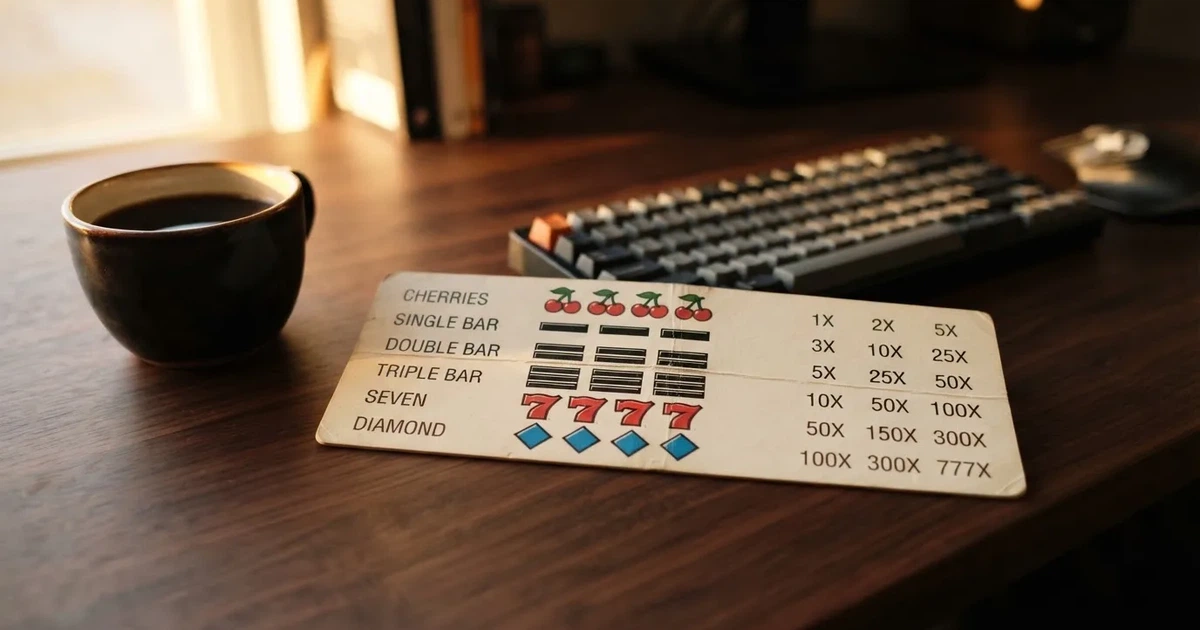
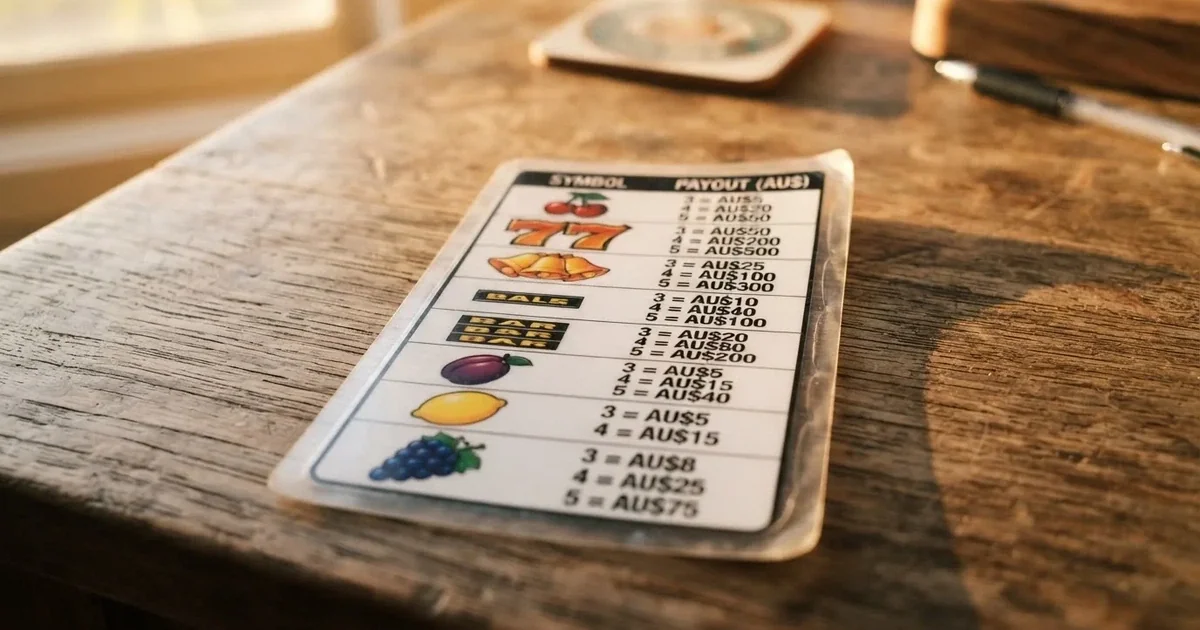
The paytable is where the format’s economics live, and a reader who has never read one reads a five-reel paytable the same way they would a three-reel version: a grid of symbols on the left, a value per combination on the right, a note on what activates a bonus round or a scatter pay. Two details that look cosmetic and aren’t: the listed payout is the maximum for the combination, not an average, and the listed return-to-player percentage is calculated over millions of spins, not the few hundred a session produces. A 96 percent RTP is a long-run average. In any given session it can be anywhere from zero to a screenful, and the house edge is the difference between the long-run average and 100 percent — the operator’s cut on every dollar cycled through the reels.
The Australian prohibition and the offshore workaround
The Interactive Gambling Act 2001, strengthened by the Interactive Gambling Amendment Act 2017, makes it an offence to provide online casino games, online pokies or in-play betting to a person in Australia. No state or territory issues a licence for them. What can be licensed is wagering on races and sport placed before the event, lotteries and keno — in practice licensed through the Northern Territory, where the Northern Territory Racing and Wagering Commission (NTRWC) regulates fifty-two of Australia’s online bookmakers (Sportsbet, Bet365, Ladbrokes among them), and the commission itself has no full-time staff and meets once a month in Darwin. The asymmetry is structural: the same regulator body that authorises Australia’s wagering industry cannot authorise a five-reel slot, because the IGA puts the game in the prohibited category by name.
The enforcement sits with the ACMA. Since November 2019, the regulator has asked Australian internet service providers to block illegal gambling and affiliate marketing websites, and the cumulative count reached 1,751 sites blocked in the round reported on 26 June 2026, with more than 230 unlicensed services leaving the Australian market since the 2017 amendment took effect. The most recent published round added twelve sites to the blocklist: 7Signs, ChromaBet, Donbet, Duospin, Freshbet, Slots Gem, Jacks Club, Lucky Start, Pointsbetz.com, Spinrise, Vinyl Casino and Wildsino. A separate figure, from H2 Gambling Capital’s 2025 report, estimates Australians lose around A$3.9 billion a year to illegal gambling sites, and that the share of gambling going through legal channels fell from 74 percent in 2021 to 64 percent.
The IGA targets the provider, not the player. An Australian who opens an account on an offshore site does not commit a criminal offence, but the offshore site gives them no Australian consumer protection, no complaints body, and no recourse if a withdrawal is refused. The site can be added to the blocklist with a balance still on the account, and the block takes effect at the internet service provider level, so the player loses access from inside Australia even if the site is still running elsewhere. Self-exclusion through BetStop, the National Self-Exclusion Register that went live in August 2023, binds only Australian-licensed online and phone wagering services; an offshore casino is not connected to it, and a player who wants the protection has to choose a wagering service to register against, which is not the game they came to exclude themselves from.
Two payment rules tighten the picture. Since 11 June 2024, credit cards, credit-related products and digital currency are banned as a payment method for licensed online wagering, with penalties up to A$247,500 for operators who take them. Legal deposit routes for a licensed wagering service are debit card, bank transfer, PayID/Osko and BPAY. A site that asks an Australian player for a credit card or a crypto deposit is operating outside the Australian regime, and the deposit itself is the point of friction that the law was rewritten to remove.
The 2026 reform sits one step ahead of this page. The Interactive Gambling Amendment (Gambling Reform) Bill 2026 passed Parliament on 19 August 2026; its advertising and inducement measures commence 1 January 2027. As of the date this page is checked, that reform is law with a start date, not a rule currently in force, and it does not change the prohibition that already covers the games this page is about. Tax is the one footnote that belongs here: gambling winnings of a recreational player are not assessable income (section 6-5 of the ITAA 1997), and losses are not deductible, unless the person carries on a business of gambling. That framing is a model rather than advice, and the ATO is the body to check with.
What the ACMA blocking rate actually means
The blocking-rate calculation asks a single question: how fast is the ACMA clearing the offshore market, given the resources it has? The inputs are the running total of blocked sites and the date of the first blocking request.
Since the first blocking request in November 2019, the ACMA has asked ISPs to block 1,751 illegal gambling and affiliate marketing websites by the round reported on 26 June 2026. That is roughly 81 months of action, which gives a published rate in the order of 21 to 22 sites per month on average across the whole period. The number conceals more than it shows. Early rounds were small; recent rounds have been larger and more frequent. The June 2026 round alone added twelve sites, and earlier rounds in the same year added comparable tranches. A reader who sees the cumulative figure should see it as a stock, not a flow: 1,751 is the count of addresses that have been taken off reach from inside Australia, and the addresses behind it have shifted over the period as services have been rebranded, repackaged and re-launched.
The same period has seen more than 230 unlicensed services leave the Australian market entirely since 2017. Leave is a softer outcome than block — a service can withdraw voluntarily, change its offering, or move its target market — and the ACMA counts both. The combined picture is that the regulator is removing roughly the equivalent of a small offshore operator’s full catalogue every week, and that the rate has accelerated rather than slowed in the years since the 2017 amendment. What the rate does not say is how many new services have entered in the same window, because the ACMA does not publish a matching count. The reader’s working assumption should be that the addressable offshore market has been pruned, not closed, and that the warning list below covers a fraction of the brands currently accepting Australian deposits.
Bonuses and free spins on a five-reel game — what the offer actually does
A “free spins” bonus on a five-reel slot is structured the same way as the bonus on any other online slot: a number of spins at a fixed stake on a named game, with winnings either paid as cash or credited as bonus money that must be turned over before it can be withdrawn. The marketing leans on the “free” word, and the contract lives in the conditions behind it. The conditions the player pays in are the wagering requirement, the maximum conversion, the game weighting, the time limit and the stake ceiling during the bonus. Each of them is a knob, and a typical offshore bonus turns several at once.
The wagering requirement is the multiplier on the bonus (or the bonus plus the deposit, depending on the structure) that has to be turned over before any of the bonus-derived winnings can be withdrawn. A 35x requirement on a A$100 bonus is A$3,500 of stake that has to pass through the games before the A$100 stops being a number on a balance page. Game weighting reduces the contribution of slot play toward that turnover (a common setting is 100 percent on slots, much less on table games), and the time limit is the deadline by which the turnover has to be completed — expiry wipes both the bonus and any winnings tied to it. The maximum conversion caps how much of the bonus-derived balance can actually be withdrawn, so a free-spins win that would have been a few hundred dollars in cash can become a smaller fixed amount once the cap is applied.
What that means in practice: the “free” label is a credit, not a gift. The offer is a way for the operator to put the player in front of a five-reel game with a balance the player cannot withdraw, and the conditions are designed to make sure the player plays long enough, on enough games, for the house edge to do its work before any payout leaves the site. A player who reads the bonus page as a chance to win is reading the wrong half of the contract. A player who reads it as a chance to spend a defined amount of money on a defined number of spins, against a defined house edge, is reading the right half.
This page describes bonuses as background reading only, on the same basis the legality section describes the offshore market: no Australian-licensed site offers a five-reel slot, no Australian-licensed site offers a five-reel bonus, and the only places that do both are the operators the ACMA has named in formal warnings. The bonus terms the operator publishes are not checked against an Australian consumer regime; they are the operator’s own contract, on an offshore site, against an Australian player.
Games, providers, and the offshore catalogue
The five-reel slot itself is not a brand — it is a layout, and the layout is licensed and reproduced by a long list of studio providers. In the Australian context, none of those studios has a presence in the local market in the sense the IGA recognises, and the names that appear in an offshore lobby are operating from Curaçao, Malta or other jurisdictions outside Australia’s regulatory perimeter. The relevant question for a player in Australia is not which studio made the game; it is whether the operator carrying the game holds an Australian licence, and the answer to that is no, for every operator carrying five-reel slots to Australians.
The land-based estate is a different story, and a reader who has only ever thought about slots as something to play in a pub should keep the two apart. Crown Melbourne’s table games — blackjack, baccarat, roulette — are approved by the Victorian Gambling and Casino Control Commission, the body that replaced the VCGLR on 1 July 2022, and Crown’s baccarat variants (Traditional Baccarat, Crown Baccarat, 2 to 1 Baccarat) sit on the regulator’s published approvals list. In NSW, section 66 of the Casino Control Act 1992 requires a casino operator to make a copy of the approved rules of any game available to patrons on request. Those rules apply inside the casino floor. They do not reach a five-reel slot running in a browser tab pointed at an offshore site.
A few points the data does carry on the offshore side. The ACMA has acted on operators running on Dama N.V. licences (Level Up, Woo, Spirit, and previously Bizzo via a TechSolutions umbrella), on Pulsup Ltd (RocketPlay), on Bamboo Media (Ignition), on Consolutetish S.R.L. (National, Bizzo), on EOD Code SRL (Instant Casino), on Ryker B.V. (Jackbit, CasinOK), on Sterplay Holding Ltd (Casino Intense), and on Hollycorn N.V. (Sky Crown, Blue Leo). The licence-holder named in a warning is not the brand the player sees in the lobby — the brand is the consumer-facing wrapper, the licence-holder is the company the ACMA names. A player who wants to know who they are actually depositing with reads the warning text, not the footer.
The point of this section is not to teach the reader the difference between a five-reel game and a five-reel video slot — that difference is a marketing distinction, and the relevant distinction is between an Australian-licensed product and an offshore one. The five-reel slot is the format; the offshore operator is the only place the format is offered to Australians online; and the ACMA’s published record is the public ledger of who has offered what, and when.
The ACMA’s named operators, and what each warning covers
The list below names the brands the ACMA has published formal warnings against, in the order the research file gives them. Each row carries the operator as published, the warning date, and the subject support flag the research assigns. No licence applies in Australia to any of them. No entry in this list is a recommendation to play.
RocketPlay
The ACMA issued a formal warning to Pulsup Ltd over Rocketplay.com.au in March 2026; Dama N.V. had earlier been warned over the same brand in May 2022. The brand presents itself under different corporate parents at different points in its life, and the ACMA’s published record shows the change of name on its own timeline. Subject support for any specific game category is not stated in the research, so the brand is described on its regulatory status only.
Verdict: a brand the regulator has warned twice under two different operators in four years; the second warning is the one that matters on a page dated 2026.
Level Up Casino
The ACMA’s May 2022 warning to Dama N.V. covered six brands — Bambet, Dazard, Level Up, Rocketplay, Wild Tornado and Cobra Casinos — under the same operator-level action. Subject support is reported by listings (Bgaming.com), which means the brand is described here only as those listings describe it and not as the operator’s own statement of fact.
Verdict: one of six brands swept into a single operator warning; the relevant fact for a player is that the operator behind the brand has been on the ACMA’s published list since 2022.
Woo Casino
The ACMA issued a further formal warning to Dama N.V. over Woo Casino in March 2025, two and a half years after the May 2022 action. Subject support is not given for this brand, and the page describes it on the warning record.
Verdict: a second touch on an operator the ACMA already named; the warning record is the only signal the regulator has chosen to publish.
Spirit Casino
The ACMA’s May 2025 warning to Dama N.V. covered Spirit Casino as a separate brand under the same operator. No subject support is reported, and the page leaves it at the published record.
Verdict: same operator as Woo, different brand wrapper, separate entry on the ACMA’s published list.
National Casino
The ACMA issued a formal warning to Consolutetish S.R.L. over National Casino in July 2025. Subject support is reported by listings (en.wikipedia.org). The brand is described as those listings describe it and not as a claim by the operator.
Verdict: a fresh operator entry in 2025, with a published warning that pre-dates this page by less than twelve months.
Bizzo Casino
The ACMA warned Consolutetish S.R.L. over Bizzo Casino in July 2025; the brand had already been the subject of a 2022 formal warning to TechSolutions (CY) Group Limited and TechSolutions Group N.V. Two operators, two warnings, the same brand wrapper. No subject support is reported.
Verdict: the only brand in this list with two ACMA warnings across two different operators, four years apart.
Ignition Casino
The ACMA’s July 2025 warning to Bamboo Media covered Ignition Casino. No subject support is reported, and the brand is described on the warning record only.
Verdict: a 2025 warning, the ACMA’s first published action against this operator.
Instant Casino
The ACMA issued a formal warning to EOD Code SRL over Instant Casino in February 2025. No subject support is reported, and the brand is described on the warning record only.
Verdict: the earliest 2025 warning in this set, and one of the cleaner single-operator, single-brand entries on the ACMA’s list.
Jackbit
The ACMA issued a formal warning to Ryker B.V. over Jackbit and CasinOK in April 2026. The warning covered two brands under one operator; only Jackbit appears in this ranking. No subject support is reported.
Verdict: a same-operator pair, of which one brand carries forward into this list.
Casino Intense
The ACMA issued a formal warning to Sterplay Holding Ltd over Casino Intense in April 2025. Subject support is reported by listings (Abc.net.au, acma.gov.au, Crownmelbourne.com.au), and the brand is described only as those listings describe it.
Verdict: a 2025 warning, with the page relying on listings rather than operator claims.
Sky Crown
The ACMA issued a formal warning to Hollycorn N.V. over Sky Crown and Blue Leo, published as a PDF in September 2022. No subject support is reported.
Verdict: the oldest warning in this list, and the one with the longest publication record.
Comparison of ACMA-named operators
The table below is built from the same facts the per-operator blocks above carry. Columns are: brand; the ACMA action and date; the operator the ACMA named; and the subject support flag from the research. Cells the research does not cover stay empty.
| Brand | ACMA action and date | Operator named by the ACMA | Subject support |
|---|---|---|---|
| RocketPlay | Formal warning, March 2026; earlier May 2022 | Pulsup Ltd (2026); Dama N.V. (2022) | — |
| Level Up Casino | Formal warning, May 2022 | Dama N.V. | listings-only |
| Woo Casino | Formal warning, March 2025 | Dama N.V. | — |
| Spirit Casino | Formal warning, May 2025 | Dama N.V. | — |
| National Casino | Formal warning, July 2025 | Consolutetish S.R.L. | listings-only |
| Bizzo Casino | Formal warning, July 2025; earlier 2022 | Consolutetish S.R.L. (2025); TechSolutions (2022) | — |
| Ignition Casino | Formal warning, July 2025 | Bamboo Media | — |
| Instant Casino | Formal warning, February 2025 | EOD Code SRL | — |
| Jackbit | Formal warning, April 2026 | Ryker B.V. | — |
| Casino Intense | Formal warning, April 2025 | Sterplay Holding Ltd | listings-only |
| Sky Crown | Formal warning, September 2022 | Hollycorn N.V. | — |
The shape the table reveals: the ACMA’s published record is dominated by Dama N.V., which carries four of the eleven brands (Level Up, Woo, Spirit, plus the 2022 RocketPlay) and is the operator behind the cluster that surfaces most often in 2025. TechSolutions and Consolutetish S.R.L. each appear on Bizzo at different dates, which means the brand has lived under two different corporate parents across two warnings. The remaining operators appear once. None of the warnings produces an Australian licence — the IGA does not let a warning be cured into one — and none of the brands is in a position to claim Australian regulation.
Responsible gambling, when play is the problem
If five-reel online slot play starts to feel compulsive or stressful — and for some readers of this page it will, because the operators named above are precisely the ones the page is about — free confidential help is available around the clock through Gambling Help Online (webchat) and the National Gambling Helpline on 1800 858 858. Both services are Australian, both are free, neither requires a name.
Self-exclusion sits in a different place for this market than for the licensed one. BetStop, the National Self-Exclusion Register, has been live since August 2023, but it binds only Australian-licensed online and phone wagering services. An offshore casino is not connected to it, so a player who self-excludes through BetStop has done the right thing for the licensed wagering market and not for the offshore casino market. Closing the offshore account at the operator end is the parallel step, and it is the operator’s own decision whether to honour it.
The age floor is eighteen for any gambling product in Australia. A site that does not check age at sign-up is operating outside the rule every licensed Australian operator follows. A player under eighteen who lands on one of the brands above has been failed by the operator and not by anything the player should have known to do. The free help line is the right first contact in that situation as well.
Frequently asked questions
What makes a five-reel slot different from a standard five-reel video slot?
A five-reel slot names the layout — five spinning columns of symbols. A “video” slot names the technology — a screen rather than a physical reel. Modern five-reel slots are almost always video slots, and the older distinction between a three-reel mechanical game and a five-reel video game has collapsed into a layout choice rather than a mechanic.
Can five-reel slot machines be found in licensed Australian pubs and clubs?
Yes, in licensed premises. Australian venues outside casinos run roughly 97,103 gaming machines as of 2010, and the count is in the same order of magnitude across NSW (87,298 in June 2023), Victoria (26,380 in 2021–22), Queensland (21,122 in October 2023), South Australia (11,672 in September 2023) and the ACT (3,587 in November 2023). The online version is not licensed in any state or territory.
Do five-reel slots typically pay out differently than newer five-reel formats?
The payout difference is in the math, not the reel count. A five-reel slot with fifty virtual stops per reel can offer odds against a top combination in the hundreds of millions to one; a three-reel slot with ten physical symbols per reel offers about a thousand combinations. Modern five-reel video slots are usually higher-variance than the older three-reel format because they fit more combinations onto the same screen.
Is a five-reel slot online the same game as a five-reel machine on a casino floor?
The reel layout is similar; the regulatory regime is not. A pub or club machine in Australia is governed by the state or territory regulator, has a published return-to-player figure, and pays out through an on-site cash desk. An online five-reel slot on an offshore site is governed by the operator’s own terms, has no Australian regulator checking the math, and pays out only at the operator’s discretion — and the site can be blocked with a balance on it.
Are five-reel slots for real money available legally from an Australian-based site?
No. The Interactive Gambling Act 2001, as amended in 2017, prohibits the supply of online casino games and online pokies to a person in Australia, and no state or territory issues a licence for them. Real-money five-reel online slots to Australians exist only on offshore sites outside the Australian regime.
Does a slot’s reel count change how its paytable and volatility are usually described?
Yes, in the sense that a longer reel set is usually paired with more symbols, more paylines and higher variance. The paytable is laid out the same way regardless of reel count — symbol on one axis, combination value on the other — but the volatility class on a five-reel video slot is usually higher than on a three-reel mechanical slot because the larger combinations space produces rarer large wins.
Prepared by the Casino Offshore Hub editorial staff.