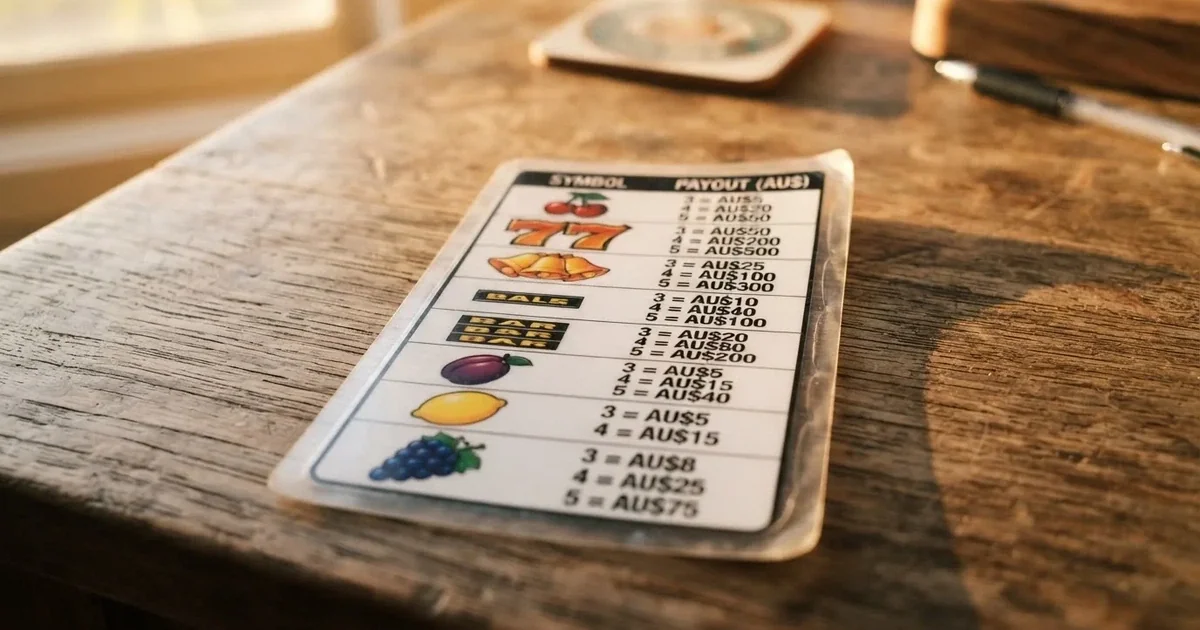
7 reel slots in Australia: a format readers search for, in a market where it is prohibited
 Available in US
A seven-reel slot is the kind of thing people ask about because they remember it from somewhere, or because they have just seen it listed on a site that the Australian Communications and Media Authority has spent the last few years trying to block. That second fact is the one that matters here. No online casino game of any reel count is licensed for real-money play anywhere in Australia, and a 7-reel variant is no exception. The Interactive Gambling Act 2001 treats it the same as a five-reel or a three-reel pokie: as a prohibited interactive gambling service.
This page explains the 7-reel format on its own terms, then sets out what a reader who follows the offshore sites offering it is actually choosing. The cost is not the bonus advertised on the landing page. It is the absence of Australian consumer protection, the absence of a working complaints body, the chance that the site itself is blocked while a balance sits on it, and the chance that a payment route the site asks for is the one Australian law specifically bars for licensed wagering. None of that is hidden in fine print. It is just what the search leads to, and a reader deserves to know it before the marketing reaches them.
Data current as of 24 September 2026, checked against the ACMA register and current Australian licensing arrangements.
Table of Contents
- Why a 7-reel slot exists at all
- What Australian law actually says
- How the ACMA enforces this
- The cost a reader actually pays
- Bonuses and free spins: what the offer actually is
- The 7-reel format compared with what people usually play
- What the ACMA’s enforcement list actually looks like
- A blocking-rate calculation, in plain prose
- What a reader comparing these brands is actually choosing
- Reading the offshore marketing on its own terms
- Responsible gambling and the boundaries that hold
- Tax position on winnings, briefly
- The shape of the decision
- Frequently asked questions
Why a 7-reel slot exists at all
Charles Fey built the first automatic slot mechanism in San Francisco in the late nineteenth century: three reels, five symbols per reel — horseshoes, diamonds, spades, hearts and the Liberty Bell — with three bells across the payline paying the top prize of ten nickels. That machine defined the format for decades. Bally’s “Money Honey” of 1963 added a bottomless hopper so a machine could pay up to 500 coins without an attendant, removing the human link in the payout chain. The first true video slot, developed by Fortune Coin Co. in Kearny Mesa, California in 1976, freed the format from physical reels and opened the door to anything a screen could draw.

The result is a category that has grown almost without a ceiling. A modern video slot can carry five reels or more, with fifty or more symbols on a single reel, and the odds against the top combination can run as high as three hundred million to one. A classic three-reel mechanical machine with about ten symbols per reel offered roughly one thousand possible combinations; a five-reel video slot with fifty symbols per reel offers combinations in the tens of billions. A seven-reel slot sits between those two poles. The reel count is unusual but not exotic, and a handful of developers ship variants in this layout.
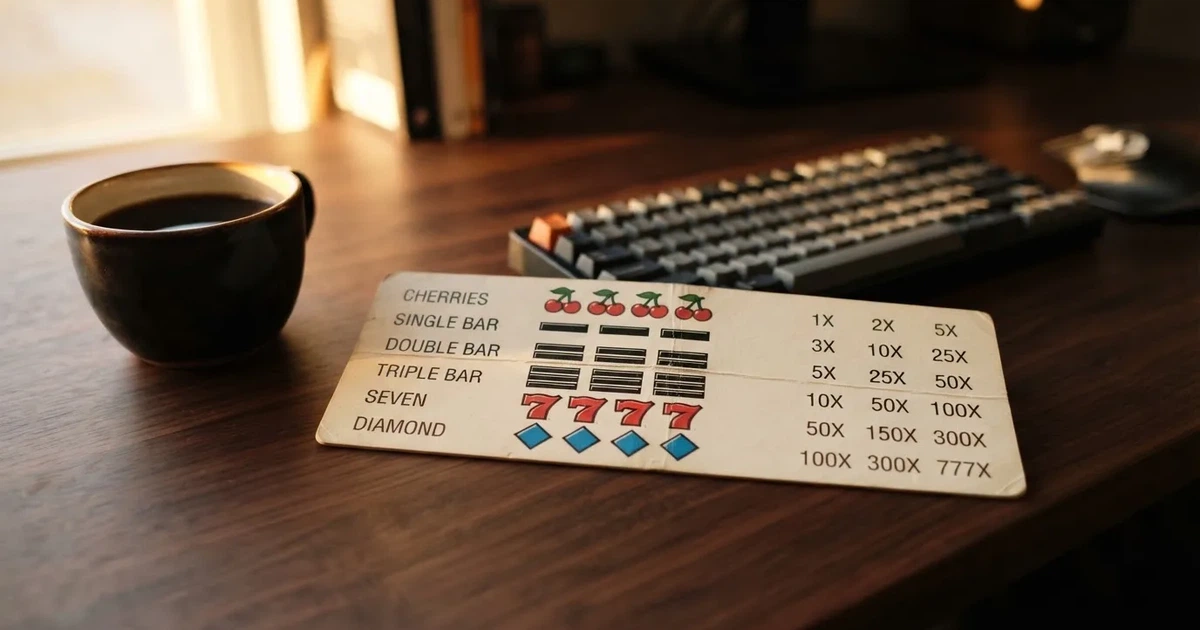
What a 7-reel format does mechanically is straightforward: more reels, more symbol positions, more possible symbol combinations per spin, and a wider spread between the most common small win and the rarest large one. The paytable — the printed or on-screen chart showing what each symbol combination pays — has to be read against that wider spread. A reader who has only played three-reel or five-reel machines should expect the odds against the top combination to be longer than they are used to, and the small wins along the way to be smaller. That is the mechanical cost of the extra reels, before any house edge is considered.
What Australian law actually says
The Interactive Gambling Act 2001, as tightened by the Interactive Gambling Amendment Act 2017, makes it an offence to provide online casino games, online pokies or in-play betting to a person physically in Australia. No state or territory issues a licence for those products. What is licensable is wagering on racing and sport placed before the event, lotteries and keno — in practice licensed by the Northern Territory, through a body called the Northern Territory Racing and Wagering Commission, which the ABC has described as a regulator with no full-time staff that meets once a month in Darwin. That same body oversees fifty-two of Australia’s online bookmakers, including Sportsbet, Bet365 and Ladbrokes.

The IGA targets the provider, not the individual player. An Australian who logs on to an offshore casino is not personally at risk of prosecution. But the offshore operator gives the player none of the things an Australian licence implies: no dispute resolution, no working complaints body, no recourse if a withdrawal is refused, and no guarantee the site will still be reachable next week. The minimum age for any gambling product in Australia is eighteen.
The Interactive Gambling Amendment (Gambling Reform) Bill 2026 passed Parliament on 19 August 2026. Its advertising and inducement measures commence 1 January 2027. The bill is now law with a start date, not yet in force on a 2026 page.
How the ACMA enforces this
The ACMA investigates, issues formal warnings, and directs Australian internet service providers to block illegal sites. According to the ACMA as reported in June 2026, a total of 1,751 illegal gambling and affiliate marketing websites have been blocked since the first blocking request in November 2019. More than 230 unlicensed gambling services have left the Australian market since enforcement was strengthened in 2017.
The blocking is incremental, not a single event. In a single round reported on 26 June 2026, the ACMA asked Australian ISPs to block twelve more sites in one batch: 7Signs, ChromaBet, Donbet, Duospin, Freshbet, Slots Gem, Jacks Club, Lucky Start, Pointsbetz, Spinrise, Vinyl Casino and Wildsino. A blocked site can come back through a new domain or a new operator shell. The total rises because new sites appear as quickly as old ones are blocked.
What this means for a reader is practical: a balance on an offshore site is not a balance in a safe. If the ACMA acts against the site while a withdrawal is pending, the site can become unreachable from an Australian connection. There is no Australian complaints body to write to. The player bears that risk entirely.
The cost a reader actually pays
There are three layers to the cost of chasing an offshore 7-reel site in Australia. None of them appear on the landing page.
The first is the legal layer. No Australian consumer protection applies. If a withdrawal is refused, the account is closed, or the bonus terms are rewritten mid-play, the reader has no Australian body to complain to. Offshore licensing the site advertises — typically Curaçao, occasionally Anjouan, occasionally Malta — is real, in the sense that those jurisdictions exist. It is also not equivalent to an Australian licence. The complaints processes those licences offer are not designed for an Australian reader, and they are not fast.
The second is the payments layer. Credit cards, credit-related products and digital currency have been banned as payment for licensed online wagering in Australia since 11 June 2024, with penalties of up to A$247,500 for operators. The legal deposit routes for licensed wagering are debit card, bank transfer, PayID/Osko and BPAY. A site that asks an Australian reader for a credit card or a crypto deposit is, by definition, not operating under the Australian rules, because no licensed Australian operator accepts either route for wagering. Paying through crypto on an offshore casino means no chargeback path, no bank intermediary, and no record the Australian bank will help recover.
The third is the access layer. A site the ACMA has acted against can be blocked at the ISP level. A reader who has deposited on a site one week can find it unreachable the next. There is no automatic refund mechanism for a blocked site. The site can reappear under a new name, often run by the same operator. This is the shape of the offshore market, and it is what the ACMA’s blocking total — 1,751 sites since November 2019 — describes.
A reader who weighs only the advertised bonus is not weighing the real cost. The real cost is the absence of the protections an Australian licence implies.
Bonuses and free spins: what the offer actually is
The marketing language on an offshore casino landing page is built around a “welcome package” — a multi-deposit bonus, free spins on a named slot, and a “VIP” tier that promises cashback. None of that is delivered in the form the marketing suggests.
A welcome bonus is a percentage match on a deposit, with a wagering multiple attached. A 100% match up to A$500 with a 40x wagering multiple means a player who deposits A$500 receives a A$500 bonus that must be wagered 40 times — A$20,000 of turnover — before any of it can be withdrawn. The wagering is almost always restricted to a small list of approved games, with 7-reel titles either excluded or contributing at a reduced rate. Free spins are credited at a fixed coin value, often the minimum stake, and the winnings carry their own wagering multiple, frequently higher than the deposit bonus multiple.
“Free” is not free. The bonus is paid for twice: once by the wagering time it locks up, and once by the games it restricts the player to during that time. A reader who values time should value this; a reader who values variety should value it more. The math is on the page when the math is on the page; the math is hidden when it isn’t.
Where research carries no exact figure for a particular brand’s multiple or game list, the qualitative point still holds: any multi-deposit welcome package on an offshore site carries a wagering multiple, a game restriction list, and a maximum withdrawal cap that varies by promotion. A reader who reads only the headline number is reading the marketing. A reader who reads the terms is reading the offer.
The 7-reel format compared with what people usually play
The bulk of the Australian market, on the legal side, plays pokies — slot machines outside casinos. New South Wales recorded 87,298 of them in June 2023, Victoria 26,380 in 2021–22, Queensland 21,122 in October 2023, South Australia 11,672 in September 2023 and the ACT 3,587 in November 2023. New South Wales legalised slot machines in 1956, and by 2010 Australia operated an estimated 97,103 gaming machines outside casinos — a per-capita rate about five times that of the United States.
Those machines are predominantly five-reel video pokies. The 7-reel format is closer in feel to the older mechanical three-reel format than to a modern video pokie, in one specific way: the odds against the top combination are longer than a five-reel video slot with fifty symbols per reel can produce, but the spin cadence is faster, because the extra reels do not slow the spin. The player sees more symbols change per spin. The paytable is denser. The base-game small wins arrive more often. The top combination arrives less often.
A reader who plays a 7-reel machine is not playing a “looser” or “tighter” machine than a five-reel player. They are playing a machine with a different distribution of wins: more small, fewer large. That is not a value judgement. It is a mechanical fact. Whether it suits the reader’s bankroll and patience depends on the reader.
US state regulation sets minimum payout percentages for slot machines that vary by jurisdiction: Nevada requires at least 75%, Mississippi at least 80%, and New Jersey at least 83%. No comparable minimum applies to an offshore online slot offered to an Australian reader. The payout percentage is whatever the developer ships.
What the ACMA’s enforcement list actually looks like
Eleven brands appear in the ACMA’s published enforcement action relevant to a reader searching for offshore online slots. They are not a ranked list. They are not a recommendation. They appear here because the ACMA has issued a formal warning over each of them for offering prohibited interactive gambling services to people in Australia. None of them is licensed to offer online casino games to an Australian reader, regardless of any licence they display on their own site.
| Brand | ACMA action and date | Operator named by the ACMA | Subject support (7-reel format) |
|---|---|---|---|
| RocketPlay | Formal warning, March 2026; earlier warning to a related operator, May 2022 | Pulsup Ltd (Rocketplay); Dama N.V. (May 2022) | — |
| Level Up Casino | Formal warning, May 2022 | Dama N.V. | listings-only (BGaming) |
| Woo Casino | Formal warning, March 2025 | Dama N.V. | — |
| Spirit Casino | Formal warning, May 2025 | Dama N.V. | — |
| National Casino | Formal warning, July 2025 | Consolutetish S.R.L. | listings-only (en.wikipedia.org) |
| Bizzo Casino | Formal warning, July 2025; earlier warning, 2022 | Consolutetish S.R.L. (July 2025); TechSolutions Group (2022) | — |
| Ignition Casino | Formal warning, July 2025 | Bamboo Media | — |
| Instant Casino | Formal warning, February 2025 | EOD Code SRL | — |
| Jackbit | Formal warning, April 2026 | Ryker B.V. (also CasinOK) | — |
| Casino Intense | Formal warning, April 2025 | Sterplay Holding Ltd | listings-only (ABC.net.au, ACMA.gov.au, Crown Melbourne) |
| Sky Crown | Formal warning, September 2022 | Hollycorn N.V. (also Blue Leo) | — |
Three of the brands — Level Up, National Casino and Casino Intense — appear in third-party listings that reference a 7-reel or similar extended-reel slot. That is what those listings report. It is not a confirmation that any of them offers a fully featured 7-reel format at the level a reader searching for this format would expect. For the remaining eight, no source in research supports a 7-reel offering. They are presented here on the ACMA action alone.
The pattern in the table is what an enforcement register looks like over five years. The same operator shell — Dama N.V. — appears four times across the table under different brand names, in 2022 and again in 2025. Consolutetish S.R.L. appears twice in the same month. Hollycorn N.V. appears once. Ryker B.V. appears once with two brand names. The repetition is not coincidence. It is the same kind of rebrand-and-relaunch cycle the ACMA’s blocking round in June 2026 was designed to disrupt: twelve new domains, all named in one batch.
A blocking-rate calculation, in plain prose
The ACMA’s blocking register is the cleanest measure of enforcement activity. The first blocking request went out in November 2019, and the cumulative total reached 1,751 blocked sites and affiliate pages by the count reported in June 2026. That is roughly six and a half years of enforcement. Divided across the period, the running rate sits in the band of around 260 to 270 blocked sites per year on average. The band is wider in the early years and narrower later, because the volume rose after the 2017 amendments and stabilised as the ACMA settled into the steady enforcement tempo of monthly batches.
The rate is a measure of how much offshore supply the ACMA is clearing, not how much is being created. The blocking total stops rising only when new sites stop appearing, and the June 2026 batch — twelve sites in one round — suggests new supply continues to arrive. A reader should treat the figure as a flow rate, not a stock. The number that matters is not how many have been blocked, but how many more are being added each round.
What a reader comparing these brands is actually choosing
The eleven brands in the table differ in name and operator shell. They do not differ in the fundamental fact that determines whether an Australian reader should engage with any of them: none is licensed for the product being offered. The choice between them is not a choice between good and bad. It is a choice between operators that have been formally warned at different times, by different names, under different shells.
A reader who reads the table as a recommendation is misreading the table. A reader who reads it as a register of who has been warned, when, and by whom is reading it correctly. The ACMA’s action is the most authoritative Australian public statement that each brand has offered a prohibited service. It is not a guarantee the brand still offers it, nor a guarantee the brand will be blocked. It is what it is: a published warning, dated, naming the operator behind the brand.
A handful of these brands have appeared under multiple operator names across multiple years. RocketPlay was warned under Dama N.V. in May 2022 and again under Pulsup Ltd in March 2026. Bizzo Casino was warned under TechSolutions in 2022 and under Consolutetish S.R.L. in 2025. The rebranding is not invisible to the ACMA; it is just the normal lifecycle of an offshore operation. A reader who picks a brand on the assumption that a 2022 warning has been resolved should look at whether the same operator shell has been named again.
Reading the offshore marketing on its own terms
A landing page for an offshore casino says several things at once, and the reader who treats them as a single offer is the reader who loses most. They say: the bonus. They say: the games. They say: the licence. They say: the payments. Each of those says something different, and each has a different shelf life.
The bonus has a wagering multiple, a game list, and a maximum withdrawal. It is good for as long as the wagering is unfinished; it expires if the player does not clear it within the time window.
The games are the games the site has shipped this month. A 7-reel slot on the games page today can be removed next month. The site is under no obligation to keep any title available.
The licence is whatever offshore jurisdiction the site displays — usually Curaçao, occasionally Anjouan, occasionally Malta. It is a real licence in the sense the regulator exists. It is not an Australian licence. The complaints process that licence offers is not designed for an Australian reader, and it is not fast.
The payments are whatever the cashier accepts. If the cashier accepts credit cards or crypto, the site is asking for a payment method Australian law specifically excludes from licensed wagering. That is a signal about the site’s regulatory position, not a marketing choice.
A reader who reads each of those four separately is reading the offer. A reader who reads them as a single thing is reading the marketing.
Responsible gambling and the boundaries that hold
If thinking about any of this starts to feel compulsive or stressful, free confidential help is available around the clock. Gambling Help Online runs a chat service and a national helpline on 1800 858 858, free and 24/7. BetStop, the National Self-Exclusion Register, has been live since August 2023. BetStop binds Australian-licensed online and phone wagering services. An offshore casino is not connected to it, and a BetStop registration does not block an offshore site. It is, however, the strongest single tool an Australian reader has for limiting access to the legal side of the market, and it is the right starting point for anyone whose gambling has moved from entertainment into something else.
The helpline, the chat service and the self-exclusion register are the three pieces of the Australian framework that work regardless of what a reader is tempted by online. They are worth contacting before the temptation reaches the cashier.
Tax position on winnings, briefly
Gambling winnings of a recreational player are not assessable income under section 6-5 of the ITAA 1997, and losses are not deductible, unless the person carries on a business of gambling. That is the ATO model. A reader with a specific question about their own position should check with the ATO directly — the rule is general and the application is fact-specific. The point here is that the tax treatment does not depend on whether the site is licensed; it depends on whether the activity amounts to a business.
The shape of the decision
A reader who has reached this page has done one of two things: searched for a 7-reel slot and found offshore sites at the top of the results, or searched for one and found this page instead. The first reader is the one the ACMA’s enforcement register is built for. The second reader is the one this page is written for.
The mechanical facts of the 7-reel format — more reels, more symbols, longer odds against the top combination, more frequent small wins — are real and worth knowing. The legal fact that no online casino game of any reel count is licensed for an Australian reader is the fact that determines whether playing one for real money is a sensible choice. The cost of that choice, where it lands, is in the absence of consumer protection, the absence of a complaints body, the absence of any guarantee the site will still be reachable next week, and the chance the cashier is asking for a payment Australian law has specifically excluded from licensed wagering.
A reader who decides the offer is worth taking despite all that has decided it with eyes open. A reader who decides the offer is not worth taking has decided the obvious thing. Either way, the decision is the reader’s. The job of a page like this is to make sure the cost is on the table before the deposit button is.
Frequently asked questions
What makes a 7-reel slot different from a standard five-reel video slot?
The reel count itself. A five-reel slot typically carries around fifty symbols per reel in a modern video build, producing combinations in the tens of billions. A 7-reel slot has two extra reels, so the symbol grid is wider, the odds against the top combination are longer, and small wins arrive more often than the rare big one. The mechanical feel is closer to a fast three-reel machine than to a slow five-reel video pokie.
Can 7-reel slot machines be found in licensed Australian pubs and clubs?
No. Australian pubs and clubs operate pokies under state and territory regimes — 87,298 machines in NSW alone as of June 2023 — and those machines are predominantly five-reel video pokies. The 7-reel format is not a standard licensed-pub product in Australia; it appears mainly on offshore sites, none of which is licensed to offer online casino games to Australians.
Do 7-reel slots typically pay out differently than newer five-reel formats?
The payout distribution differs: a 7-reel slot pays smaller wins more often and a top combination less often than a five-reel slot with many symbols per reel. The long-run house edge depends on the specific game’s RTP, which is set by the developer and varies title by title. There is no general rule that one reel count is “looser” than another.
Is a 7-reel slot online the same game as a 7-reel machine on a casino floor?
Often not. A physical 7-reel machine, where one exists, is a mechanical or hybrid device with a fixed symbol set per reel. An online 7-reel slot is a software build that may share a name with a physical machine but is almost always a separate game with its own paytable, RTP and bonus structure. Treating the two as the same product is a mistake.
Are 7-reel slots for real money available legally from an Australian-based site?
No. Online casino games and online pokies cannot be licensed anywhere in Australia under the Interactive Gambling Act 2001. Any Australian-facing site offering a 7-reel slot for real money is operating outside Australian law, regardless of any offshore licence it displays. The player is not prosecuted, but the player has no Australian consumer protection.
Is reel count still a useful way to compare volatility between older and newer slots?
Partly. Reel count sets the maximum possible combinations, which sets an upper bound on how long the odds against the top prize can be. Modern video slots have widened the symbol range per reel so much that reel count alone no longer captures the volatility picture. Two five-reel slots with different symbol counts can have wildly different top-combination odds. Reel count is a starting point, not a verdict.
Published by the Casino Offshore Hub team.