
Highest RTP Pokies Australia: What the Paytable Number Buys You
A “high RTP pokies” page written for Australia is, on closer reading, two pages forced to share one URL. The first is a technical question about what return-to-player actually means on a licensed Australian machine, which states set which floor, and which titles sit closest to the ceiling. The second is a jurisdictional one: online casino products — including online pokies — cannot be licensed for Australian customers under the Interactive Gambling Act 2001, so every offshore site advertising a 98% return is doing so from outside the reach of any Australian regulator. This page works through both. The first matters when a player walks up to a machine in a NSW pub or a Melbourne casino; the second matters when the same player opens a browser and types a search like the one that brought them here.
Data current as of 8 November 2026, verified against the Australian Communications and Media Authority’s published register of formal warnings and blocking actions.
Table of Contents
- What “High RTP” Means on a Pokies Machine
- State-by-State Variation in the Machine Stock
- Where the Paytable Figure Actually Sits
- The Prohibition That Frames the Online Side
- The Offshore Landscape the ACMA Has Acted On
- How Fast the Blocking List Has Grown
- The Narrow Set of Products a Reader Can Verify
- Smaller Wins, More Often, or Bigger Wins, Less Often
- Onshore Numbers a Reader Can Read Against
- Responsible Gambling: What BetStop and the Helpline Cover
- The Choice a Reader Is Actually Making
- Frequently Asked Questions
What “High RTP” Means on a Pokies Machine
Return-to-player is a long-run statistical figure: the share of every dollar a machine takes in that it is mathematically expected to return to players across millions of spins. A 90% RTP machine keeps, on average, ten cents in the dollar. A 98% machine keeps two. The difference looks small on paper; compounded across a session, it is the single largest variable a player can move on the machine side.

The figure is set by the manufacturer and approved by the state regulator before a machine can be placed on a venue floor. It is not a marketing promise from the venue. It is not a guarantee on any single visit. It is a parameter, audited and disclosed, that the game runs to across its installed life.
Onshore, the floor sits where each state’s regulator put it. The minimum return-to-player for poker machines is 85% in New South Wales, the Northern Territory, Queensland, and generally in Victoria — 87% at Crown Melbourne — 87% in the Australian Capital Territory and Tasmania, 87.5% in South Australia, and 90% in Western Australia. Those are minimums. A pub in Sydney may carry a 90% machine on top of its 85% floor; Crown Perth, the only venue in WA where pokies are legal at all, runs machines approved by the state’s Gaming and Wagering Commission on a 90% baseline. Above the floor, the choice of game and denomination is what decides what the paytable actually returns.
State-by-State Variation in the Machine Stock
The number of machines a reader can find depends on which state they are standing in. New South Wales, the largest market, had 87,298 gaming machines outside casinos across 2,195 venues in June 2023, with player losses of A$8.18 billion in 2022-23. Queensland had 21,122 machines operating in 351 venues as of October 2023. Victoria had 26,380 outside Crown Casino in 488 venues in 2021-22, sitting under a statewide cap of 30,000. Tasmania ended Federal Group’s monopoly over poker machines in November 2021 and moved oversight to the Tasmanian Liquor and Gaming Commission, with mandatory pre-commitment cards scheduled for late 2025. Western Australia remains the outlier: poker machines were banned in pubs and clubs when Crown Perth opened in 1985, and Crown Perth’s machine count has since grown from about 200 in 1985 to roughly 2,500 — every one approved by the state.
| State or territory | Machines outside casinos | Approx. venue count | Statutory RTP minimum | Notes |
|---|---|---|---|---|
| New South Wales | 87,298 | 2,195 | 85% | Largest machine stock by far |
| Victoria | 26,380 | 488 | 85% (87% at Crown Melbourne) | Hard cap of 30,000 statewide |
| Queensland | 21,122 | 351 | 85% | — |
| Western Australia | 0 (outside Crown Perth) | 0 | 90% at Crown Perth | Only casino venue in the state |
| Tasmania | — | — | 87% | Federal Group monopoly ended November 2021 |
| ACT | — | — | 87% | — |
| South Australia | — | — | 87.5% | — |
| Northern Territory | — | — | 85% | Hosts 52 online bookmakers under NTRWC licences for tax reasons |
The variation matters because a “high RTP” machine in Perth is running at the legal ceiling, while a “high RTP” machine in Sydney is simply one with a settings profile above a lower floor. The paytable does not advertise which ceiling or floor sits underneath it. A player who wants to read the figure has to find it on the help screen of the machine itself, or ask the venue.
Where the Paytable Figure Actually Sits
Australian regulators do not require the RTP to be printed on the front of the cabinet. The requirement is disclosure on the game’s help or info screen, accessed through a button combination the venue can show a player on request. Crown Melbourne, for instance, lists baccarat variants as approved table games under section 66 of the NSW Casino Control Act 1992 — and the operator must, on request, hand a patron a copy of the approved rules. The principle is the same in pokie jurisdictions: the figure exists, it has been audited, and a player who asks can see it.
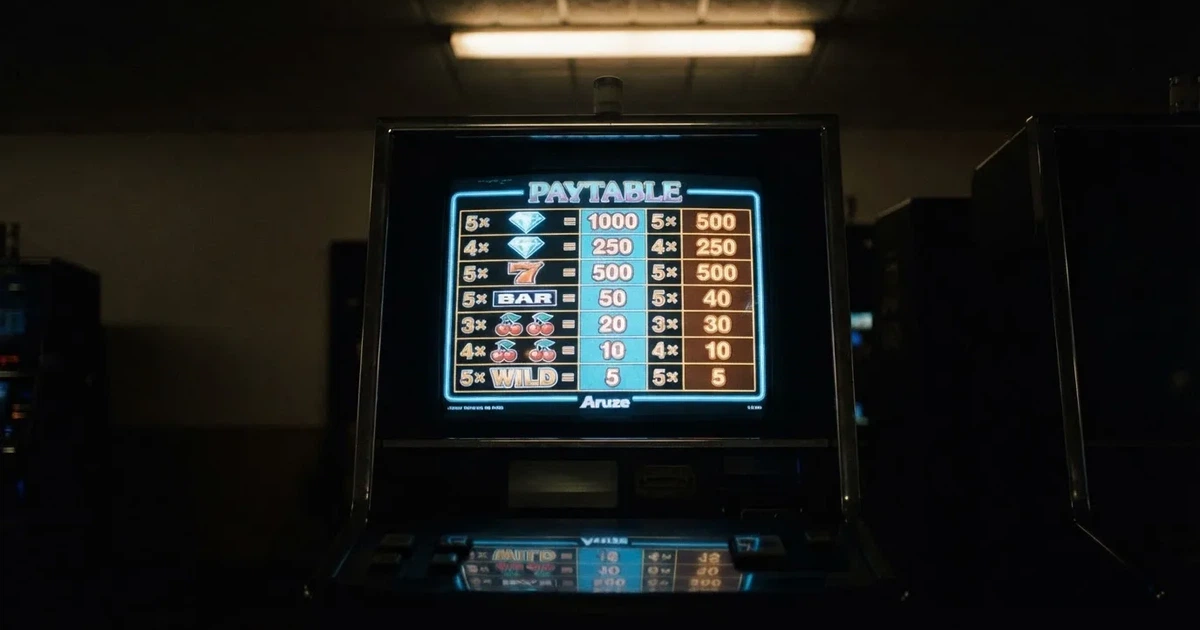
That detail is the seam between a regulated machine and an offshore online pokie. The onshore machine carries a printed paytable, a regulator-tracked settings profile, and a venue that has signed an operator licence. The offshore site carries a logo, a return figure it has self-published, and no Australian licence behind it. Both pages of this article describe the same search.
The Prohibition That Frames the Online Side
Online pokies cannot be licensed for Australian customers. The Interactive Gambling Act 2001, tightened by the Interactive Gambling Amendment Act 2017, makes it an offence to provide online casino games, online pokies or in-play betting to a person in Australia; no state or territory licenses them. What is licensable is wagering on races and sport placed before the event, lotteries and keno — and in practice that wagering is licensed by the Northern Territory, where 52 online bookmakers including Sportsbet, Bet365 and Ladbrokes hold NTRWC licences for tax reasons. A casino licence is not among them.
The minimum age for any legal gambling product in Australia is 18. Credit cards, credit-related products and digital currency have been banned as payment for licensed online wagering since 11 June 2024, with penalties up to A$247,500 for operators. The legal deposit routes for licensed wagering are debit card, bank transfer, PayID/Osko and BPAY. A site asking an Australian player for a credit card or a crypto deposit is running outside the Australian framework — and if it is also offering online pokies, it is also running outside the IGA.
This is the line the rest of the page is built on. The onshore machines in the table above are the legal high-RTP pokies in Australia. Everything offered under a “best RTP pokies Australia 2026” banner online sits on the other side of that line.
The Offshore Landscape the ACMA Has Acted On
The ACMA does not produce a comparison of offshore casinos. It produces, instead, a list of formal warnings and a running count of blocked sites, and that list is the closest the regulator comes to a public map of the offshore market Australians encounter. The June 2026 round asked Australian internet providers to block 12 more websites: 7Signs, ChromaBet, Donbet, Duospin, Freshbet, Slots Gem, Jacks Club, Lucky Start, Pointsbetz, Spinrise, Vinyl Casino and Wildsino. Branded by affiliates, run by different parent companies — and every one operating under the same structural defect, that no licence in Australia covers what they offer.
What that list, taken with the formal-warning register, looks like in one view:
| Brand | ACMA action and date | Operator named by the ACMA | Subject support |
|---|---|---|---|
| RocketPlay | Formal warning, March 2026; earlier Dama N.V. action, May 2022 | Pulsup Ltd | — |
| Level Up Casino | Formal warning, May 2022 | Dama N.V. | Pokies titles listed in BGaming’s catalogue (BGaming publisher page) |
| Woo Casino | Formal warning, March 2025 | Dama N.V. | — |
| Spirit Casino | Formal warning, May 2025 | Dama N.V. | — |
| National Casino | Formal warning, July 2025 | Consolutetish S.R.L. | Pokies titles listed in Wikipedia entry |
| Bizzo Casino | Formal warning, July 2025; earlier TechSolutions action, 2022 | Consolutetish S.R.L. | — |
| Ignition Casino | Formal warning, July 2025 | Bamboo Media | — |
| Instant Casino | Formal warning, February 2025 | EOD Code SRL | — |
| Jackbit | Formal warning, April 2026 | Ryker B.V. | — |
| Casino Intense | Formal warning, April 2025 | Sterplay Holding Ltd | Listed as approved operator in Australian media and ACMA context |
| Sky Crown | Formal warning, September 2022 | Hollycorn N.V. | — |
The “subject support” column is what each operator’s own marketing or a third-party listing site claims about its high-RTP pokie content. For most of the brands above that column is empty, because the only descriptions of their pokies libraries sit on affiliate marketing pages — sources whose interest is a click-through, not a figure a reader can verify. The two entries with publisher-page or Wikipedia coverage (Level Up Casino and National Casino) reflect what those listing pages state about the catalogue, not what an Australian regulator has assessed.
The single thing the column does not show is that all eleven brands share the same status: no Australian licence covers what they offer. A formal warning is a regulatory finding that an operator has been providing prohibited interactive gambling services to Australians. The ACMA’s next step, where the warning is not heeded, is to direct Australian ISPs to block the site.
How Fast the Blocking List Has Grown
The arithmetic behind the ACMA’s running count is the most concrete figure this page can offer on the offshore market’s scale. As reported in June 2026, a total of 1,751 illegal gambling and affiliate marketing websites had been blocked since the first blocking request in November 2019, and more than 230 unlicensed gambling services had left the Australian market since enforcement was strengthened in 2017. From the November 2019 first-blocking request to the June 2026 figure is roughly 79 months — a blocking rate that sits in a band of roughly 22 new sites blocked per month on average, with the actual monthly figure varying widely as the ACMA issues blocking orders in batches. H2 Gambling Capital’s 2025 estimate puts Australian losses to illegal gambling sites at about A$3.9 billion a year, with the share of gambling going through legal channels falling from 74% in 2021 to 64%.
The band — about 22 sites per month, averaged — is the right way to read this. Some months the regulator publishes no new blocks; some months, like the June 2026 round, it publishes twelve in one direction. The annualised figure smooths over both, which is exactly what an average is for.
What an ACMA Formal Warning Actually Does
A formal warning is not a fine and not a prosecution. It is a published notice that the regulator has found an operator offering prohibited services to Australians, and that further enforcement action will follow if the operator does not stop. The published notices name the parent company — Dama N.V., Hollycorn N.V., Ryker B.V., Bamboo Media, and so on — rather than the front-end brand, which is why a single parent can sit behind a stack of warnings that name different sites. Dama N.V. alone has carried warnings for Bambet, Dazard, Level Up, Rocketplay, Wild Tornado and Cobra Casinos in May 2022, then Woo Casino in March 2025, then Spirit Casino in May 2025 — three years of repeated findings against the same operator under different brand names.
The warning is what an Australian customer of those sites would not have seen, because the sites themselves do not publish it. The ACMA’s register is the only place these findings sit in one list.
What an Offshore Site Cannot Do for an Australian Customer
The IGA targets the provider, not the individual player. An Australian who opens an account with one of the offshore brands above does not face prosecution. What the player does face is the absence of every protection onshore customers take for granted: no Australian complaints body, no recourse if a withdrawal is refused, no requirement that the operator hold player funds in trust, no connection to BetStop (the National Self-Exclusion Register, live since August 2023, binds only Australian-licensed online and phone wagering services), and the standing risk that the site will be on the next blocking list with a balance still attached.
The reason offshore “high RTP” figures cannot be checked against an Australian register is that the register does not exist for offshore sites. The figure on the paytable is published by the operator, on the operator’s site, for marketing purposes. The physical cabinet on the floor of a NSW club is the only place an RTP figure sits inside an audited framework an Australian can read against.
The Narrow Set of Products a Reader Can Verify
What a player can verify, walking into a regulated venue, is the machine’s help screen and the venue’s licence. A machine in a NSW pub carries an 85% statutory floor; a machine at Crown Perth runs against a 90% floor; Crown Melbourne’s baccarat variants sit on rules approved by the Victorian Gambling and Casino Control Commission, which replaced the VCGLR as the state’s casino regulator on 1 July 2022. Each of those figures is auditable. The figure on an offshore “98% RTP” page is not.
For games other than pokies, the audit-able analogues are different in kind but similar in regulatory shape. Baccarat, played against the house, carries a house edge of 1.06% on the Banker bet, 1.24% on the Player bet and 14.36% on the Tie — figures set by the game’s drawing rules and confirmed in third-party analysis. Blackjack under optimal strategy runs at about 0.28% under liberal Las Vegas Strip rules (dealer stands on soft 17, double on any two cards, double after split, resplit aces, late surrender) and about 0.43% under Atlantic City rules. Those numbers are stable across venues because they describe the game, not the marketing. A licensed Australian casino running baccarat or blackjack sits inside that frame; an offshore site running the same-named game sits outside it.
The reason this matters for the “highest RTP pokies” question is that the highest return a player can verify is, by definition, the highest return that has been approved by a regulator with jurisdiction over the operator. Every figure above that ceiling is, for an Australian player, unverifiable.
Smaller Wins, More Often, or Bigger Wins, Less Often
A high RTP figure does not, on its own, mean smaller individual wins or larger individual wins — it means a smaller margin for the house across the long run, and the game designer chooses how to spend that margin. Two machines at 95% can pay completely differently: one can return most of the stake in small, frequent line wins, the other can sit on long dry spells and pay out in occasional large features. Both are valid designs. A player who prefers one shape over the other should read the game’s volatility rating rather than its RTP alone.
The caveat to attach to both is that the design lives on the math model, not on the marketing. A 98% low-volatility machine and a 98% high-volatility machine are not interchangeable, and a paytable that quotes the return without naming the variance is omitting the second of the two numbers the player needs.
Onshore Numbers a Reader Can Read Against
The Australian machine stock in 2020-21 took almost A$150 billion in bets through gaming machines and returned about A$137.8 billion to players in losses, a net loss of A$12.18 billion — the difference between the money taken in and the money paid out, on roughly 195,000 machines nationwide. Australia holds about 3% of the world’s pub and club poker machines with 0.3% of the global population. Those figures sit on the licensed, onshore side of the line and describe a market whose scale is hard to grasp until it is on the page.
For a single player, the consequence is the opposite direction: 195,000 machines is a very wide catalogue, and the spread between the floor and the highest-returning approved game in a given venue is the actual playing field. Walking past the machines and reading the help screen is the only way to find the top of that range.
Responsible Gambling: What BetStop and the Helpline Cover
The protection architecture onshore is built around voluntary and statutory exclusion, not around return figures. BetStop, the National Self-Exclusion Register, has been live since August 2023 and binds every Australian-licensed online and phone wagering service — every bookmaker licensed by the NTRWC, and the lottery and keno operators licensed in their respective states. An offshore casino is not connected to BetStop, which is part of why the register does not, on its own, close the offshore side. State-level self-exclusion registers operate on the same logic: they bind the venues that hold the relevant state licence, and an offshore site does not.
The National Gambling Helpline is 1800 858 858, free, 24/7, with web chat at Gambling Help Online. Both are free and confidential, and both work whether or not the caller’s account is with an Australian-licensed operator. For someone who has found themselves on a site outside the Australian framework and wants to stop, the helpline is the entry point that does not depend on the operator cooperating.
Player losses to onshore gaming machines ran at A$12.18 billion in 2020-21 — a figure that makes the case for the protection architecture without making it for any individual game design.
The Choice a Reader Is Actually Making
A reader who searched for “best RTP pokies Australia” has, on closer reading, three options. They can play onshore, where every machine’s return figure has been approved by a state regulator, where the complaint path exists, and where BetStop can be invoked. They can play at an offshore site, where the figure on the page is whatever the operator chose to publish, where no Australian complaint body has jurisdiction, and where the site may be blocked by their ISP at any time. Or they can choose not to play, which the protection architecture also exists to support.
The first option is what “high RTP” means in this country in a way the regulator would recognise. The second is what the marketing banners are selling under the same words. The third is a real answer for a real situation, and a page that omits it is a page that has done the selling and skipped the choice.
The offshore brands catalogued above sit, every one of them, on the second side of that line. They are listed here because the ACMA itself published formal warnings about them — not because they are recommended, and not because they have anything to do with what an Australian player can verify.
Frequently Asked Questions
What counts as a “high” RTP figure on an Australian pokies machine?
There is no industry-wide threshold. In practice, anything noticeably above the state minimum is treated as high by players — 95% and up in NSW or Queensland, 95% and up in Victoria outside Crown (where the figure sits at 87% or higher), and 92% and up in Western Australia where the floor is already the highest in the country. The minimums themselves run from 85% in four states to 90% in Western Australia.
Is RTP the same thing as the chance of winning on any single spin?
No. RTP is a long-run average across millions of spins, not a probability for any individual spin. A 95% RTP machine can produce a string of ten losses in a row, or a single spin that returns a multiple of the stake; both are consistent with the long-run figure. The RTP tells a player what the machine returns on average over time, not what any one session will look like.
Where is a pokies machine’s RTP figure legally required to be disclosed in Australia?
On the game’s help or info screen, accessible through a button combination on the cabinet. Australian regulations require the figure to be available to a player on request, but not printed on the front of the machine. A patron who asks the venue can be shown how to access it.
Can a venue change a machine’s RTP setting after it’s installed?
No. The settings profile is locked in at the regulator-approval stage and cannot be altered by the venue without re-approval. A pub or club that swapped a cabinet’s return profile without going back through the regulator would be breaking the licence conditions the venue itself sits under.
Does a high RTP figure mean smaller or larger individual wins?
Neither, on its own. Two machines at 95% can pay completely differently — one through frequent small line wins, the other through occasional large features — because the RTP describes the average return, while the variance describes the shape of the payouts around that average. Volatility and RTP are separate parameters, and a player who cares about the size of the individual wins needs to read the volatility rating as well.
How does the number of pokies machines vary between Australian states?
By a wide margin. New South Wales had 87,298 machines outside casinos across 2,195 venues in June 2023; Victoria had 26,380 outside Crown Casino in 488 venues under a 30,000 statewide cap; Queensland had 21,122 machines in 351 venues in October 2023. Western Australia allows poker machines only at Crown Perth, which holds roughly 2,500. Tasmania, the ACT, South Australia and the Northern Territory each set their own minimums and host smaller stocks of machines.