
Video Slots Australia 2026: What “Best” Means When the Product Is Prohibited Online
The phrase “best video slots Australia 2026” sounds like a shopping question. It is, in fact, a regulatory one. The reason is short and worth saying once before anything else: online casino games, including video slots, cannot be licensed for Australian customers under the Interactive Gambling Act 2001. No state or territory issues such a licence, and the sites that advertise themselves as “best” for Australian players are by definition the ones the regulator has been moving against. So a comparison built on those sites is not a comparison of games at all; it is a comparison of brands the ACMA has already contacted, and the rest of this page is the consequence of that fact — what the licensed market offers, where the offshore market sits, and what an Australian reader is actually choosing between.
Data current as of 8 November 2026, verified against the Australian Communications and Media Authority register of formal warnings and blocking actions.
Table of Contents
- Why the Online “Best” Comparison Doesn’t Hold in Australia
- What Makes a Video Slot a Video Slot, and Not a Three-Reel Pokie
- The Australian Licensed Market: EGMs in Pubs, Clubs and Casinos
- Offshore Video Slot Brands the ACMA Has Acted Against
- Bonuses and Free Spins: Inducement, Not Value
- Mobile Play and Apps: What Carries Over and What Doesn’t
- Responsible Gambling: What Protects an Australian Player and What Doesn’t
- What a Reader in Australia Is Actually Choosing Between
- Tax: A Footnote Worth Knowing
- What This Page Does Not Cover
- Frequently Asked Questions
Why the Online “Best” Comparison Doesn’t Hold in Australia
The Interactive Gambling Act 2001, tightened by the Interactive Gambling Amendment Act 2017, makes it an offence to provide online casino games or online pokies to a person physically in Australia. The prohibition is on the provider, not the player. The Australian Communications and Media Authority investigates, issues formal warnings, and directs Australian internet service providers to block offending websites. As of June 2026, the ACMA had requested the blocking of 1,751 illegal gambling and affiliate marketing websites since the first such request in November 2019, and more than 230 unlicensed services had left the Australian market since enforcement was strengthened in 2017. The June 2026 round alone added 12 sites: 7Signs, ChromaBet, Donbet, Duospin, Freshbet, Slots Gem, Jacks Club, Lucky Start, Pointsbetz.com, Spinrise, Vinyl Casino and Wildsino.

The licensed onshore market, by contrast, is well established and concentrated in physical venues. Pokies-style slot machines outside casinos numbered 87,298 in New South Wales as of June 2023, 26,380 in Victoria across 2021–22, 21,122 in Queensland in October 2023, 11,672 in South Australia in September 2023 and 3,587 in the ACT in November 2023. These are the machines a reader who walks into a pub, club or casino in Australia actually sees. They are the only legal venue in which to play a slot machine product in the country, and the comparison you are asking for lives almost entirely outside them.
H2 Gambling Capital’s 2025 report estimates Australians lose about A$3.9 billion a year to illegal gambling sites, and that the share of gambling going through legal channels fell from 74% in 2021 to 64%. That gap between intent and law is the page’s subject. Everything that follows — the mechanics of the modern video slot, what a mobile version changes, how bonuses function as inducements, and which brands the ACMA has moved against — sits inside that gap.
What Makes a Video Slot a Video Slot, and Not a Three-Reel Pokie
A video slot is a slot machine whose outcomes are decided by software rather than by spinning mechanical reels, and whose visual presentation is rendered on a screen. The first machine of this kind was developed by Fortune Coin Co. in Kearny Mesa, California, in 1976. The category grew out of Bally’s 1963 “Money Honey,” the first slot with a bottomless hopper and automatic payout of up to 500 coins without an attendant, and out of Charles Fey’s late-19th-century three-reel Liberty Bell, which used five symbols (horseshoes, diamonds, spades, hearts and a bell) and paid ten nickels for three bells in a row.

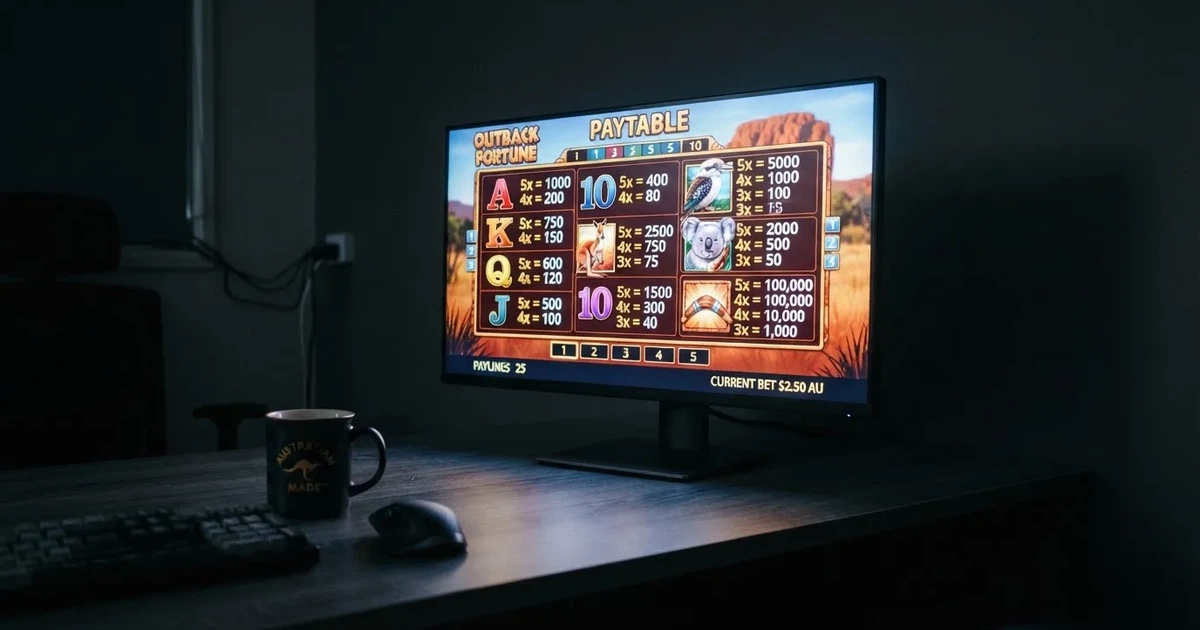
The practical difference is reach. A classic mechanical machine carried about ten symbols per reel and offered roughly 1,000 distinct combinations. A modern video slot can use five or more reels with 50 or more symbols per reel, producing odds against a top combination as steep as 300 million to one. That is the mechanical reason a video slot carries so many features a three-reel pokie cannot: multiple paylines, scatter pays, cascading reels, expanding wilds, free-spin rounds, pick-a-prize bonuses, and progressive jackpots linked across machines. The math has more room; the game design has more to do with it. House edges sit lower than those headline odds suggest — typical return-to-player figures for video slots run in the 94%–96% range, well above the floor U.S. states set (Nevada at least 75%, Mississippi at least 80%, New Jersey at least 83%) — but the volatility is much wider, and that is the part a reader feels.
Volatility varies even within a single provider’s catalogue because each title is tuned separately. Two slots from the same studio, both running at 96% RTP, can pay out small wins often or rare wins large; one suits a short session, the other suits a long one. That is the answer to the question “why do some video slots feel like they pay nothing for an hour and then pay everything”: it is a feature of the design, not a malfunction.
The Australian Licensed Market: EGMs in Pubs, Clubs and Casinos
Australian slot machines outside casinos are governed by state and territory regulators. NSW legalised slot machines in 1956; by 2010 Australia operated an estimated 97,103 gaming machines outside casinos, a per-capita rate about five times that of the United States. Inside casinos, table games are approved by the state regulator — section 66 of the NSW Casino Control Act 1992 requires a casino operator not to permit a game such as baccarat to be played unless the game and its rules are approved by the regulator, with a copy available to patrons on request. In Victoria, the Casino Control Act 1991 routes the same approval through the Victorian Gambling and Casino Control Commission, which replaced the VCGLR on 1 July 2022. Crown Melbourne’s approved changes include renaming the “Perfect Pairs” blackjack side bet to “Crown Pairs” on 23 December 2024 and introducing a “Free Bet” option with a new “Pot of Gold” side bet on 25 March 2024. Three baccarat variants are approved for the Melbourne floor — Traditional Baccarat, Crown Baccarat and 2 to 1 Baccarat.
None of this describes what an Australian reader who searched “best video slots Australia 2026” was probably looking for. The licensed EGMs in pubs and clubs are, by international standards, modern video slot machines — five reels, multiple paylines, bonus features — but they are not an online casino product. They cannot be played from a phone at home. The reader who wanted to play them online is, by the act itself, looking at the prohibited market.
Offshore Video Slot Brands the ACMA Has Acted Against
The table below lists eleven brands the ACMA has issued formal warnings against for offering prohibited interactive gambling services to Australians. The page describes these brands — it does not recommend them. Each carries the date and the operator the regulator named in its public action. The “subject support” column shows whether the inputs themselves name these brands as video-slot suppliers, or whether nothing was found.
| Brand | ACMA action and date | Operator named by the ACMA | Subject support |
|---|---|---|---|
| RocketPlay | Formal warning, March 2026 | Pulsup Ltd (Rocketplay.com.au) | — |
| Level Up Casino | Formal warning, May 2022 | Dama N.V. | listings-only (Bgaming.com) |
| Woo Casino | Formal warning, March 2025 | Dama N.V. | — |
| Spirit Casino | Formal warning, May 2025 | Dama N.V. | — |
| National Casino | Formal warning, July 2025 | Consolutetish S.R.L. | listings-only (en.wikipedia.org) |
| Bizzo Casino | Formal warning, July 2025 (prior warning to TechSolutions, 2022) | Consolutetish S.R.L. | — |
| Ignition Casino | Formal warning, July 2025 | Bamboo Media | — |
| Instant Casino | Formal warning, February 2025 | EOD Code SRL | — |
| Jackbit | Formal warning, April 2026 | Ryker B.V. (also over CasinOK) | — |
| Casino Intense | Formal warning, April 2025 | Sterplay Holding Ltd | listings-only (Abc.net.au, acma.gov.au, Crownmelbourne.com.au) |
| Sky Crown | Formal warning (PDF, September 2022) | Hollycorn N.V. (also over Blue Leo) | — |
The pattern is the point. Several operators reappear across rows. Dama N.V. is named in four of the eleven entries, over different brand names, across years. TechSolutions was warned in 2022 over Bizzo Casino; Consolutetish S.R.L. was warned in 2025 over the same brand. Hollycorn N.V. appears under Sky Crown and Blue Leo. The brand is a wrapper; the operator is the unit the ACMA acts against, and a reader who recognises a “new” offshore site is most likely seeing a re-skinned version of a brand the regulator has already contacted.
Level Up Casino and Casino Intense are the only entries in this set for which a subject-support source was found. The support they carry is from listings that name them as suppliers of video slots, not from any Australian licence or approval. The other eight rows carry no subject support in the research; the page records the ACMA action and leaves the brand unconnected to the slot-supplier question.
Blocking rate since November 2019
The arithmetic belongs to this shelf: the ACMA’s blocking rate. From the first blocking request in November 2019 to the June 2026 total of 1,751 blocked sites gives roughly 81 months of enforcement. That is an average of about 21.6 blocked sites per month across the running period, though the monthly rate is far from even — the June 2026 round alone added 12 sites, and earlier single rounds have moved similar numbers. State the result as a band rather than a single figure: somewhere between 20 and 25 sites per month on average since November 2019, with the pace concentrated in periodic bulk rounds rather than continuous daily action. The condition that drives the variance is the ACMA’s enforcement model — formal warnings to operators first, ISP-blocking requests after — which means the monthly number reflects completed investigations, not the underlying rate at which new prohibited sites appear.
What the offshore brand actually offers, and what the licence on its footer means
Every brand in the table above displays a licence on its website. None of those licences covers Australian players. The Interactive Gambling Act is jurisdictional: a Curaçao or Anjouan licence permits the operator to run the site; it does not permit the site to offer casino games to a person in Australia. A reader who sees a “licensed” badge on a slot site is seeing the licence that authorises the operator to exist, not the licence that authorises it to take an Australian deposit. The ACMA’s formal warnings make this distinction explicit: each one names the operator, the brand, and the prohibited interactive gambling service the regulator found the brand offering to Australians.
The practical consequence for the reader: an offshore casino gives no Australian consumer protection. There is no local complaints body, no local recourse if a withdrawal is refused, no guarantee the balance can be withdrawn at all, and a real chance the site is blocked mid-session with funds still on it. The individual player is not prosecuted under the IGA — the Act targets the provider — but the player is also the one who loses access if the blocking order lands. The brand’s terms page is the only contract the player has, and that contract is written under a different jurisdiction’s law.
Bonuses and Free Spins: Inducement, Not Value
Video slots with free spins, with bonus rounds, with deposit matches — these are how offshore casinos advertise. They are not how the licensed Australian market advertises; licensed wagering operators carry different inducement rules, and the Interactive Gambling Amendment (Gambling Reform) Bill 2026, passed by Parliament on 19 August 2026, brings advertising and inducement measures into force on 1 January 2027. That is law with a start date, not yet in force on a page written in 2026.
A bonus in this offshore market works the same way regardless of which brand offers it. The headline number is the inducement. The wagering multiple — how many times the bonus must be turned over before any winnings can be withdrawn — is the cost. Free-spin winnings usually carry their own playthrough. Game-weighting clauses restrict which video slots count toward the requirement and at what percentage. Maximum-cashout caps cap the amount that can be withdrawn from bonus-derived winnings. Time limits push the player to clear the requirement inside a window. Each of these terms is a place the marketing word “free” stops meaning what it says.
The page does not name any specific bonus figure from these brands because no input supplies a verifiable one for the operators in the table above. The bonus market around prohibited Australian-facing video slots is documented by affiliate pages, which are not reliable sources for what an offer actually pays out. A reader who sees a bonus headline from one of these sites should read the wagering multiple first, the game-weighting list second, and the maximum-cashout cap third — in that order — before deciding whether the inducement is worth the playthrough it asks for.
Mobile Play and Apps: What Carries Over and What Doesn’t
Modern video slots are designed mobile-first. The same HTML5 engine that runs on a desktop browser runs in a mobile browser; the touch interface substitutes for mouse clicks on the spin and bet-size controls; the paytable, the bonus-round picker and the free-spin counter all reflow into portrait or landscape. A mobile browser version of a modern video slot is the same game as the desktop version: same RNG, same RTP, same feature triggers. The visual layer scales, the audio may compress, and a long session on a smaller screen can be harder on the eyes than the same session at a desk — but the game underneath is unchanged.
A dedicated app, where one exists, is usually a wrapper around the same browser engine with push notifications added. It is not a different product. The distinction matters for an Australian reader because the IGA applies to the offering, not to the channel: an app that delivers a prohibited interactive gambling service is as prohibited as a website that does so. The ACMA’s blocking orders cover apps in the same rounds as websites. The Northern Territory Racing and Wagering Commission, which regulates 52 of Australia’s online bookmakers — Sportsbet, Bet365 and Ladbrokes among them, licensed in the Territory for tax reasons — has no role in approving casino apps; the commission has no full-time staff and meets once a month in Darwin, and its remit covers wagering, not casino games.
Mobile performance is the one part of this shelf where research offers no specific load-time or battery-drain figures for the brands in the table. The page states the qualitative point: modern video slots run in a mobile browser without a dedicated app; the experience is the same game, and the regulatory position is unchanged.
Responsible Gambling: What Protects an Australian Player and What Doesn’t
The Australian onshore framework offers a player real, enforceable protections. BetStop, the National Self-Exclusion Register, has been live since August 2023 and binds Australian-licensed online and phone wagering services. A person who registers is excluded from those services, and the operator’s compliance with that exclusion is auditable. The National Gambling Helpline, 1800 858 858, is free and operates 24/7; chat support runs at Gambling Help Online.
BetStop binds licensed Australian operators. It does not bind an offshore casino. A self-exclusion registered through BetStop stops a player from Australian-licensed wagering sites; it does not stop the same player from opening an account with an offshore brand that has no connection to the register. The same is true of deposit limits, time-out tools and reality checks offered by Australian-licensed operators — they are contractual features of the licensed product, not features the offshore market is required to provide. The offshore site’s own responsible-gambling page, where one exists, is the only protection in place, and that protection sits inside the site’s own terms.
Payment rules draw a similar line. Credit cards, credit-related products and digital currency have been banned as payment for licensed online wagering since 11 June 2024, with penalties up to A$247,500 for operators. Legal deposit routes for licensed wagering are debit card, bank transfer, PayID/Osko and BPAY. An offshore site asking an Australian customer for a credit card or a crypto deposit is operating outside the Australian rules — that is one of the easier tells.
If gambling stops being fun, the page’s standing recommendation is the National Gambling Helpline on 1800 858 858. That number works regardless of which market the reader is using.
What a Reader in Australia Is Actually Choosing Between
Three options exist for an Australian who wants to play a video slot.
The first is the licensed onshore product — poker machines in pubs, clubs and casinos, regulated by state and territory authorities, with venue-level self-exclusion and state-level complaints bodies. The games are modern video slots in design terms: five reels, multiple paylines, bonus features. They cannot be played from home.
The second is the licensed online wagering market — sports and race wagering with the 52 NT-licensed bookmakers, plus lotteries and keno. These are not casino games. A reader who wants to play a video slot online is not in this market.
The third is the offshore market — the brands in the table above and the broader set the ACMA has acted against. The product is what you are searching for; the legal position is that offering it to an Australian is prohibited, and the protective framework is whatever the operator chooses to provide.
The page’s subject — the consequence of these three positions — is that “best video slots Australia 2026” is not a comparison within one of these options. It is a comparison across them, and the right answer for most readers is the first: the licensed onshore product, played at a venue, under local protections. For the small set of readers who will still choose the offshore option despite that, the table above names eleven brands the regulator has already contacted, and the rest of this page is what they should know before depositing.
Tax: A Footnote Worth Knowing
Gambling winnings of a recreational player in Australia are not assessable income under section 6-5 ITAA 1997, and losses are not deductible. A professional gambler — a person who carries on a business of betting — sits under a different model; the standard advice is to check with the ATO. This applies whether the play is at a Crown Melbourne baccarat table or at an offshore video slot the ACMA has just warned; the tax treatment of recreational play does not change with the venue.
What This Page Does Not Cover
This page does not rank video slots by RTP, by provider or by theme. Research carries no comparable RTP figures for the titles in any of the eleven offshore brands in the table; volatility is given even less often. A “top 10 slots” list built on these inputs would restate marketing, and the page’s job is to deflate that. The page does not list bonus codes or voucher codes; the only sources for those were affiliate marketing pages, and the inputs themselves carry no verifiable offer.
The page also does not promise that any of the offshore brands is safe to use. The legal position in Australia is that the offering itself is prohibited, and the page’s consequence-first angle is to make that position the first fact the reader sees.
Frequently Asked Questions
What makes a video slot different from a classic three-reel pokies machine?
A video slot is software-driven and rendered on a screen, while a classic three-reel machine is mechanical with physical reels. A modern video slot can run five or more reels with 50 or more symbols per reel, producing odds against a top combination as steep as 300 million to one. A classic machine offers roughly 1,000 combinations. The expanded math is what lets video slots carry multiple paylines, bonus rounds and free-spin features.
Do video slots typically include bonus rounds that classic machines don’t have?
Yes. Multiple paylines, scatter pays, cascading reels, expanding wilds, free-spin rounds, pick-a-prize bonuses and progressive jackpots are all features of modern video slots. The mechanical three-reel pokie that started the category — Fey’s late-19th-century Liberty Bell — paid a single line for three bells in a row and had no second mode of play.
Are video slots on a mobile browser the same game as the desktop version?
Yes. Modern video slots use an HTML5 engine that runs the same way in a mobile browser as on desktop; the touch interface substitutes for mouse clicks but the RNG, the RTP and the feature triggers are unchanged. A dedicated app, where one exists, is usually a wrapper around the same engine. The regulatory position is the same in either case: an app that delivers a prohibited interactive gambling service to an Australian is as prohibited as a website that does so.
How many paylines does a typical modern video slot use?
There is no single answer. Modern video slots run from the low tens of paylines up to several hundred, with Megaways-style titles offering tens of thousands of ways to win on a single spin. The number of paylines is a design choice by the provider; it sits alongside the RTP and the volatility as one of the three numbers a reader can use to compare titles, and it is the easiest of the three to read off the paytable screen.
Why do video slots vary in volatility even within the same provider’s catalogue?
Each title is tuned separately. Two slots from the same studio, both at 96% RTP, can be set to pay small wins often or rare wins large. The RTP is the long-run return; the volatility is how that return is distributed across sessions. A low-volatility title suits a short session on a small bankroll; a high-volatility title suits a longer session with a bankroll large enough to absorb the dry spells.
Which Australian state has the most licensed gaming machines outside casinos?
New South Wales, by a wide margin. Pokies-style slot machines outside casinos numbered 87,298 in NSW as of June 2023, against 26,380 in Victoria across 2021–22, 21,122 in Queensland in October 2023, 11,672 in South Australia in September 2023 and 3,587 in the ACT in November 2023. NSW legalised slot machines in 1956 and remains the dominant jurisdiction for the product.