
Plinko casino in Australia: what the game is, who blocks it and what changes when crypto is the deposit
A plinko casino game borrows its silhouette from the pegboard contestants have been dropping chips down since 1983 — a pyramid of pegs, a ball, and a row of multiplier slots at the bottom. Offshore sites put real money on that ball-drop. None of them hold an Australian licence to do so, and several have been the subject of formal warnings or site-blocking orders from the ACMA over the past two years. The page below walks through the paytable the operators advertise, the legal position Australians sit in, and the record of enforcement that has built up around this particular product.
Data current as of 8 November 2026, checked against the ACMA’s published formal-warning register and the Interactive Gambling Act 2001 (Cth).
Table of Contents
- Payment methods at offshore Plinko sites: what they take, what they ship back
- The Plinko game itself: paytable, RTP and what the ball-drop actually decides
- The 11 offshore brands named in this comparison
- The legal position: what is licensed in Australia and what is not
- How the ACMA enforces: warnings, blocks and the cumulative record
- Responsible gambling: where the protections actually are
- Crypto deposits: what changes and what does not
- What this comparison is actually for
- Frequently asked questions
Payment methods at offshore Plinko sites: what they take, what they ship back
The plinko casino payment shelf reads like a payment-method buffet rather than a list tuned to Australian rails. Most offshore sites that surface in this corner of the market accept Visa and Mastercard bank cards, e-wallets (Skrill, Neteller, MiFinity, Jeton), bank transfers, prepaid vouchers and several cryptocurrencies — Bitcoin, Ethereum, Litecoin, Tether and Dogecoin recur across the segment. The reason to list them is not to recommend a route; it is to flag that the deposit path an Australian sees offered tells them something about the operator’s standing with the local regime.

Credit cards and credit-related products have been banned as a deposit route into Australian-licensed online wagering since 11 June 2024, and digital currency is treated in the same category under the same instrument. Legal deposit routes for licensed wagering are debit card, bank transfer, PayID/Osko and BPAY. A site asking an Australian for a credit card or a crypto deposit is not on the Australian rails — the operator is asking for payment methods the local regulator has explicitly ruled out.
Withdrawals are the line that shows where the operator actually stands. A claim of “instant payouts” on the landing page usually means e-wallet approvals within hours; a bank transfer routinely clears in one to three business days; a crypto withdrawal can settle within an hour once approved but goes through whatever confirmation window the chain itself demands. The plinko casino payout shelf is uneven across this segment, and the spread is part of the offer — a site quoting “instant” alongside another quoting “1-3 days” is comparing different approval pipelines, not different speeds of physics.
The honest framing is: the deposit method you arrive with has nothing to do with whether the operator is licensed here. A Bitcoin deposit at a Curaçao-licensed brand is the same unlicensed product from the perspective of Australian consumer law as a Visa deposit. That is the trap a crypto entry point can hide — it looks different, and it isn’t.
The Plinko game itself: paytable, RTP and what the ball-drop actually decides
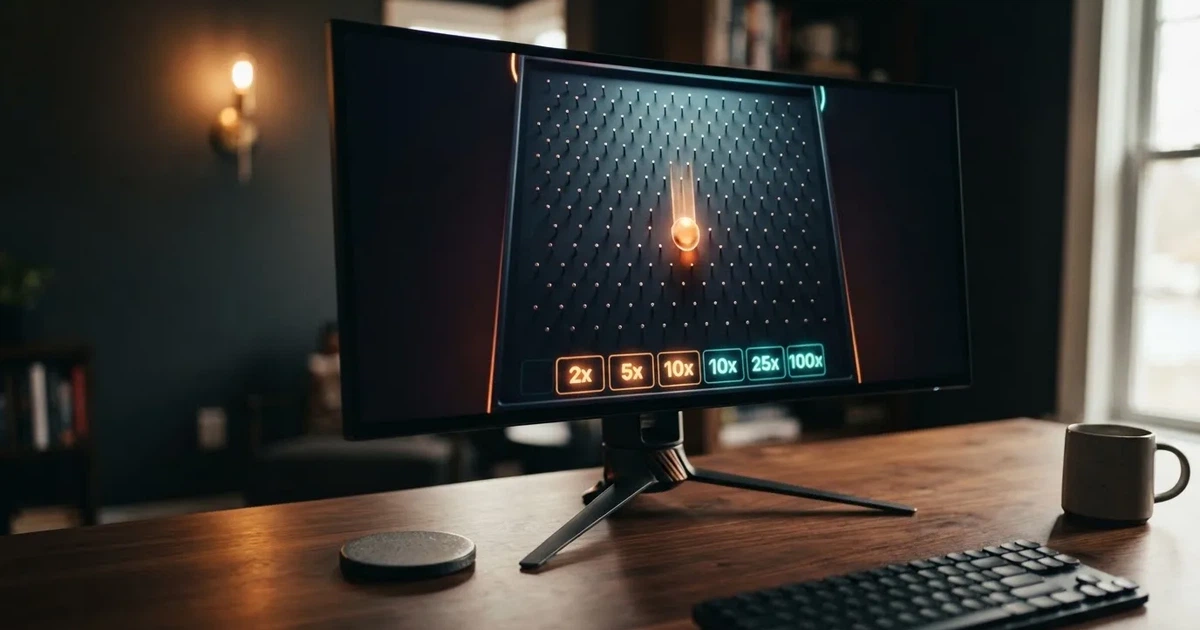
The plinko casino game is one of the simplest products in the offshore lobby. A ball is dropped from the top of a pegged pyramid; it bounces through rows of pegs into one of several slots at the bottom; the slot it lands in carries a multiplier that scales the stake. There are no reels, no paylines, no bonus rounds. The entire result is the multiplier the ball settles on.
BGaming’s Plinko — the version most offshore pages reproduce — advertises a 99% return-to-player figure and a top multiplier of ×1,000. The 99% RTP figure is the headline the marketing carries; the multiplier range is the headline the player feels. A player sets two variables before each round: the risk level (low, normal or high) and the number of lines the board is divided into (between 8 and 16). Both choices reshape the paytable. A low-risk, 16-line board concentrates the ball’s likely destination near the centre slot — small wins, infrequent swings. A high-risk, 8-line board pushes the distribution outward — most rounds lose, occasionally the ball lands on a ×1,000 multiplier and the round returns a thousand times the stake.
That is the trade a Plinko casino game actually offers: an even-money-ish grind with a thin top end, or a high-variance lottery with the same long-run house edge. The headline RTP sits at 99% across every configuration BGaming publishes; the volatility profile and the spread of outcomes move dramatically between settings, but the average does not. The 1% the house keeps is the same in either configuration; the journey to losing it is not.
The plinko slot framing is worth a sentence on its own. Plinko is not a slot in the reels-and-paylines sense — the result is generated by the ball’s path, not by a symbol combination across spinning reels. Offshore pages bundle it into the slot lobby because it lives in the same interface, not because it has the same architecture. A player who treats Plinko as a “high-RTP slot” is right about the average return and wrong about the rest of the comparison.
The price-is-right Plinko board the game is descended from had nine bottom slots, valued $100, $500, $1,000 and $0 from the outside in, with the centre slot worth $10,000. Before 1998 the centre slot paid $5,000. The maximum possible win on the show was $50,000. The casino version borrows the silhouette and replaces the dollar figures with multipliers — the structure is the same even if the denominations are not.
The 11 offshore brands named in this comparison
The product itself is prohibited in Australia. The brands below are listed because the ACMA itself has issued a formal warning over each one for offering prohibited interactive gambling services to Australians. No bonus terms are given — the only sources for those were affiliate marketing pages. None of the eleven hold an Australian licence to offer online casino games, and the law that prohibits them is the same in every case.
RocketPlay — a 2026 warning and an earlier 2022 one
Pulsup Ltd received a formal ACMA warning over RocketPlay in March 2026, and an earlier formal warning had already been issued to Dama N.V. in May 2022 covering Rocketplay alongside five sister brands. The site offers the Plinko casino game alongside the rest of a typical offshore lobby. The repeated warning is the entry that stands out here — the ACMA has returned to the same product under a new operator of record inside four years.
Level Up Casino — the first Dama N.V. wave
Dama N.V. took a formal ACMA warning in May 2022 covering six casino brands, with Level Up Casino among them. The Plinko game is present on the site under BGaming’s catalogue. The 2022 warning is the older end of the ACMA’s recent enforcement record against this operator group, and it predates the bulk of the 2024-2026 blocking round.
Woo Casino — a 2025 warning to the same Dama N.V.
A formal ACMA warning went to Dama N.V. over Woo Casino in March 2025. The site offers the standard offshore lobby, including BGaming’s Plinko. The 2025 warning sits inside the same operator-of-record thread as the 2022 wave — the ACMA has revisited Dama N.V. twice across three years.
Spirit Casino — a second 2025 Dama N.V. warning
A formal ACMA warning went to Dama N.V. over Spirit Casino in May 2025. The site offers the standard offshore lobby. Two Dama N.V. warnings in 2025 alone is the part of the record that registers.
National Casino — a 2025 Consolutetish S.R.L. warning
Consolutetish S.R.L. took a formal ACMA warning over National Casino in July 2025. The site offers BGaming’s Plinko in its catalogue. The operator of record here is different from the Dama N.V. thread above, but the offering is the same and the legal status is the same.
Bizzo Casino — a warning that was already the second
Consolutetish S.R.L. took a formal ACMA warning over Bizzo Casino in July 2025 — and the brand had already been the subject of a 2022 formal warning to TechSolutions (CY) Group Limited and TechSolutions Group N.V. Two operator-of-record changes, two ACMA warnings for the same brand, same product.
Ignition Casino — a 2025 Bamboo Media warning
Bamboo Media took a formal ACMA warning over Ignition Casino in July 2025. The brand offers the standard offshore casino lobby. The Bamboo Media operator-of-record entry is the freshest of the recent warnings — it did not appear in the 2022 wave.
Instant Casino — a February 2025 EOD Code SRL warning
EOD Code SRL took a formal ACMA warning over Instant Casino in February 2025. The product is the standard offshore lobby. February 2025 is one of the earliest entries in the 2025 cluster of warnings, and the operator of record has not appeared elsewhere on the list.
Jackbit — an April 2026 warning covering two brands
Ryker B.V. took a formal ACMA warning in April 2026 covering Jackbit and a sister brand, CasinOK. The product is the standard offshore lobby including Plinko. Two brands on one warning is the unusual shape here — it points to a portfolio-level enforcement rather than a single-product action.
Casino Intense — a Sterplay Holding Ltd warning
Sterplay Holding Ltd took a formal ACMA warning over Casino Intense in April 2025. The brand offers the standard offshore casino lobby. Casino Intense is the brand listed on the ABC News coverage of NT regulatory reform in April 2026, which is the same regulator-oversight thread this comparison lives inside.
Sky Crown — a 2022 Hollycorn N.V. warning
Hollycorn N.V. took a formal ACMA warning over its Sky Crown and Blue Leo casino services in September 2022. The Plinko product is present on the site. The 2022 date makes this the oldest entry in the comparison and the brand that has been on the ACMA’s published register the longest without a fresh warning in 2025 or 2026.
The legal position: what is licensed in Australia and what is not
Online casino games — including the Plinko casino game — cannot be licensed anywhere in Australia. The Interactive Gambling Act 2001 (Cth), strengthened by the Interactive Gambling Amendment Act 2017, makes it an offence to provide online casino games, online pokies or in-play betting to a person physically in Australia. Penalties reach A$220,000 per day for individuals and up to A$1.1 million per day for corporations. The federal statute pre-empts any state or territory licence for these products: no state or territory issues one.
What is licensable in Australia is wagering on racing and sport placed before the event, lotteries and keno. In practice these are licensed by the Northern Territory Racing and Wagering Commission (NTRWC), which regulates 52 of Australia’s online bookmakers — Sportsbet, Bet365 and Ladbrokes among them — under a Territory tax arrangement. The Commission has no full-time staff and meets once a month in Darwin. The bookmaker licence is the closest thing to an Australian online gambling licence, and it does not cover online casino games.
The federal regime targets the provider, not the player. An individual Australian playing at an offshore site is not personally prosecuted under the IGA. The site is. The consequence for a player is not a fine but a complete absence of the protections a licence provides: no Australian complaints body, no recourse if a withdrawal is refused, no obligation on the operator to act in the player’s interest. The Interactive Gambling Amendment (Gambling Reform) Bill 2026 passed Parliament on 19 August 2026 and brings advertising and inducement measures into force on 1 January 2027 — that is law with a start date, not yet in force on a page written in 2026.
Tax is the smaller and cleaner point. Gambling winnings of a recreational player are not assessable income under section 6-5 ITAA 1997 and losses are not deductible, unless the person carries on a business of gambling. The general rule covers most players; the business-of-gambling carve-out is narrow and the ATO is the source to check.
How the ACMA enforces: warnings, blocks and the cumulative record
The ACMA’s enforcement record on prohibited interactive gambling services has built up steadily across the past two years, and the blocking-round headline is the cleanest summary of where the cumulative pressure has landed.
According to the ACMA as reported in June 2026, a total of 1,751 illegal gambling and affiliate marketing websites had been blocked since the first blocking request in November 2019, and more than 230 unlicensed gambling services had left the Australian market since enforcement was strengthened in 2017. In the round reported on 26 June 2026 alone, the ACMA asked Australian internet service providers to block 12 more illegal gambling websites: 7Signs, ChromaBet, Donbet, Duospin, Freshbet, Slots Gem, Jacks Club, Lucky Start, Pointsbetz, Spinrise, Vinyl Casino and Wildsino. The blocking requests are the visible end of an enforcement chain that begins with an investigation, runs through a formal warning to the operator, and only escalates to a block if the warning does not produce a result.
The arithmetic the data supports: from the first blocking request in November 2019 through the cumulative total reported in June 2026, the ACMA’s blocking instrument has been used roughly 250-275 times per year, with year-on-year variation around that band. The condition on the band is that the figure is an average across seven years of enforcement, not a steady-state rate — the early years of the regime carried fewer blocks, and the most recent rounds have run at a higher cadence. A reader quoting “250 blocks a year” is right at the order of magnitude and wrong to present it as a flat annual rate.
H2 Gambling Capital’s 2025 report estimates that Australians lose about A$3.9 billion a year to illegal gambling sites, and that the share of gambling going through legal channels fell from 74% in 2021 to 64%. The legal-share decline is the structural fact behind the blocking-round cadence: every block shifts a slice of the illegal channel off the table, and the cumulative total of 1,751 sites blocked is the visible part of that work. The A$3.9 billion figure is the size of the channel the enforcement is reaching for.
Responsible gambling: where the protections actually are
A player at an Australian-licensed wagering operator can self-exclude through BetStop, the National Self-Exclusion Register, which has been live since August 2023. BetStop binds Australian-licensed online and phone wagering services — and only those. An offshore casino offering the Plinko casino game is not connected to BetStop and is not bound by the exclusion a player registers there.
The National Gambling Helpline on 1800 858 858 is free, runs 24 hours a day, and supports chat through Gambling Help Online. Both services are independent of any operator. State-level support services — Gambler’s Help in Victoria, GambleAware in NSW and equivalents in the other states — provide counselling and financial counselling. The support shelf exists; it does not reach into an offshore site, and an offshore site does not connect a player to it.
The framing on this page is the framing the law supports. A player at an offshore site can call the same helpline, but the operator will not be required to act on an exclusion request and will not be subject to Australian complaints handling if a withdrawal is refused. The BetStop entry is what the licensed channel offers; the offshore channel offers its absence.
Crypto deposits: what changes and what does not
The crypto version of the Plinko casino game pays out the same way the real-money version does. The ball still drops, the multiplier still scales the stake, and the long-run return is the same 99% figure BGaming advertises. The chain the winnings are settled in does not change the game underneath. A Bitcoin multiplier win is paid in Bitcoin at the same multiplier it would have paid in fiat at the same RTP.
What changes is the deposit path and the regulatory status of the channel. Crypto deposits sit in the same ban-category as credit cards under the 2024 instrument — digital currency is treated as a banned payment method for licensed Australian wagering. The deposit that arrives at an offshore Plinko site through a Bitcoin wallet is a deposit the Australian rules have explicitly ruled out for the licensed channel; at an unlicensed site, the same deposit has the same consumer-law consequences and the additional risk that the chain path is permanent and the operator’s withdrawal handling is final.
The honest statement: paying with crypto does not verify, license or protect a player at an offshore casino. The product is prohibited in Australia regardless of the currency it is paid in, and the protections an Australian player expects — dispute resolution, complaints handling, exclusion registers — do not extend to crypto deposits at an unlicensed site.
What this comparison is actually for
The list above is not a recommendation. Every brand on it is listed because the ACMA itself published a formal warning over it for offering prohibited services to Australians, and the law under which that warning was issued is the same law under which any online casino game — Plinko included — is prohibited here. The comparison shows the spread of warnings across two operator groups and across 2022 to 2026, and it shows which brands the ACMA has returned to. It does not show which brand is safe to play at, because none of them is licensed to offer the product here.
A player reading this page who is deciding what to do with the information has three honest options. They can play at one of these sites and accept that they are using an unlicensed channel with no Australian consumer protection and no BetStop coverage. They can play the same game at a casino licensed in another jurisdiction and accept that the offshore status is the price of playing Plinko for real money. Or they can play at an Australian-licensed operator, which means wagering on a sport or a race before the event — not a Plinko casino game.
The page describes the segment. It does not advise on it.
Frequently asked questions
What is the Plinko casino game, and how does the ball-drop mechanic actually determine a payout?
The Plinko casino game is a digital version of the pegboard game that premiered on The Price Is Right on 3 January 1983. A ball drops through a pyramid of pegs and lands in one of several multiplier slots at the bottom; the slot’s multiplier scales the stake for that round. BGaming’s version advertises a 99% RTP and a top multiplier of ×1,000. The ball’s path is determined by the peg layout and the player’s two settings — risk level and number of lines — and the multiplier is whatever slot the ball settles in.
Does a crypto version of Plinko pay out any differently to a standard real-money version?
No. The game underneath is the same — same ball, same pegs, same multiplier slots, same RTP. The payout is settled in the cryptocurrency the player deposited with at the same multiplier the fiat version would have used. The chain does not change the return-to-player figure; it changes the deposit path and the regulatory standing of the operator accepting it.
Is playing Plinko for real money at an offshore casino something Australians are legally allowed to do?
The Interactive Gambling Act 2001 makes it an offence to provide online casino games, including Plinko-style multiplier games, to customers in Australia. The individual player is not prosecuted, but the operator is, and an offshore casino gives no Australian consumer protection, no complaints body and no recourse if a withdrawal is refused. Australian-licensed wagering does not cover Plinko; only races, sport and lotteries are licensed here.
What return-to-player rate do offshore sites typically advertise for their Plinko game?
BGaming’s Plinko — the version most offshore pages reproduce — advertises a 99% RTP with a ×1,000 top multiplier. The 99% figure is the long-run average across many rounds; individual rounds settle on whatever multiplier the ball lands on, and the distribution of those multipliers depends on the player’s choice of risk level and number of lines. A 99% average does not promise a 99% return on any single session.
Why do Plinko casino apps get advertised separately from ordinary Plinko casino websites?
A Plinko casino app is the same game in a mobile wrapper — the same ball-drop mechanic, the same RTP, the same operator. The separation in marketing reflects a different delivery path: an app is downloaded, sits on the phone, and is reached through an icon rather than a browser. The game’s underlying licence status does not change between web and app delivery, and an app from one of the operators in the comparison above carries the same ACMA warning as the website.
How does a Plinko game’s payout table differ from a pokies reel in terms of the odds involved?
Plinko has no reels and no paylines. The result is the multiplier the ball settles on after a peg-determined bounce, not a symbol combination across spinning reels. A pokies spin is generated by a random number generator that decides symbol positions on each reel; a Plinko round is generated by the ball’s path through the peg layout. Both have a published RTP and a house edge; the difference is in what generates the outcome and what the player is choosing between when they set up a round.