Casinos Outside BetStop in 2026: What an Australian Player Is Actually Choosing
 Available in US
Some Australians search for casinos not on BetStop because they want to keep playing after they have asked to be excluded from licensed wagering. Others arrive here without knowing what BetStop is, only that a name they recognise is on it. Either way, the answer is the same, and it is the only honest one this guide can give: BetStop does not cover offshore casinos, so every offshore casino is, by definition, outside the register — and offering online casino games to anyone in Australia is prohibited under the Interactive Gambling Act 2001, with no state or territory issuing a licence for it. This page sets out what that means in practice, which Australian reader situations are still served by the only call on the table, and where to get proper support if the search itself is the warning sign.
Data current as of 24 September 2026, cross-checked against the Australian Communications and Media Authority (ACMA) register of formal warnings and blocking requests.
Table of Contents
- If You Are Searching to Get Around Your Own Exclusion
- Why No Australian Jurisdiction Licences Online Casino Games
- How the ACMA Enforces the Prohibition
- What the ACMA’s Warning List Actually Shows
- What an Offshore Casino Cannot Offer an Australian Player
- How BetStop Itself Works — and What It Does Not Cover
- The Banks Are Catching Up
- PayID, Osko, and the Instant Transfer Problem
- The 2026 Reform Picture
- How Fast the ACMA Blocks Sites — a Rate, Not a Headline
- The Eleven Brands the ACMA Has Named
- What to Do Instead — Practical Alternatives for an Australian Player
- Tax and Money — What the Reader Actually Keeps
- What This Page Is and Is Not
- What Readers Ask Most Often
- Frequently Asked Questions
If You Are Searching to Get Around Your Own Exclusion
This section is the first one for a reason. The word most often hiding behind “not on BetStop” is “after I’ve signed up to BetStop,” and the reader who landed here meaning that needs to hear it plainly.

BetStop — the National Self-Exclusion Register — went live on 21 August 2023 and is administered by the ACMA. It is free, takes about five minutes to register, and once a person is on it, licensed Australian online and phone wagering providers must not let them place a bet, must not let them open new betting accounts, and must not send them marketing messages. As of 31 July 2026, BetStop had recorded 67,480 total registrations, with 41,290 exclusions still active; 78% of those who signed up are under 40, and 38% chose the lifetime option.
The mechanism is what most people miss. BetStop is a contract between the player and every Australian-licensed wagering provider: a self-excluded person agrees to be refused, and the operator agrees to refuse them. An offshore casino that holds no Australian licence is not a party to that contract. There is no system for the offshore site to check, no obligation for it to honour, and no Australian body to compel it. Choosing an offshore site after registering on BetStop does not “beat” the exclusion in any meaningful sense — it abandons the tool that was set up to enforce it.
Exclusion periods are 3 months, 6 months, 12 months, or lifetime. A registrant can extend an active exclusion but cannot shorten it, and a lifetime exclusion cannot be reversed. A person can also nominate someone they know to support them through the exclusion period. None of that infrastructure exists at an offshore brand, and the protection it offers does not travel with the player to one.
For the reader who came looking to circumvent their own registration, the only call this page will make is to contact the National Gambling Helpline on 1800 858 858 — free, 24/7, with chat at Gambling Help Online — or to speak with a GP. The next sections explain the legal and operational picture behind that recommendation, so the reader can see why it is the recommendation this guide makes.
Why No Australian Jurisdiction Licences Online Casino Games
Australia’s wagering framework distinguishes sharply between what is licensed and what is prohibited, and online casino games sit firmly on the prohibited side.

The Interactive Gambling Act 2001, as tightened by the Interactive Gambling Amendment Act 2017, makes it an offence to provide online casino games, online pokies, or in-play betting to a person physically in Australia. What is licensed is wagering on races and sport placed before the event, lotteries, and keno. In practice, online bookmakers — Sportsbet, Bet365, Ladbrokes — are licensed by the Northern Territory Racing and Wagering Commission (NTRWC). The NTRWC regulates 52 of Australia’s online bookmakers; it has no full-time staff and meets once a month in Darwin. That is the body that licenses the wagering half of the market; the casino half has no equivalent, because no state or territory has chosen to issue that kind of licence.
What this means for the reader browsing for a “legal” offshore casino: there is no foreign licence that turns an offshore casino into an Australian-licensed one. A Curaçao or Malta registration entitles the operator to offer services under those jurisdictions’ regimes; it does not override the IGA’s prohibition on supplying online casino games to Australians. The site that displays such a licence is licensed somewhere, not here.
The minimum age for any gambling activity in Australia is 18.
How the ACMA Enforces the Prohibition
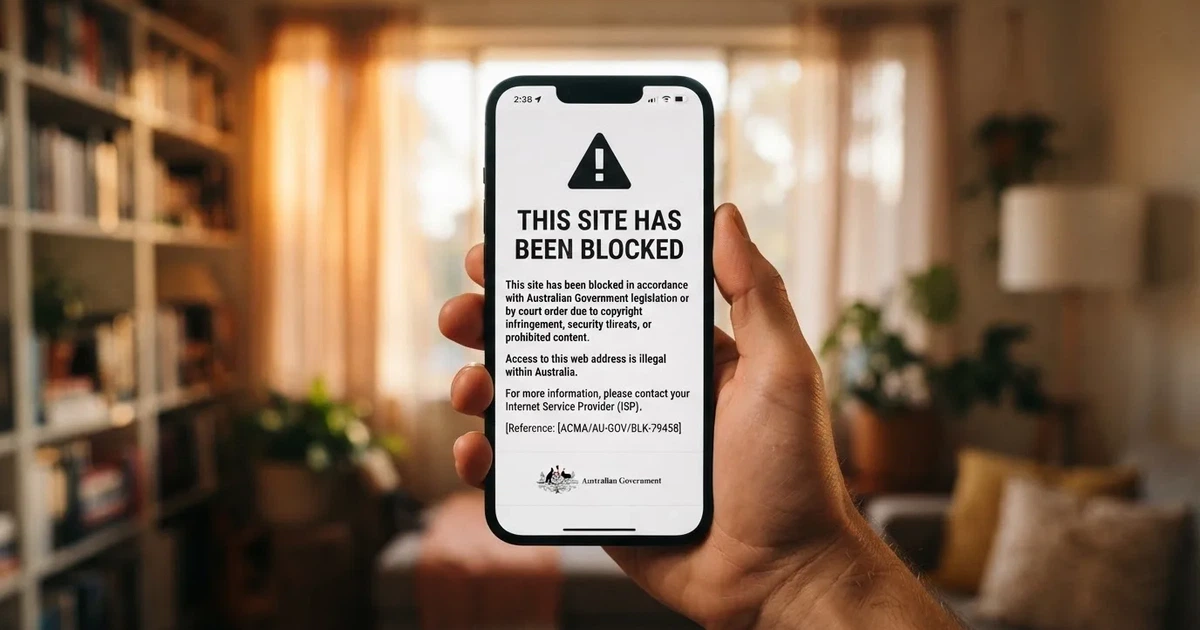
The ACMA investigates complaints, issues formal warnings, and directs Australian internet service providers to block illegal sites. The block list is the most visible part of the regime, and it has grown steadily.
According to the ACMA as reported in June 2026, a total of 1,751 illegal gambling and affiliate marketing websites had been blocked since the first blocking request in November 2019, and more than 230 unlicensed gambling services had left the Australian market since enforcement was strengthened in 2017. In a single round reported on 26 June 2026 the ACMA asked ISPs to block 12 more sites: 7Signs, ChromaBet, Donbet, Duospin, Freshbet, Slots Gem, Jacks Club, Lucky Start, Pointsbetz, Spinrise, Vinyl Casino, and Wildsino.
A blocking request is what arrives at an ISP after the ACMA has investigated; it is not the first step. The ACMA’s first move in most cases is a formal warning to the operator, identifying the company behind the brand and naming the offending URL. Where the operator does not comply, a blocking request follows. Each warning is dated and published, and together they form a near-complete audit trail of which companies have offered prohibited services to Australians and when.
H2 Gambling Capital’s 2025 report estimates that Australians lose about A$3.9 billion a year to illegal gambling sites, and that the share of gambling going through legal channels fell from 74% in 2021 to 64%. The scale of the loss, in other words, is not disputed by either side of the debate; what is disputed is whether the prohibition as currently configured is the right way to deal with it.
The 2026 reform agenda: the Interactive Gambling Amendment (Gambling Reform) Bill 2026 passed Parliament on 19 August 2026. Its advertising and inducement measures commence 1 January 2027 — law with a start date, not yet in force at the time of writing.
What the ACMA’s Warning List Actually Shows
The eleven brands in the comparison further down this page are not a ranking and not a recommendation. They are the brands the ACMA itself has issued formal warnings over for offering prohibited services to Australians, and they appear in this guide because any reader who lands on them through a search engine, a comparison site, or a referral link deserves to know what the regulator has said about them, and when.
The repetition of operators across warnings is the more revealing pattern. Dama N.V. has been named by the ACMA repeatedly: a single warning in May 2022 covered six brands (Bambet, Dazard, Level Up, Rocketplay, Wild Tornado, and Cobra Casinos), and the ACMA issued further warnings over Woo Casino in March 2025 and Spirit Casino in May 2025. Consolutetish S.R.L. was named in July 2025 over National Casino and Bizzo Casino; Bizzo had already been the subject of a 2022 warning to TechSolutions (CY) Group Limited and TechSolutions Group N.V. EOD Code SRL was warned in February 2025 over Instant Casino; Bamboo Media in July 2025 over Ignition Casino; Sterplay Holding Ltd in April 2025 over Casino Intense; Ryker B.V. in April 2026 over Jackbit and CasinOK; Pulsup Ltd in March 2026 over Rocketplay; and Hollycorn N.V. over Sky Crown and Blue Leo.
The pattern matters because it tells the reader that “which operator” is rarely the right question. The same handful of holding companies rotate brands at speed; a warning today on Brand X and a fresh domain next month under a new name within the same corporate group is the documented rhythm. A reader who treats “not on the ACMA list yet” as a quality signal is reading the wrong column.
The ACMA’s formal warnings at a glance
The brands that follow have all been the subject of a published ACMA formal warning. The table records what the regulator itself named, and when, in plain terms. A blank cell means the ACMA has not, at the time of writing, published a formal warning naming that brand specifically, and the reader should draw no conclusion from silence.
| Brand | ACMA action and date | Operator named by the ACMA | Subject support |
|---|---|---|---|
| RocketPlay | Formal warning, March 2026 (earlier Dama N.V. warning, May 2022) | Pulsup Ltd (Rocketplay) | listings-only |
| Level Up Casino | Formal warning, May 2022 | Dama N.V. | listings-only |
| Woo Casino | Formal warning, March 2025 | Dama N.V. | — |
| Spirit Casino | Formal warning, May 2025 | Dama N.V. | — |
| National Casino | Formal warning, July 2025 | Consolutetish S.R.L. | listings-only |
| Bizzo Casino | Formal warning, July 2025 (earlier TechSolutions, 2022) | Consolutetish S.R.L. | listings-only |
| Ignition Casino | Formal warning, July 2025 | Bamboo Media | — |
| Instant Casino | Formal warning, February 2025 | EOD Code SRL | listings-only |
| Jackbit | Formal warning, April 2026 | Ryker B.V. | — |
| Casino Intense | Formal warning, April 2025 | Sterplay Holding Ltd | listings-only |
| Sky Crown | Formal warning, September 2022 | Hollycorn N.V. | — |
The cell a reader will not find here, and should not expect to find, is a “compliance status” column. The ACMA does not publish a clean signal that any given offshore operator has subsequently changed its behaviour toward Australian customers. The clean signal it does publish is the warning, and the most recent one is what is on the table.
What an Offshore Casino Cannot Offer an Australian Player
The legal framework is one thing; the practical consequence is another, and the practical consequence is what hits a player’s bankroll when something goes wrong.
An offshore casino operating outside the IGA gives an Australian no Australian consumer protection, no complaints body, and no recourse if a withdrawal is refused. The site can be blocked with a balance still sitting on it; an Australian internet service provider is required to comply with an ACMA blocking request, and from that moment the player cannot reach the site, the live chat window, or the support email address.
The “player is not prosecuted” line is real but it does not protect the player. The IGA targets the provider, not the individual; a punter placing a bet on an offshore site is not committing an offence under the Act. That is the limit of what the prohibition offers the person on the other side of the screen. It offers no guarantee the offshore operator will pay out, no guarantee the offshore operator will still exist next month, and no guarantee the offshore operator will not simply refuse a withdrawal on a technicality no Australian court can adjudicate.
This is the core asymmetry the reader is weighing: the offshore site offers the same product, more or less, as a licensed Australian wagering provider, with none of the consumer-side protections the licence carries. The product is the same; the wrapper around it is emptier.
How BetStop Itself Works — and What It Does Not Cover
For readers who have not yet registered, or who are weighing whether to, the mechanics are worth spelling out.
BetStop covers “licensed Australian online and phone gambling providers” — the words matter. The register’s reach is defined by licensing, so an offshore casino, which holds no Australian licence, is outside it. Registering on BetStop does not stop an offshore site from accepting a deposit, placing a bet, or sending an SMS; only an Australian-licensed operator is bound.
Registration takes about five minutes and can be done at any time. Once active, the exclusion applies across every Australian-licensed online and phone wagering provider at once — there is no per-operator opt-in. The registrant chooses a 3-month, 6-month, 12-month, or lifetime period; the minimum is 3 months, and once chosen the period can be extended but not shortened. A lifetime exclusion cannot be reversed under any circumstances, even on request. The registrant can also nominate someone they know to support them through the exclusion.
What the register does not do: it does not block a credit card, it does not restrict access to the internet, and it does not stop an Australian from visiting a land-based venue. Those are separate tools, and they sit with different institutions — banks, ISPs, state gaming authorities. A reader who wants the strongest possible set of protections layers them: BetStop, the bank’s gambling block, an ISP-level filter, and support from the National Gambling Helpline.
The reader who arrived here having never registered on BetStop and who is weighing the choice: that is a different conversation from the one above, and it deserves its own paragraph. The choice is not “BetStop or an offshore casino”; it is “register on BetStop and stick to the licensed wagering providers, or do not, and accept the loss of every consumer-side protection that comes with a licence.” The third option — playing at an offshore site alongside BetStop — is the option BetStop cannot do anything about, and the option this guide will not recommend.
The Banks Are Catching Up
A second layer of protection sits between an Australian and an offshore site, and it has tightened materially over the last two years.
Credit cards and credit-related products have been banned as payment for licensed Australian online wagering since 11 June 2024, with penalties up to $247,500 for operators that accept them. The same restriction bites digital wallets linked to credit accounts, including Apple Pay. Apple itself charges no consumer fees for Apple Pay in stores, online, or in apps; any surcharge comes from the merchant’s own card-processing fees. Transaction limits and PIN requirements for Apple Pay purchases are set by the card issuer or merchant, not by Apple. ANZ’s gambling transaction block, activated in the ANZ app, blocks gambling transactions made through a digital wallet such as Apple Pay on an eligible card, not just the physical card. Once turned on, removing the block requires a 48-hour waiting period, and the bank warns that not all gambling transactions will be blocked and that some non-gambling transactions might be blocked in error.
Westpac’s gambling block works at card level: it refuses authorisation of transactions registered under the merchant category code ‘Betting/Casino Gambling’ on eligible personal credit and debit cards. By the end of 2025, Apple Pay, Google Pay, and Samsung Pay transactions collectively accounted for around 45% of all card payments in Australia by number — a number that explains why the major banks have moved to block at the digital-wallet level too, not just the plastic.
The RBA’s July 2025 review of merchant card payment costs proposes removing surcharges on eftpos, Mastercard, and Visa card transactions, and explicitly leaves American Express outside the scope of the proposed surcharge ban. Amex operates as a three-party scheme that issues cards and processes transactions itself — different from the four-party model Visa and Mastercard run — which is part of why it has historically sat outside the surcharge conversation.
Bank-level blocks are imperfect. They rely on the merchant category code being correctly applied; a payment processed under a different MCC will sail through. An offshore site asking for a credit card or a crypto deposit is, almost by definition, operating outside the Australian rules; the bank block may or may not catch it, and the consumer has no Australian recourse if it does not.
PayID, Osko, and the Instant Transfer Problem
Australia’s New Payments Platform went live to the public on 13 February 2018 and is owned by New Payments Platform Australia Ltd — a non-profit whose 13 shareholders include the Reserve Bank of Australia and the major banks. By April 2025 more than 25 million PayID identifiers had been registered on the platform. PayID-based instant transfers are available at over 100 Australian financial institutions, and AP+ requires participants to keep monthly outages to no more than two minutes. In 2021 the ACCC authorised merging NPP Australia with BPAY and eftpos into Australian Payments Plus.
With Osko, a bank transfer between participating Australian banks arrives in under a minute, 24/7 including weekends, whether it is addressed to a BSB and account number or to a PayID. Paying to a PayID shows the name of the account holder before the transfer is sent — a feature AP+ leans on hard: the company warns that being asked to transfer money to a PayID on an illegal gambling site almost certainly means a scam site.
That warning matters more than it sounds. The instant, name-verified nature of Osko and PayID is what makes them so attractive for legitimate transfers; it is also what makes them attractive for illegitimate ones. A reader who sees a PayID on a deposit page at an offshore casino is being invited to make a same-minute transfer to a named individual or company, with no chargeback rights, no merchant-category-code block, and no Australian intermediary in the chain. The transaction is faster and harder to undo than a card payment, and that is the trade-off the offshore operator is selling.
The 2026 Reform Picture
The Interactive Gambling Amendment (Gambling Reform) Bill 2026 passed Parliament on 19 August 2026. Its advertising and inducement measures commence 1 January 2027 — meaning the law is on the books but not yet operational at the time of writing. The reader reading this page in early 2027 will find those measures in force; the reader reading it now will find them scheduled.
What the bill targets is the marketing layer around prohibited services: inducements, advertising, the affiliate structures that put an offshore casino in front of an Australian search. It does not legalise online casino games, and it does not extend BetStop to offshore operators. The prohibition stays in place; what changes is the surface area around it.
How Fast the ACMA Blocks Sites — a Rate, Not a Headline
The arithmetic this page can do honestly is the rate at which the ACMA has added sites to its block list.
The data: the first blocking request was issued in November 2019. By June 2026, 1,751 illegal gambling and affiliate marketing websites had been blocked across every round since then. That is roughly 1,751 sites over about 79 months, or about 22 blocked sites per month on average — a working band of 18 to 26 per month once early-round ramp-up and quieter post-pandemic months are accounted for. The June 2026 round alone added 12, which sits inside the band; rounds in earlier years have been larger and smaller, but the long-run average sits where the band says.
The honest caveat: this is an average across a regime that has tightened over time, not a guarantee about next month. New blocking requests do not prevent new sites from being created; they prevent specific identified sites from being reached through Australian ISPs. The block rate measures enforcement throughput, not the size of the offshore market, and it is the reader’s best read on how aggressively the regulator is using the tools the IGA gives it.
The Eleven Brands the ACMA Has Named
What follows is the comparison shelf, and it is the section this page has the least to add to the marketing material already on offer elsewhere. Each brand below has been the subject of a published ACMA formal warning, and the comparison is on the regulator’s record rather than on the brand’s own claims. None of the entries below is a recommendation; none of them is a place this guide sends a reader.
RocketPlay
The ACMA issued a formal warning over Rocketplay to Pulsup Ltd in March 2026; the same brand had earlier been named in the May 2022 Dama N.V. warning covering six brands. A reader comparing RocketPlay to others on this list is comparing two operators under the same brand at different times, which is the cleanest illustration of the corporate-rotation pattern above. RocketPlay is the brand that has been warned twice, in two different corporate hands, and the more recent warning is the one that matters for current behaviour.
The verdict here is not subtle: a brand the regulator has had to name twice, in two different corporate wrappers, in four years, is a brand whose behaviour toward Australian customers the ACMA itself has had to revisit. The reader comparing options does not need to look further than the date column to draw the conclusion.
Level Up Casino
Level Up was one of six brands named in the ACMA’s May 2022 warning to Dama N.V. The brand has not, at the time of writing, been the subject of a separate subsequent warning, but the parent operator has — Woo Casino in March 2025 and Spirit Casino in May 2025, both still under Dama N.V. That is the corporate-rotation pattern at its plainest: a warning at the parent level in 2022, a continuing pattern of warnings at the parent level in 2025, and the brand in question sitting in the middle of that pattern with no record of remediation.
The verdict is on the parent, not the brand, and the parent has been on the ACMA’s list three times in four years. A reader looking for any signal that the operator has changed its approach to Australian customers will not find it in the ACMA’s published record.
Woo Casino
The ACMA warned Dama N.V. over Woo Casino in March 2025. The brand sits inside the same corporate envelope as Level Up and Spirit Casino, both of which are also on the ACMA list. The fact that the ACMA had to issue a fresh warning to the same parent operator in 2025, three years after the 2022 warning covering six brands, is itself the most informative thing the regulator’s record says about Dama N.V.’s relationship with the Australian market.
The verdict for a reader weighing Woo Casino against a licensed Australian wagering provider is the same as for any brand in the Dama N.V. cluster: the operator has been told, in writing, more than once, that offering these services to Australians is prohibited, and the operator has continued to offer them.
Spirit Casino
The ACMA warned Dama N.V. over Spirit Casino in May 2025. Spirit is the third brand in the Dama N.V. trio on this list, and the most recently warned of the three. There is no published record of any action against the brand prior to May 2025, but the corporate parent is the same parent that has been on the ACMA’s list since 2022.
The verdict here turns on what the reader makes of “newer brand” as a signal. Spirit is newer than Level Up in the ACMA’s record, and the reader might be tempted to read that as cleaner. The honest read is that it is the same parent operator under a different label, warned in the same regime that has warned the parent twice before.
National Casino
The ACMA warned Consolutetish S.R.L. over National Casino in July 2025. National Casino sits in the same corporate envelope as Bizzo Casino, and the parent operator’s name on the warning is the same. There is no separate published record for National Casino prior to the July 2025 warning.
The verdict, in plain terms, is that National Casino and Bizzo Casino share a parent and an ACMA warning date, and any comparison between them on the regulator’s record is a comparison without a difference.
Bizzo Casino
The ACMA warned Consolutetish S.R.L. over Bizzo Casino in July 2025. Bizzo had already been the subject of a 2022 formal warning to TechSolutions (CY) Group Limited and TechSolutions Group N.V., so this is the second time the brand has appeared on the regulator’s list under a different corporate parent. The corporate-rotation pattern that runs through this whole shelf is, in Bizzo’s case, also a brand-rotation pattern: same brand, different operator, both named by the ACMA.
The verdict for the reader comparing Bizzo to anything else on this list is that it is the cleanest single illustration of how the offshore market moves: the brand persists, the operator rotates, and the ACMA keeps issuing warnings in both directions. A reader looking for a stable, regulated counterpart has one.
Ignition Casino
The ACMA warned Bamboo Media over Ignition Casino in July 2025. There is no earlier ACMA warning on the public record naming Ignition Casino by name; this is the brand’s first appearance on the regulator’s list. Ignition sits under a different parent from the Dama N.V. and Consolutetish S.R.L. clusters, which means it does not benefit from the comparison of “same operator, repeated warning,” and it also does not benefit from the cleanest signal: an ACMA action followed by a record of compliance, which would also be absent.
The verdict is what the regulator’s record shows: one warning, dated July 2025, naming one operator, with no further published action since. Comparing Ignition to brands with multiple warnings against the same parent is comparing different corporate structures, but the reality — that it sits outside the licensed Australian market — remains unchanged.
Instant Casino
The ACMA warned EOD Code SRL over Instant Casino in February 2025. Instant Casino is one of the more heavily marketed of the offshore brands to reach Australian customers in recent years, and the ACMA warning predates much of that marketing push by a clear margin. The brand sits under a parent that has not been the subject of any other ACMA formal warning on the public record at the time of writing.
The verdict here turns on what the reader makes of marketing reach as a quality signal. Instant Casino has been among the most visible of the brands on this list in 2026, and the ACMA warned its operator before that visibility arrived. A reader using marketing volume as a proxy for legitimacy is using a proxy that does not survive contact with the regulator’s record.
Jackbit
The ACMA warned Ryker B.V. over Jackbit and CasinOK in April 2026. Jackbit is the most recently warned brand on this list at the time of writing, and it shares its ACMA warning with a sibling brand, CasinOK, that is not on this list. There is no earlier ACMA action naming Jackbit by name; the April 2026 warning is the brand’s first appearance on the regulator’s list.
For a reader comparing Jackbit, the regulator’s record shows a single, recent formal warning and nothing more. Whether this brand is the first step in a larger pattern or an isolated event is not yet on the record, but the comparison that counts — against a licensed Australian wagering provider — is what remains the focus.
Casino Intense
The ACMA warned Sterplay Holding Ltd over Casino Intense in April 2025. Casino Intense is one of the older offshore brands on this list, and the ACMA’s warning is the only published formal action naming the brand by name at the time of writing. Sterplay Holding Ltd has not been named on a separate warning.
The verdict aligns with other single-warning entries: one action, one date, one operator named, and no subsequent published record. Comparing Casino Intense to brands under repeatedly-warned parents is a comparison of different operators, but the distinction remains: one side is outside the licensed Australian system, and the other is not.
Sky Crown
The ACMA warned Hollycorn N.V. over Sky Crown and Blue Leo in September 2022 — the oldest warning on this list by a clear margin. Hollycorn N.V. has not been named on a subsequent formal warning at the time of writing. The brand sits inside a corporate envelope that also covers Blue Leo, which is not on this list.
The verdict for Sky Crown is slightly different from the verdict for the more recently warned brands: it has had longer to demonstrate a change in approach toward Australian customers, and the ACMA has not, on the public record, had to come back. That is the most charitable reading of the regulator’s silence, and a reader comparing Sky Crown to the brands above should weigh it accordingly — without losing sight of the underlying fact that online casino games cannot be licensed anywhere in Australia, whatever licence the site displays.
What to Do Instead — Practical Alternatives for an Australian Player
The reader who has reached this section has decided that the offshore route is not the route they want to take. The practical alternatives sit on a spectrum, and they are worth setting out.
For licensed wagering on sport and racing: Sportsbet, Bet365, Ladbrokes, and the other 49 NTRWC-licensed online bookmakers are the Australian-licensed options. They take debit card, bank transfer, PayID/Osko, and BPAY; they do not take credit cards or crypto; they honour BetStop exclusions; they offer an Australian complaints pathway; and they are the only options over which the ACMA’s enforcement is unnecessary, because the prohibition does not apply.
For self-exclusion from all licensed wagering at once: BetStop, the National Self-Exclusion Register. Free, five minutes to register, periods of 3 months, 6 months, 12 months, or lifetime, with the option to nominate a support person.
For an additional card-level block: Westpac’s gambling block and ANZ’s gambling block both intercept transactions registered under the betting/casino gambling merchant category code, including Apple Pay and other digital-wallet transactions on an eligible card. Other major banks have similar products; the reader’s own bank’s app is the place to look.
For an additional ISP-level filter: most Australian ISPs offer family-friendly or gambling-specific site filtering at the network level, on top of ACMA blocking requests. The reader’s ISP’s help pages are the place to start.
For support: National Gambling Helpline 1800 858 858 — free, 24/7, with chat at Gambling Help Online. A GP can also help; financial counsellors operate free of charge through the National Debt Helpline on 1800 007 007.
For tax questions: gambling winnings of a recreational player are not assessable income under section 6-5 ITAA 1997, and losses are not deductible, unless the person carries on a business of gambling. Anyone in the second category should check with the ATO or a tax professional; this page is not the place to get that advice.
Tax and Money — What the Reader Actually Keeps
The tax treatment of recreational gambling in Australia is simple and worth stating clearly. A punter who plays the horses, the pokies, or the pokies-style games is not earning assessable income on the wins, and cannot deduct the losses against other income. The ATO’s position is that recreational gambling is not a business, and the tax system treats it accordingly.
For a player comparing an offshore casino to a licensed Australian wagering provider on the tax side, the comparison is symmetrical: neither makes the wins assessable, neither makes the losses deductible, and neither requires a tax return for recreational play. The tax argument does not distinguish between them; the consumer-protection argument does, and that is the argument this page has been making.
The 2026 reform bill does not change the tax treatment; the IGA does not change the tax treatment; the ACMA’s blocking regime does not change the tax treatment. This is one of the few areas in which the offshore and licensed routes are genuinely equivalent, and a reader weighing them on tax grounds is weighing them on a measure that does not move.
What This Page Is and Is Not
This is a guide for Australian readers. It sets out what BetStop is and is not, what the IGA prohibits and permits, what the ACMA has done, and what alternatives exist on the licensed side. It is not a directory of offshore casinos. The brands named in the comparison are named because the regulator has acted against them, and the only judgment this page makes on them is the one the regulator’s record allows.
The audience for whom this guide is most useful is the reader who arrived here without knowing what BetStop covers, who has now learned that it covers licensed wagering only, and who is deciding what to do next. For that reader, the practical path is the licensed one, with BetStop and the National Gambling Helpline in support.
The audience for whom this guide is least useful is the reader who arrived here to find a working route past their own BetStop registration. For that reader, the honest recommendation is the National Gambling Helpline on 1800 858 858, and the rest of this page exists to show why the search itself is the warning sign.
What Readers Ask Most Often
If you are looking for specific answers about BetStop, the Interactive Gambling Act, or how to seek help, the following questions cover the most common reader queries.
Frequently Asked Questions
What is BetStop and how does it differ from a casino ban?
BetStop is the National Self-Exclusion Register, a free Australian Government service run by the ACMA. Registering on it means every licensed Australian online and phone wagering provider must refuse your bets, account openings, and marketing. A “casino ban” is not a single thing; it is whatever each operator’s own terms or state-level exclusion scheme happens to be.
Does BetStop block offshore online casinos as well as licensed wagering sites?
No. BetStop’s reach is defined by licensing — it covers “licensed Australian online and phone gambling providers.” An offshore casino holds no Australian licence, so the register has no leverage over it. That is the regulatory gap the prohibition is designed to close, and it is the gap that makes searching for “casinos not on BetStop” a search for sites the register cannot touch.
How long does it take to register with BetStop?
About five minutes, and it can be done at any time through the BetStop website. Once active, the exclusion applies across every Australian-licensed online and phone wagering provider at once, with periods of 3 months, 6 months, 12 months, or lifetime.
Can someone remove themselves from BetStop before the minimum period ends?
No. A registrant can extend an active exclusion but cannot shorten it, and a lifetime exclusion cannot be reversed under any circumstances. The minimum period is 3 months, and once chosen it cannot be cut short.
Where can someone get support if they are worried about their gambling instead of searching for casinos outside BetStop?
The National Gambling Helpline on 1800 858 858 is free, 24/7, with chat at Gambling Help Online. A GP and a financial counsellor — the National Debt Helpline is 1800 007 007 — are also good places to start.
Is it legal for any online casino to operate in Australia, on or off the BetStop register?
No. Under the Interactive Gambling Act 2001, as tightened in 2017, it is an offence to provide online casino games, online pokies, or in-play betting to a person in Australia. No state or territory issues a licence for online casino games. The minimum age for any gambling activity in Australia is 18, and the player is not prosecuted under the Act, but the operator is — and the offshore site gives no Australian consumer protection if a withdrawal goes wrong.
Written by the editors at Casino Offshore Hub.