
iPad casinos in Australia in 2026: how the tablet fits an illegal market
The interface arrives on the tablet in a different shape, not under a different law. Whatever an iPad casino site looks like on the screen, the operator offering it from offshore is doing the same thing the operator would be doing on a desktop browser: providing an unlicensed, prohibited interactive gambling service to a person physically in Australia. The Interactive Gambling Act 2001 (the IGA) names the act, not the device. This page is written from the standpoint of a person holding the tablet. It works through what a browser-based casino site actually does on an iPad, what the Australian regulator has done about that kind of site in 2025 and 2026, and what changes for the person paying for it once the screen changes from a monitor to a touchscreen.
Current as of 7 November 2026 · data verified against the Australian Communications and Media Authority (ACMA) register and AUSTRAC guidance.
Table of Contents
- How the Australian iPad casino market actually looks
- Legality in Australia: what the IGA actually prohibits
- Responsible gaming on a tablet: where the device changes the risk
- Payments on an iPad casino: what works, what gets blocked, what to watch
- Mobile and app: how an iPad casino actually reaches the screen
- Operator enforcement record: eleven brands named by the ACMA
- Operator Enforcement Summary
- Brand-by-brand read: who each operator is, and what the warning actually says
- How to read the ACMA register for any other brand a player meets
- Money, tax and the question of getting funds back
- What the 2026 reforms actually change
- What an Australian iPad player actually does
- Frequently asked questions
How the Australian iPad casino market actually looks
The phrase “iPad casino” describes a format, not a category of licence. Operators build their sites once and let them scale down to a tablet viewport. The games are the same HTML5 or wrapped applications that load on a laptop, and the cashier, the live-dealer lobby and the bonus page all live behind a single browser tab the player opens in Safari or Chrome. What differs between an iPad and a desktop is layout: a touchscreen-friendly version of a game grid, finger-sized buttons in the cashier, portrait orientation as a default. The economics are the same. The terms are the same. The licence the operator displays is the same — and for Australian players it is never an Australian licence, because no Australian licence covers online casino games or online pokies.
A player looking for a “best iPad casino” is therefore looking at offshore brands that compete on three things: how clean the touchscreen version of the site feels, whether the cashier accepts a payment method that still works after the Australian banks started blocking gambling transactions in 2024, and whether the bonus terms behind the tab are survivable. Each of those three choices happens on a site the ACMA has, in many cases, already named in a formal warning or a blocking request.
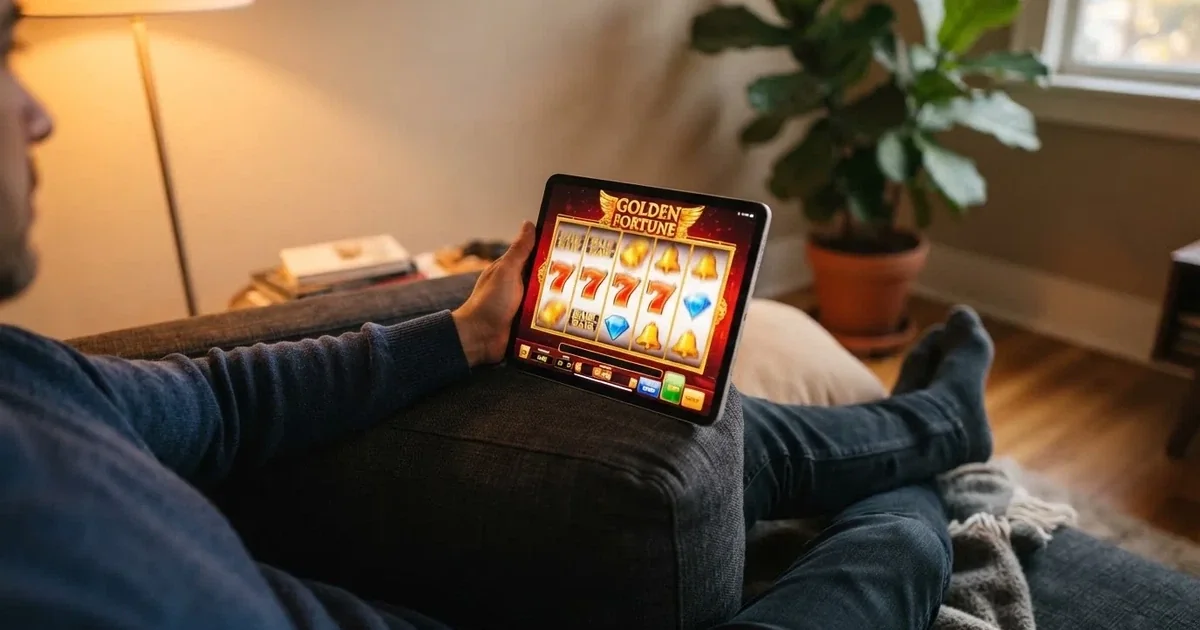
What the tablet format actually changes is the texture of play. A poker spin or a hand of blackjack runs at the same speed as on a desktop, but it runs in a chair, on a couch, between other things. A person who would never open a laptop at 1 a.m. will pick up the tablet because it is already in their hand. That matters for the next section, because the responsible-gaming tools that the law actually backs are built around deliberate sessions — a fixed deposit, a fixed time, a self-exclusion register — and the device that blurs those lines is the device a person uses the most.
See also The Reality of Offshore Pocket Pokies Casinos in Australia.
Legality in Australia: what the IGA actually prohibits
The Interactive Gambling Act 2001, as tightened by the Interactive Gambling Amendment Act 2017, makes it an offence to provide certain gambling services to a person physically in Australia. The list is short and specific: online casino games, online pokies (the Australian term for slot machines) and in-play betting on sport. Lotteries, keno and pre-event wagering on races and sport are licensable, and in practice most of those licences sit with the Northern Territory Racing and Wagering Commission (the NTRWC), which regulates 52 online bookmakers including Sportsbet, Bet365 and Ladbrokes, meets once a month in Darwin and, as reported in April 2026, runs without full-time staff. What the NTRWC does not license is any online casino game or online pokie, because no Australian state or territory has the power to issue such a licence. The minimum age to gamble online in Australia is 18.
A licence displayed in the footer of an offshore site — Curaçao, Anjouan, the Kahnawake Gaming Commission — has no effect on Australian law. The IGA is written so that the provider, not the player, commits the offence. The person who sits in front of the tablet is not prosecuted for opening the site; the offshore operator is the one the ACMA can act against. The practical consequence of that distinction is that an Australian player on an offshore site has no consumer protection under Australian law. There is no Australian complaints body to escalate a refused withdrawal to, no Australian ombudsman to argue a bonus dispute, no Australian regulator that can order a frozen balance back. The site blocks access from an Australian IP address, or the ACMA has the site added to the Australian block list, and the balance stays where it is.
The ACMA enforcement record through 2026
The ACMA’s enforcement against offshore casino and affiliate sites has built up steadily since November 2019, when the regulator made its first formal request to Australian internet service providers to block illegal gambling websites. As of June 2026 the ACMA had asked ISPs to block 1,751 illegal gambling and affiliate marketing websites in total, and more than 230 unlicensed gambling services had left the Australian market since enforcement was strengthened in 2017. The round reported on 26 June 2026 added twelve more: 7Signs, ChromaBet, Donbet, Duospin, Freshbet, Slots Gem, Jacks Club, Lucky Start, Pointsbetz, Spinrise, Vinyl Casino and Wildsino.
The H2 Gambling Capital 2025 report puts the cost of that enforcement gap at roughly A$3.9 billion a year in losses to illegal sites, with the share of gambling going through legal Australian channels falling from 74% in 2021 to 64%. Most of the loss is in casino and slots, which the IGA does not licence at all.
The formal-warning pattern by operator
The ACMA’s other main lever is the formal warning. A formal warning under the IGA is a public step that names the operator behind a site and tells them the ACMA considers their service a prohibited one. The pattern across 2022–2026 is that some operators and the corporate vehicles behind them have been warned more than once.
The Dama N.V. group sits at the centre of that pattern. In May 2022 the ACMA warned Dama N.V. over six brands — Bambet, Dazard, Level Up, Rocketplay, Wild Tornado and Cobra Casinos. In March 2025 the ACMA warned Dama N.V. again, this time over Woo Casino. Two months later, in May 2025, the warning was repeated over Spirit Casino. In March 2026 a separate warning was issued to Pulsup Ltd over Rocketplay, the same brand name as one of the 2022 Dama N.V. brands. The repetition suggests that the formal warning functions less as a deterrent and more as a public ledger of who the regulator has already told.
The Consolutetish S.R.L. group was warned in July 2025 over National Casino and Bizzo Casino. Bizzo Casino was already on the register: TechSolutions (CY) Group Limited and TechSolutions Group N.V. had been warned over it in 2022. The same July 2025 round produced a warning to Bamboo Media over Ignition Casino, and a separate warning in February 2025 named EOD Code SRL over Instant Casino. In April 2026 the ACMA warned Ryker B.V. over Jackbit and CasinOK; in April 2025, Sterplay Holding Ltd over Casino Intense. The Hollycorn N.V. corporate group, which runs Sky Crown and Blue Leo, sits on the same register from a 2022 formal warning.
The list of operators named below in this article is a direct subset of that record.
Penalties for licensed operators and the unpaid question for offshore ones
The penalties the IGA carries are written for the providers that can be reached in Australian jurisdiction. Since 11 June 2024, accepting payment by credit card, credit-related product or digital currency from an Australian customer on a licensed wagering service has carried penalties up to A$247,500 per offence. The same restriction is the reason PayID transfers to illegal sites now trigger a warning at the cashier: the operator processing them is operating outside the rules the licensed bookmakers follow.
Responsible gaming on a tablet: where the device changes the risk
A tablet in the hand changes the shape of a gambling session in ways the desktop never did. The laptop lives on a desk, in a room, behind a deliberate act of sitting down. The tablet is on the couch, on the bus, in bed, between two other taps. A responsible-gaming framework written for the desktop era assumes the player sets a limit before they start, plays until the limit is reached, and stops. On a tablet the boundary between “I am going to play” and “I am just scrolling” is harder to see, because the device is in the hand for other reasons most of the day.
The Australian system has three formal tools for managing that boundary, and all three assume a licensed Australian operator.
- Gambling blocks on bank cards. Commonwealth Bank’s gambling lock, activated in the CommBank app, blocks most gambling transactions at the card level, with the bank stating it cannot guarantee every gambling-related purchase will be stopped. ANZ runs an equivalent block, activated in the ANZ app, which also blocks gambling transactions made through a digital wallet such as Apple Pay on an eligible card. Once turned on, ANZ requires a 48-hour cooling-off period before the block can be removed. Westpac’s gambling block refuses authorisation of transactions registered under the merchant category code “Betting/Casino Gambling” on eligible personal credit and debit cards. These blocks target the merchant category, so a transaction that an offshore casino routes through a non-gambling MCC may slip past them.
- BetStop, the National Self-Exclusion Register. Live since August 2023, BetStop binds every Australian-licensed online and phone wagering service to honour a registered self-exclusion. It does not bind an offshore casino that has never held an Australian licence in the first place.
- National Gambling Helpline, 1800 858 858. Free, 24/7, with chat at Gambling Help Online.
What the system does not provide is a tool that catches a tablet session by surprise. A person who has decided to play will play; a person who has not decided to play will pick up the tablet for something else and find the casino tab still open. The first reaction is the one to plan for, and on a tablet it is worth deciding in advance — a fixed session length, a deposit cap set inside the operator’s own cashier if it offers one — rather than inside the moment.
For a person who already feels the boundary slipping, the 1800 number is the single number that works without requiring the device in their hand.
Payments on an iPad casino: what works, what gets blocked, what to watch
A player on an iPad has three payment routes open in practice: card-based payments through Apple Pay or directly through the cashier, instant bank transfers via PayID or Osko, and bitcoin or other cryptocurrency. Each of them has a different problem under Australian rules, and the rules for licensed operators differ from the rules an offshore operator enforces on its own customers.
Card payments and the credit-card ban
Since the 2023 amendment to the Interactive Gambling Act took effect on 11 June 2024, no Australian-licensed online wagering service can accept payment by credit card, by credit-related product or by digital currency. That ban extends in practice to a credit-funded Apple Pay transaction on an eligible card, because the underlying source of funds is a credit account. The Australian bank-level gambling blocks add a second layer: even on a debit card, a transaction routed through the “Betting/Casino Gambling” merchant category code will be declined by Commonwealth Bank, ANZ and Westpac blocks once they are turned on. ANZ’s block also covers Apple Pay transactions on an eligible card, and turning the block off carries a 48-hour waiting period.
The bank blocks target a merchant category code, which means an offshore casino that processes card payments under a different MCC — a general retail code, for instance — is not caught by the bank-level block. The transaction still lands on the customer’s statement, where it is clearly identifiable. That visibility is itself a control, because most Australian banks flag gambling-related transactions in their merchant description.
Apple Pay does not add a surcharge. Apple states that no consumer fees apply to Apple Pay in stores, online or in apps, and that transaction limits and PIN requirements are set by the issuing bank or the merchant, not by Apple. Any surcharge on a gambling-related transaction is the merchant’s surcharge, not Apple’s. The Reserve Bank of Australia’s July 2025 review proposed removing surcharges on eftpos, Mastercard and Visa transactions and left American Express outside the scope of that ban; Amex’s three-party network, where it issues cards and processes transactions itself rather than working through a four-party scheme, sits outside the typical interchange debate.
By the end of 2025, Apple Pay, Google Pay and Samsung Pay together accounted for around 45% of all card payments in Australia by number, which means most card transactions a player attempts from an iPad go through a wallet rather than the card itself. Whether the wallet pays with a credit or debit balance depends on the card the wallet has been loaded with.
PayID, Osko and the bank’s view of the payee
A PayID transfer is an Osko transfer, and an Osko transfer between participating Australian banks arrives in under a minute, 24/7 including weekends, addressed either to a BSB and account number or to a PayID. PayID-based instant transfers are available at over 100 Australian financial institutions and more than 25 million PayID identifiers had been registered on Australia’s New Payments Platform as of April 2025. The New Payments Platform became accessible to the public on 13 February 2018; it is owned by New Payments Platform Australia Ltd, a non-profit company whose 13 shareholders include the Reserve Bank of Australia and the country’s major banks. Participants are required to keep monthly platform outages to under two minutes, and in 2021 the ACCC authorised the merger of NPP Australia with BPAY and eftpos into a single company, Australian Payments Plus.
The PayID feature that matters most for an iPad player is the name check: the payee’s registered account name appears on the confirmation screen before the transfer is sent. Australian Payments Plus warns that being asked to transfer money to a PayID on an illegal gambling site almost certainly means a scam site. A player who sees a corporate name that does not match the brand shown on the casino tab is being shown a signal that the operator would prefer they ignore.
BPAY
BPAY is a bill-payment service operated through online banking, available at over 140 Australian banks and financial institutions and offered by over 95,000 businesses. The payer enters the Biller Code and Customer Reference Number printed on the bill. BPAY launched on 18 November 1997 and is owned equally, through parent company Cardlink Services Limited, by Australia’s four major banks: ANZ, Commonwealth Bank, National Australia Bank and Westpac. Since the 2021 ACCC authorisation it has operated under Australian Payments Plus. BPAY is not a typical deposit route for an offshore casino, but it appears on the cashier of some Australian-licensed wagering services and is the model the consumer is most used to.
Bitcoin and other cryptocurrency
Cryptocurrency is, in Australian law, “digital currency” and is banned as a payment method for Australian-licensed online wagering services since 11 June 2024. An offshore iPad casino that accepts bitcoin is not bound by that rule. From the operator’s point of view, a crypto deposit skips the merchant category code system entirely; from the player’s point of view, the same deposit bypasses every bank-level gambling block because no bank is involved.
AUSTRAC’s threshold-transaction-report rule, which requires reporting of transfers of A$10,000 or more, applies only to physical cash. Ordinary electronic bank transfers are not subject to that per-transaction reporting rule, regardless of the amount sent. A crypto transfer to a non-Australian exchange, and the conversion back to Australian dollars on the way out, sit outside the AUSTRAC threshold rule entirely. That does not make the funds untraceable, but it does mean the bank-side intervention a player might be relying on to stop them is not in play.
iPad casinos in Australia in 2026 — More on this topic at casino offshore hub.
Mobile and app: how an iPad casino actually reaches the screen
Almost no legitimate iPad casino app exists in the Apple App Store. Apple’s developer guidelines have, for the full history of the iOS App Store, restricted real-money casino apps from being distributed through the store in jurisdictions where they are not licensed. That includes Australia, where no online casino licence exists to licence an app against. What an iPad player meets instead is one of two things: a mobile browser version of an offshore casino’s regular website, or an “app” that the casino distributes as a download from its own site, a Progressive Web App shortcut, or a wrapped application installed through an enterprise profile or a third-party store. None of those are App Store apps.
The browser version is the common case. The same HTML5 code that renders a slot reel on a desktop scales down to a touch-friendly canvas; the live-dealer lobby streams to the same HLS endpoint; the cashier runs in the same iframe. What changes is friction: a finger-sized spin button rather than a click, a portrait-mode lobby that scrolls vertically, deposit buttons placed within thumb reach. The performance is comparable to a mid-range laptop running the same site in Safari, with two caveats. Battery drain under live-dealer streaming is heavier than a desktop running off mains power, and on a cellular connection the same game will buffer in a way a fixed-line connection never did.
The shortcut-style apps add a tab to the home screen and a full-screen launch experience, but underneath they are still the same browser tab. They feel more like an app than they behave like one. The third category — wrapped applications from outside the App Store — is the one where an iPad player needs to pay closest attention: installing an application profile outside Apple’s ecosystem means the application has not been reviewed by Apple and is not subject to the App Store’s privacy and data-handling rules. On a device used for online banking, that is a meaningful exposure.
The format choice is mostly invisible to the player. What is visible is whether the site responds on a 11-inch screen without zooming, whether the cashier buttons clear the thumb arc, whether the live-dealer video stutters on the device’s actual connection. Those are the same questions the marketing pages answer in their own favour. The honest test is a small deposit and a withdrawal: how the cashier behaves when money goes in is unrelated to how the cashier behaves when money comes out.
Operator enforcement record: eleven brands named by the ACMA
The ranking on this page is not a recommendation. Online casino gambling is prohibited in Australia under the Interactive Gambling Act 2001, no matter what licence an offshore site displays in its footer. The eleven brands below appear here because the ACMA itself has named them in a formal warning under the IGA, in the order the warnings were issued. A player who nonetheless opens one of these sites on an iPad does so outside Australian consumer-protection law.
The table records what research actually carries: the brand, the ACMA action and its date, the operator the ACMA named behind it, and whether the listed Australian payment or self-exclusion sources link to that brand at all. Several brands link to none of those sources at all, and that absence is itself a signal.
Operator Enforcement Summary
| Brand | ACMA Warning Date | Operator |
|---|---|---|
| RocketPlay | March 2026 / May 2022 | Pulsup Ltd / Dama N.V. |
| Level Up Casino | May 2022 | Dama N.V. |
| Woo Casino | March 2025 | Dama N.V. |
| Spirit Casino | May 2025 | Dama N.V. |
| National Casino | July 2025 | Consolutetish S.R.L. |
| Bizzo Casino | July 2025 / 2022 | Consolutetish S.R.L. / TechSolutions |
| Ignition Casino | July 2025 | Bamboo Media |
| Instant Casino | February 2025 | EOD Code SRL |
| Jackbit | April 2026 | Ryker B.V. |
| Casino Intense | April 2025 | Sterplay Holding Ltd |
| Sky Crown | 2022 | Hollycorn N.V. |
What the columns leave out is as informative as what they show. Of the eleven brands, four appear on Australian payment or register sources (Level Up on Westpac, National Casino on ACMA, AUSTRAC and BetStop, Instant Casino on ecoPayz and PayID, Casino Intense on AUSTRAC, BetStop and gambling-insider). The other seven appear in no Australian payment-side context at all, which means a player searching for the brand will not find it listed on a Westpac gambling block notice, a PayID warning page or an AUSTRAC case file. That is not a sign of safety. It is a sign that the brand has not surfaced enough for an Australian intermediary to notice.
A repeat warning against the same operator is a more pointed signal than a first. Dama N.V. was warned in May 2022 over six brands, then warned again in March 2025 over Woo and in May 2025 over Spirit; the 2026 Rocketplay warning was issued to Pulsup Ltd but covers the same brand name as the 2022 Dama N.V. entry. Bizzo Casino was warned through two different corporate vehicles — TechSolutions in 2022 and Consolutetish S.R.L. in 2025 — without the warning producing a withdrawal from the Australian market. The ACMA’s enforcement reaches the warning; it does not, in the data above, reach a withdrawal.
How fast the ACMA adds sites to the block list
The arithmetic on this page is a band rather than a single figure. The ACMA made its first blocking request in November 2019. As of June 2026 the running total of illegal gambling and affiliate marketing websites blocked was 1,751. That gives a band between roughly 214 sites a year (1751 divided by the 79 months between November 2019 and June 2026) and a slower rate in the early years when monthly rounds numbered in single digits, and a faster one in 2024–2026 when the regulator published larger rounds at shorter intervals. Reporting the rate as one figure is dishonest in either direction: the early rate was much lower than the late rate, and the published monthly rounds of 2025–2026 cluster at the high end of that band. The honest statement is that the ACMA is now adding sites to the block list at a rate that, taken across 2024–2026, sits towards the upper end of the long-run average and well above what the early enforcement years produced.
Brand-by-brand read: who each operator is, and what the warning actually says
RocketPlay
The ACMA named Pulsup Ltd in a formal warning published in March 2026 over Rocketplay. The same brand was one of six covered by the ACMA’s May 2022 warning to Dama N.V., alongside Bambet, Dazard, Level Up, Wild Tornado and Cobra Casinos. The corporate vehicle changed between the two warnings; the brand name did not. RocketPlay appears on gambling-insider listings as an offshore casino and is not connected to any Australian register. The honest reading is that the brand has been on the ACMA’s radar long enough to outlive one operator change.
Level Up Casino
The ACMA’s May 2022 formal warning to Dama N.V. is the only published action on Level Up, but the brand has surfaced in a different Australian context: Westpac’s gambling-block documentation lists Level Up among transactions that the card-level MCC check is built to catch. That puts Level Up in a small group of brands on this page that an Australian bank has chosen to name in consumer-facing compliance material. Westpac’s block refuses authorisation of transactions registered under the merchant category code “Betting/Casino Gambling” on eligible cards, so a Level Up deposit attempt from an Australian-issued card is likely to be declined on the merchant-code check regardless of the operator’s own cashier behaviour.
Woo Casino
Woo Casino was named in the ACMA’s March 2025 formal warning to Dama N.V., the second Dama N.V. warning after the May 2022 round. No Australian payment-side register links to the brand. Wagering on Woo Casino is the wagering itself: there is no licensed Australian overlay for an offshore casino, and a player on an Australian-issued card is dealing with an operator that the ACMA has formally told to stop.
Spirit Casino
The ACMA’s May 2025 warning to Dama N.V. is the public action on Spirit Casino. Spirit is the third Dama N.V. brand named in the ACMA register after the May 2022 round and the Woo Casino warning. The pattern across the Dama N.V. portfolio — six brands in 2022, two more in 2025 — is consistent with a group that has continued to operate Australian-facing casino sites despite repeated warnings.
National Casino
National Casino was named in the ACMA’s July 2025 formal warning to Consolutetish S.R.L. The same operator was warned the same month over Bizzo Casino. National Casino is one of the more visible names on this list in the Australian intermediary space: it appears on the ACMA, AUSTRAC and BetStop pages as a brand whose activity has warranted mention, alongside its appearances on gambling-insider listings. The same month-and-operator pair as Bizzo Casino is a corporate-vehicle pattern rather than a coincidence, and a player comparing the two reads the same July 2025 warning either way.
Bizzo Casino
The ACMA’s July 2025 warning to Consolutetish S.R.L. over Bizzo Casino was the second formal warning the brand has received. The first, in 2022, was issued to TechSolutions (CY) Group Limited and TechSolutions Group N.V., two related corporate vehicles in the same group. The same operator-corporate-vehicle rotation that produced two warnings against Dama N.V. across 2022 and 2025 has produced two against the TechSolutions / Consolutetish group across 2022 and 2025. Bizzo Casino appears on gambling-insider listings and, like the other Consolutetish brands, has been the subject of an Australian register mention.
Ignition Casino
Bamboo Media was named in the ACMA’s July 2025 formal warning over Ignition Casino. The brand is not connected to an Australian register in the materials available. A player on Ignition is dealing with a brand the ACMA has named once and that the Australian intermediary space has not, in the data above, had reason to mention. That is the smallest signal an offshore brand can carry.
Instant Casino
EOD Code SRL was named in the ACMA’s February 2025 formal warning over Instant Casino. Instant Casino surfaces in two Australian payment-side contexts: ecoPayz’s documentation and PayID’s warning page both name the brand in connection with offshore gambling activity. That is a more pointed signal than the ACMA warning alone: an Australian payment intermediary has chosen to single the brand out as a known offshore payment destination. The PayID warning that being asked to transfer money to a PayID on an illegal gambling site almost certainly means a scam site is consistent with the brand profile.
Jackbit
Ryker B.V. was named in the ACMA’s April 2026 formal warning over Jackbit and CasinOK in the same warning. Jackbit is a crypto-first casino and is one of the brands on this list that takes a bitcoin or other cryptocurrency deposit route as a primary option, which puts the brand outside the card-based MCC block that catches most Level Up-style transactions. The payment-side signal on Jackbit is that no Australian register mentions the brand. The legal signal is the same as the rest: the ACMA has formally warned the operator.
Casino Intense
Sterplay Holding Ltd was named in the ACMA’s April 2025 formal warning over Casino Intense. Casino Intense appears on AUSTRAC, BetStop and gambling-insider listings — three separate Australian register mentions alongside a listing-industry mention. Three Australian-side mentions on one brand is the densest concentration on this list after National Casino. The April 2025 date puts the warning after the credit-card ban took effect on 11 June 2024, which means a player trying to deposit on a credit card from an Australian bank would be attempting a transaction the issuing bank is required to refuse even before the merchant block applies.
Sky Crown
Hollycorn N.V. was named in the ACMA’s 2022 formal warning over Sky Crown and Blue Leo casino services. Sky Crown is the 2022 entry on this list — the oldest formal warning still active — and the brand is not connected to an Australian register in the materials available. The 2022 formal warning predates the credit-card ban and the August 2023 launch of BetStop, so the regulatory environment the warning was issued in differs from the one a player opening the site today would be operating in.
How to read the ACMA register for any other brand a player meets
The table above covers the eleven brands the ACMA has formally warned, in warning date order. A player meeting a brand that does not appear on the table is still meeting an offshore casino site, and the relevant question is whether the ACMA has named the operator. The ACMA publishes its formal warnings as PDFs and HTML pages on its own website, with the operator name, the brands covered and the date of the warning. A player who can find the operator on that page knows the regulator has formally told the operator their service is prohibited. A player who cannot find the operator has either found a brand the ACMA has not yet acted on, or a brand whose marketing is not what the regulator’s register expects.
The block list is a different document. The ACMA’s blocking requests to ISPs are public, and a player who wants to know whether a site is currently being blocked at the ISP level can check the list directly. A site not on the block list is not legal; a site on the block list has been formally declared prohibited. The two are different questions: the formal warning is a letter; the blocking request is an enforcement step.
Money, tax and the question of getting funds back
The IGA does not tax recreational gambling winnings. Under section 6-5 of the Income Tax Assessment Act 1997, gambling winnings of a recreational player are not assessable income, and losses are not deductible. The rule reverses for a person who carries on a business of gambling — for example, a professional card counter or a poker professional — at which point the ATO’s business-income rules apply. A casual player on an iPad casino site, depositing in Australian dollars and withdrawing the same way, sits on the recreational side of that line. Whether the deposit ever clears is the more pressing question than how the winnings are taxed, because the operator that disappears after a withdrawal request does not issue a tax statement.
Recovering funds from an offshore operator that has refused a withdrawal is the practical problem. The site is outside Australian jurisdiction. The bank that issued the card sits inside Australian jurisdiction but the chargeback rules for gambling transactions are uneven and operator-specific. A player who funded the deposit from an Australian-issued credit card after 11 June 2024 has a stronger argument — the merchant accepted a transaction the merchant should have refused — but the practical route remains the issuing bank’s dispute process rather than an Australian regulator.
What the 2026 reforms actually change
The Interactive Gambling Amendment (Gambling Reform) Bill 2026 passed the Australian Parliament on 19 August 2026. Its advertising and inducement measures commence on 1 January 2027. The page a person reads in 2026 is read under the existing law, with the 2027 measures sitting as enacted-but-not-yet-commenced provisions. What that means in practice is that an inducement or advertisement that is currently compliant becomes non-compliant on 1 January 2027, and an offshore casino marketing into Australia is the same legal entity both before and after the commencement date. The 2026 amendments do not change the underlying prohibition on online casino games. They tighten the inducement rules around licensed wagering.
What an Australian iPad player actually does
The legal answer is the boring one: do not open the offshore casino site, because the operator is committing the offence the IGA was written to reach. The practical answer is more layered.
A player who has already been playing and wants to stop has a single number to call, 1800 858 858, and a single register to enrol in, BetStop. Both are free. BetStop binds Australian-licensed wagering services; an offshore casino is not in the system, but the bank-level gambling blocks (CommBank, ANZ, Westpac) cover the cash side of an offshore deposit. Turning on all three — the helpline for the human side, the register for the licensed-wagering side, the bank block for the cash side — closes the practical routes through the system the IGA does not cover.
A player who wants to keep playing within Australian law has a short list of options: licensed wagering on races and sport, pre-event and through a Northern Territory–licensed bookmaker such as Sportsbet, Bet365 or Ladbrokes; lotteries and keno through a state-licensed operator; and the social-casino apps on the App Store that run on virtual currency rather than real money. None of those is an iPad casino in the sense the marketing pages use the word.
A player who is going to open an offshore site on an iPad anyway should know what they are paying for, in concrete terms: no Australian consumer protection, no BetStop binding, no bank block that catches every transaction, no tax statement on the winnings, and a real chance that the ACMA has the site on the block list or the operator on the formal-warning register by the time the deposit clears. The marketing pages have an answer for none of that. Honest information does.
Frequently asked questions
Is it legal to play at an online casino on an iPad in Australia?
No. The Interactive Gambling Act 2001 prohibits online casino games and online pokies from being provided to a person in Australia, regardless of the device. The IGA names the act of providing the service, not the screen it appears on, so a browser tab on a tablet is covered exactly the same way as a desktop. The operator, not the player, commits the offence. What the player loses is Australian consumer protection.
Why do most iPad casino sites run through a browser instead of a dedicated app?
Apple restricts real-money casino apps from the App Store in jurisdictions where they are not licensed, and no Australian licence covers online casino games. Operators respond by either shipping a mobile browser version of their regular site or distributing a wrapped application through their own download page or a third-party store. The performance is similar but the wrapped applications have not been reviewed by Apple and carry more data-handling exposure.
Does a bitcoin-funded iPad casino work any differently from a card-funded one?
From the player’s side, the experience is comparable: deposit, play, request a withdrawal. From the operator’s side, a bitcoin deposit skips the card network entirely, so the merchant category code system the bank-level gambling blocks target does not apply. Digital currency is, in any case, banned as a payment method for Australian-licensed wagering services since 11 June 2024, so the bitcoin option is also a marker that the operator is operating outside the Australian licensed-wagering rules.
What conditions usually apply before an iPad casino no-deposit bonus can be withdrawn?
A no-deposit bonus still runs through the same review process as any other bonus before a withdrawal is possible, and the published terms usually include a wagering multiple, a maximum cashout cap, an expiry on the bonus itself and a list of games that contribute differently to the wagering. The review is a manual one and can take several business days. No Australian register checks the operator’s stated terms, so the player is the only one reading them.
Are the games on an iPad casino site identical to the desktop version?
The game library is the same HTML5 or wrapped code; the layout adapts to the touchscreen. The RNG, the RTP and the house edge are properties of the game server and do not change between desktop and tablet. What does change is the texture of the session: a touchscreen session is easier to start and harder to time, which is the responsible-gaming point the desktop was never asked to address.
What should someone check before entering payment details into an iPad casino site?
The first check is the operator’s own corporate name in the terms page, and whether that name matches the brand name on the casino tab; the ACMA register can be searched by operator name to see whether the operator has been formally warned. The second is the payment method: a request for a credit card or a cryptocurrency deposit on an Australian-facing site is itself a sign that the operator is outside the Australian licensed-wagering rules. The third is the Australian intermediary space — a Westpac gambling-block notice, a PayID warning page, an AUSTRAC case — for any mention of the brand at all, which is the closest thing to a consumer-side signal the Australian system provides.