
What a $10 minimum-deposit online pokies page in Australia is really telling you
The straight answer is on the first line: there is no licensed $10 minimum-deposit online pokies product in Australia. The Interactive Gambling Act 2001 prohibits online casino games and online pokies for anyone in this country, and no state or territory issues a licence for them. Every site that advertises itself as a $10 deposit pokies room to an Australian player is doing so from outside Australian law, which is the single fact the rest of this guide comes back to. Anyone thinking about sending $10 to one is buying access to an offshore service that the ACMA has been working through for years, with no Australian consumer protection attached, and that is the frame the page works inside.
Current as of 29 October 2026; verified against the ACMA’s published formal-warning register.
Table of Contents
- Payments, settlement, and the quiet gap between $10 in and $10 back
- The eleven names on the ACMA’s warning list, side by side
- The picture behind the page
- The fundamentals of $10 minimum-deposit online pokies play in Australia
- Legality, and the Australian frame around it
- Safe $10 deposit pokies play — and the help that is actually free
- The blocking record, read as an arithmetic
- The operators behind the ads — and the picture the record paints
- What the table actually adds up to
- How this page sits next to a real Australian pokie
- What the arithmetic costs in plain language
- The deeper reading of the page
- What the page is, and what it is not
- Where to read more, and where to get help
- Frequently asked questions
Payments, settlement, and the quiet gap between $10 in and $10 back
How a $10 deposit would settle on an Australian card — and why that is the wrong question
A $10 deposit on a licensed Australian wagering account follows PayID, Osko, BPAY, debit card or direct bank transfer; the funds move through the standard NPP rails or the card network and typically land within seconds for PayID and minutes for the rest. None of that applies here. A site marketing itself as a $10 deposit online pokies room to an Australian punter is not connected to NPP or the local banking layer, and the deposit the page is talking about is a card payment, an e-wallet top-up or, increasingly often, a crypto transfer to a wallet the punter does not control. The settlement question — how fast does $10 land — is the wrong question, because the deeper one is which system is actually receiving it.
What the deposit pathway tells you about the brand
When the checkout is asking for a Visa or Mastercard on a Curacao-registered domain, or a Bitcoin address next to a “min deposit $10” line, the operator is advertising itself to Australians from outside the framework that protects the rest of a punter’s banking. Credit cards and credit-related products have been banned for licensed online wagering in Australia since 11 June 2024, with penalties up to A$247,500 for operators; a site asking for a credit card is on the wrong side of that line. PayID, Osko and BPAY are not relevant because they are not channels the offshore brand accepts. The fastest “instant” deposit in this market is also the slowest to dispute: a crypto transfer that arrives on-chain cannot be recalled once it is confirmed.
What happens to a withdrawal — and why it stalls
For a licensed Australian wagering account, withdrawal timing is governed by the operator’s own published terms, by the bank’s NPP windows, and by e-payment scheme rules; PayID and Osko payouts land in seconds, BPAY payouts clear the same day, and bank transfers settle overnight. The offshore version of this page has none of that protection. The operator processes withdrawals on its own schedule, in its own currency of choice, and the player has no Australian complaints body to take a stalled payout to. ACMA actions over the years have covered brands that simply stopped paying — formal warnings have named individual sites whose customers were waiting on balances that never came. The point is not that every offshore brand refuses payouts; the point is that the system that catches a refusal — the local regulator, AFCA, the ePayments Code — does not reach the offshore operator.
The PayID gap, the credit-card ban and the NPP ceiling
The local deposit mix is worth naming in full, because it shows how thin the legitimate side of the market is. PayID, Osko and BPAY move money in real time between Australian bank accounts, and direct debit and bank transfer cover the rest of the licensed bookmaker business. Credit cards and credit-related products are out. Digital currencies are out. Anything else an Australian sees in a deposit box on an offshore site is the operator’s own choice. From a player’s perspective the practical result is that the licensed deposit mix is small, fast and well-regulated; the offshore deposit mix is broad, opaque, and in the wrong jurisdiction the moment a complaint is needed.
The eleven names on the ACMA’s warning list, side by side
Every brand below has had an ACMA formal warning issued over it for offering prohibited interactive gambling services to people in Australia. The table is a snapshot of the regulator’s published record, not a ranking and not a recommendation; nothing here is being suggested as a place to play. The column “subject support” reflects only what the cited sources list; where the support line is empty, the brand is presented on its other fields only.
| Brand | ACMA action and date | Operator named by the ACMA | Subject support |
|---|---|---|---|
| RocketPlay | Formal warning, March 2026 (Pulsup Ltd); earlier Dama N.V., May 2022 | Pulsup Ltd | — |
| Level Up Casino | Formal warning, May 2022 | Dama N.V. | Listed on BGaming’s partner page (listings-only) |
| Woo Casino | Formal warning, March 2025 | Dama N.V. | — |
| Spirit Casino | Formal warning, May 2025 | Dama N.V. | — |
| National Casino | Formal warning, July 2025 | Consolutetish S.R.L. | Listed in coverage of Australian-facing casino brands (listings-only) |
| Bizzo Casino | Formal warning, July 2025; earlier TechSolutions, 2022 | Consolutetish S.R.L. | — |
| Ignition Casino | Formal warning, July 2025 | Bamboo Media | — |
| Instant Casino | Formal warning, February 2025 | EOD Code SRL | — |
| Jackbit | Formal warning, April 2026 | Ryker B.V. | — |
| Casino Intense | Formal warning, April 2025 | Sterplay Holding Ltd | Listed in Australian regulatory coverage (listings-only) |
| Sky Crown | Formal warning, September 2022 (Sky Crown and Blue Leo) | Hollycorn N.V. | — |
The table is the page’s one piece of arithmetic: every row is a name the regulator itself has published against an Australian-facing operator, and every row carries a date. The “operator named by the ACMA” column is the registered company the regulator has on file — the licensee behind the marketing brand — and it is worth noting that several operator names repeat across rows (Dama N.V. appears four times in this set, Consolutetish S.R.L. twice). The pattern is the point: a small number of offshore holding companies run a long list of skins, and the ACMA is working through them brand by brand, year by year.
Reading the table the way the regulator’s record reads
A formal warning is the ACMA’s first public step, not its last. The warnings run in a familiar sequence: the regulator publishes a list, ISPs are asked to block the named domains, and the operator — if it is the same holding company — opens new ones. The 26 June 2026 blocking round alone named 12 fresh domains (7Signs, ChromaBet, Donbet, Duospin, Freshbet, Slots Gem, Jacks Club, Lucky Start, Pointsbet, Spinrise, Vinyl Casino and Wildsino), all on the same round. The names in the table above are the ones that have stuck long enough to have a published warning attached, and the new ones are appearing on a rolling basis. Treat any “new” $10 deposit pokies site that surfaces in an Australian ad buy as the latest edition of a list the regulator has been working through since 2017.
The picture behind the page
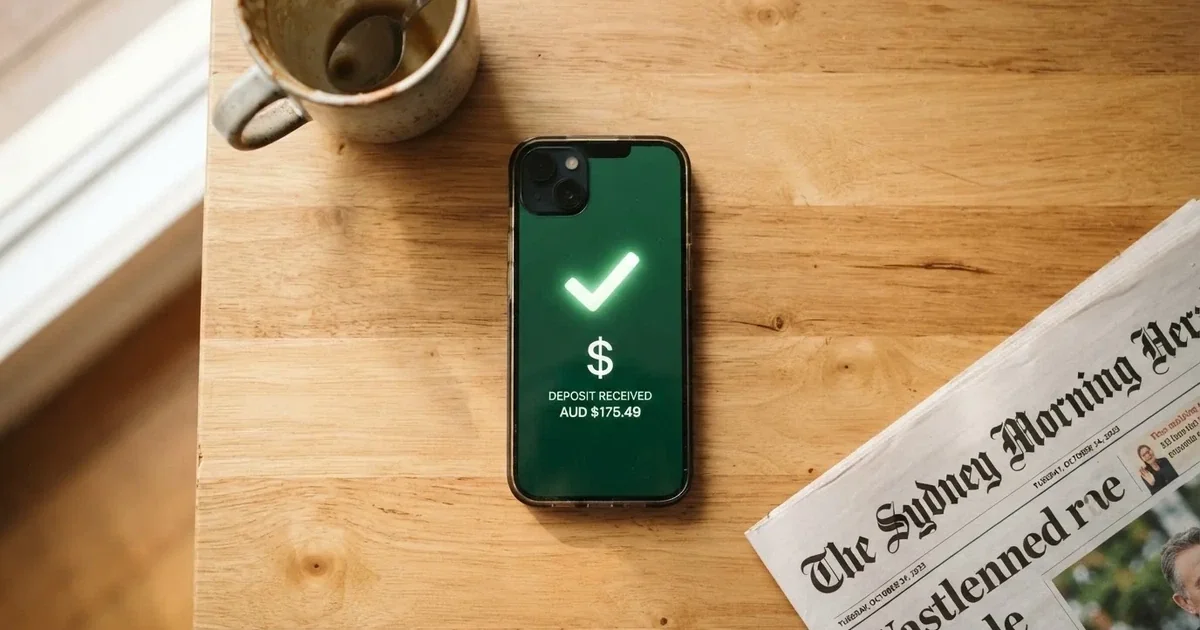
A smartphone screen, a kitchen table and the Woo Casino warning
The ACMA issued formal warnings over Woo Casino in March 2025 and Spirit Casino in May 2025. Both warnings named Dama N.V. as the registered operator; both warnings followed the same Interactive Gambling Act template; both warnings landed within two months of each other and named two brands run by the same holding company. The pattern is so common on the regulator’s website that it stops looking like coincidence and starts looking like an industry model: one operator, many brand names, one regulator playing catch-up.
The desk, the search page and the July 2025 round
In July 2025 the ACMA issued formal warnings over Ignition Casino, National Casino and Bizzo Casino, the last of which had already been warned in 2022. The earlier 2022 warning had been issued to TechSolutions (CY) Group Limited and TechSolutions Group N.V.; the 2025 one to Consolutetish S.R.L. The operator had changed, the brand name had not, and the regulator was filing the second warning on the same product. Each step on a regulator’s record is a brand that survived a previous warning, was re-detected, and was warned again — and the gaps between warnings are the silent measure of how long an offshore brand can keep running with Australian traffic between name changes and domain swaps.
The red triangle and the Instant Casino warning
In February 2025 the ACMA issued a formal warning over Instant Casino, naming EOD Code SRL as the operator. The warning was published in the same format as every other on the register; the brand was on the same kind of Curacao-registered footing as the others in the table. What is unusual about the Instant Casino case is the speed of the regulator’s response: a brand that was barely six months old in some tracking feeds had already drawn a formal warning, and the warning sat on the register inside the year it was set up. The lesson is not that the regulator caught every new entrant, but that the regulator caught this one in time, and the rest of the field is what the rest of the page is about.
The fundamentals of $10 minimum-deposit online pokies play in Australia
What “minimum deposit $10” actually packages
A “min deposit $10” line on a pokies site is a marketing filter designed to pick up low-stakes traffic. It does not mean the casino is cheap to play on; it means the floor is set at $10 so that a search for “pokies $10 deposit” lands on it. Below that line, the operator offers a signup bonus, a first-deposit match and often a free-spins package on a flagship pokie, all of which carry wagering requirements, maximum cashout caps and game-weighting rules the player meets only by reading the terms. The $10 is the price of entry; the rest is the offer the player is then sold, and the two are easy to confuse because they appear on the same landing page.

How the offer’s wagering actually works
A typical first-deposit bonus multiplies the deposit by a factor — somewhere between 30 and 50 times is the published range across this market — and asks the player to run that multiplied total through eligible pokies before any winnings become withdrawable. A $10 deposit with a 40x wagering requirement on the bonus creates a required turnover of $400 in eligible pokie bets, which on a $1-per-spin stake is 400 spins, which at roughly five seconds per spin runs to around 33 minutes of play. The catch is that the “bonus” in this arithmetic is often the bonus amount, not the deposit-plus-bonus; a $10 deposit with a 100% match and a 40x bonus-only requirement runs $400 of required turnover, but the same match with a 40x deposit-plus-bonus requirement runs $800. Reading which of the two applies is the single most expensive paragraph in any terms page.
The cost the marketing never names
On a pokie with a 96% return-to-player, every dollar wagered returns 96 cents on average across a long session — meaning a 4 cent per dollar house edge. The expected cost of clearing that $400 of bonus-only wagering, assuming only the bonus is run through the games, is $16 of expected loss across the clearing session; on the deposit-plus-bonus version it is $32. The marketing word for this is “free spins” or “bonus cash”; the arithmetic word is “expected cost”. Players with a small bankroll feel this edge more sharply because their session covers a smaller share of the long-run average, and the variance can empty the account before the wagering requirement is cleared at all.
The volatility question the $10 deposit hides
A $10 deposit runs out fast on a high-volatility pokie, which is the kind the welcome bonus is usually tied to. High-volatility pokies pay less often and in larger amounts, so the same $10 has to survive long losing runs before any feature round pays out, and the wagering requirement has to be cleared during those runs. Low-volatility pokies pay more often and in smaller amounts, which keeps the $10 alive longer but makes the bonus harder to “clear” in any impressive sense. The $10 deposit floor is a slot-machine marketing device, and the choice of pokie it ties the bonus to decides whether the $10 is gone in two minutes or two hours.
Legality, and the Australian frame around it
What the Interactive Gambling Act actually says
The Interactive Gambling Act 2001 (IGA), strengthened by the Interactive Gambling Amendment Act 2017, makes it an offence to provide online casino games, online pokies or in-play betting to a person physically in Australia. The offence is on the provider — the operator offshore — not on the individual player. The IGA does not name online pokies by that phrase, but the regulations and the ACMA’s enforcement record treat online casino games as a prohibited interactive gambling service in practice, and online pokies sit squarely inside that class. What is licensable is wagering on races and sport placed before the event, lotteries and keno, which in practice are licensed by the Northern Territory Racing and Wagering Commission. The NTRWC regulates 52 of Australia’s online bookmakers — including Sportsbet, Bet365 and Ladbrokes — from a one-day-a-month meeting in Darwin and a very small staff.
What the ACMA does, in order
The ACMA’s enforcement steps run in a sequence: investigate, issue formal warning, ask ISPs to block, and refer for civil penalty proceedings where the conduct continues. The blocking side has been busy. The ACMA reported in June 2026 that a total of 1,751 illegal gambling and affiliate marketing websites had been blocked since the first blocking request in November 2019, and more than 230 unlicensed gambling services had left the Australian market since enforcement was strengthened in 2017. The pace has not slowed: the June 2026 round alone asked ISPs to block 12 more. From a punter’s perspective the point is that the list of brands the regulator has acted against is not a closed one — it is a rolling register, and the page above is a snapshot of it, not an endpoint.
What is licensed, and what is not
The licensed product in Australia is the pub or club poker machine, regulated state by state, plus the licensed online and phone bookmaker taking bets on races and sport. New South Wales had 87,298 gaming machines outside casinos across 2,195 venues in June 2023, with player losses of A$8.18 billion in 2022–23. Queensland had 21,122 gaming machines in 351 venues in October 2023. Victoria had 26,380 machines outside Crown Casino in 488 venues in 2021–22, under a 30,000 statewide cap. Western Australia banned poker machines in pubs and clubs when Crown Perth opened in 1985, leaving the casino’s roughly 2,500 machines as the only legal pokies in the state. None of these machines is the $10 deposit online pokie the search terms ask for, and the difference between the two — the legal one and the offshore one — is the entire subject of this page.
The minimum return-to-player the law requires
The legal minimum return-to-player for poker machines varies by jurisdiction: 85% in NSW, the NT, Queensland and (generally) Victoria, with 87% at Crown Melbourne, 87% in the ACT and Tasmania, 87.5% in South Australia, and 90% in Western Australia. These are floors, not averages — many machines sit above them, and Crown Perth’s 90% floor is the highest in the country. The offshore site advertising $10 minimum deposit pokies has no Australian-mandated floor, no Australian-tested RNG and no Australian-published return-to-player figure. The 96% number used as an example in the previous section is a typical online figure, not a guaranteed one, and the brand does not have to publish its own.
Why the rule targets the provider, not the player
The IGA puts the offence on the operator. A punter who clicks through to an offshore site does not commit an offence under the Act; the operator does. That asymmetry is what makes the offshore market tenable from one end and untenable from the other. The player can place a deposit without committing an Australian offence; the operator that accepts that deposit is offering a prohibited service to an Australian. Once the deposit is accepted, the player has no AFCA route, no ePayments Code coverage, and no local complaints body to turn to, because the operator is not in any of those systems. The legal freedom of the player is the structural exposure of the player.
The 2026 reform that has not started yet
The Interactive Gambling Amendment (Gambling Reform) Bill 2026 passed Parliament on 19 August 2026, and its advertising and inducement measures commence on 1 January 2027. The reform is law with a start date, not a regime in force on a 2026 page. From 2027 the inducement side — bonus offers, “free bet” promotions and sign-up credit — will face new constraints, and the offshore brands chasing Australian traffic will have less of a marketing surface to buy ads on. The reform does not legalise online pokies; it tightens the rules around how the existing prohibition is marketed.
Safe $10 deposit pokies play — and the help that is actually free
The free, confidential help that does run around the clock
If any of the above starts to feel compulsive — the urge to chase a $10 loss with another $10, the late-night session that runs longer than planned, the growing list of deposit attempts on the bank statement — free confidential help is available around the clock. Gambling Help Online runs a 24/7 chat and phone service, with the National Gambling Helpline at 1800 858 858. The line is free from any Australian phone, the chat is staffed by counsellors rather than salespeople, and the service does not ask the caller to leave a name. The same service handles family members and friends who are worried about someone else’s play.
BetStop and what it cannot reach
BetStop, the National Self-Exclusion Register, has been live since August 2023 and binds Australian-licensed online and phone wagering services. A punter who registers with BetStop is excluded from every licensed Australian bookmaker; the operator has to refuse the bet and refund any deposit that slips through. BetStop does not bind an offshore casino. A punter who has registered with BetStop can still open an account at an offshore site, because that site is not in the BetStop network, has not agreed to honour the exclusion, and is not bound by the National Consumer Protection Framework. The exclusion is real for the licensed side of the market; it is invisible on the offshore side.
The practical line between a hobby and a problem
There is no clean threshold between recreational play and gambling harm; the marker is whether the play is doing what the punter thinks it is. A $10 deposit that gets treated as the cost of an evening’s entertainment, with any winnings as a bonus, looks different from the same $10 sent to chase a previous $10 loss. The honest version of the question — am I choosing this or am I running from the last one — is the line the help services are set up to talk through, and the line that the marketing on the offshore side is built to blur. A punter who notices the second pattern in their own play is the punter the helpline is for.
Why the consumer protection gap matters
A licensed Australian bookmaker sits inside the Australian consumer protection system: AFCA can hear a complaint, the ePayments Code covers disputed transactions, the bank’s chargeback rules apply, and the operator’s licence is at risk if it mishandles a withdrawal. An offshore operator sits outside every one of those. A withdrawal that stalls cannot be charged back through the local bank in the same way; a complaint cannot be raised with a local body; a balance left on a blocked account is, in practice, gone. The “free spins” line on the deposit page is the marketing surface; the missing Australian consumer protection is the rest of the product.
A short note on age, identity and minimum
Minimum age for any Australian-licensed gambling product is 18. The offshore sites that advertise to Australians do not verify an Australian identity in the same way the licensed bookmakers do, and the verification they do is the verification that decides whether a withdrawal will be paid, not whether a deposit can be made. KYC on the offshore side happens at cashout, not at signup, which is the opposite order from the licensed side and is the reason the local regulator’s enforcement focuses on the provider.
The blocking record, read as an arithmetic
The numerator and the date it starts from
The ACMA reported in June 2026 that a total of 1,751 illegal gambling and affiliate marketing websites had been blocked since the first blocking request in November 2019. That figure is the running total of domains the regulator has asked Australian ISPs to take offline, and it covers both gambling sites and the affiliate marketing pages that feed traffic to them. From November 2019 to June 2026 is roughly 79 months, and the 1,751 figure is the sum of every blocking request the ACMA has made across that period.
Reading the rate as a band, not a single number
The blocking rate is not a single monthly figure; it is a band whose shape depends on how the requests are batched. A single blocking round in June 2026 asked for 12 more domains; some rounds are smaller; some are larger; some weeks pass without a new round. Reading the published total as a straight average, the regulator has been adding blocked domains at an order-of-magnitude rate of around 22 per month across the 79 months since November 2019, but that average hides the batching — the real picture is uneven rounds separated by quieter weeks, with the heavy rounds often tied to a particular operator that has just rolled out new skins. The honest band is “a few domains per week on quiet stretches, a dozen or more on a heavy round”, and the ACMA’s enforcement tempo is best read as a rolling worklist rather than a monthly metric.
What the rate tells a punter thinking about the next $10
From the punter’s perspective the blocking rate is the regulator’s answer to the marketing rate: the offshore industry is launching new domains as fast as the regulator can name them, and the regulator is naming them as fast as it can build the case. A $10 deposit sent to a domain that is six weeks old is a deposit sent to a domain the regulator is, statistically, already looking at; a $10 deposit sent to a domain on the warning register is a deposit sent to a brand the regulator has already named. The arithmetic is the regulator’s; the punter’s arithmetic is the chance that the balance will be there when the punter comes to withdraw.
The operators behind the ads — and the picture the record paints
RocketPlay
RocketPlay has been on the ACMA’s list twice. Dama N.V. took a formal warning in May 2022, and the ACMA issued a fresh formal warning in March 2026, naming Pulsup Ltd as the operator. The operator name has changed between the two warnings; the brand has not. The third warning on the same product would be the regulator’s clearest signal yet that the brand has outlived its welcome; on the current record it has had two and continues to market to Australians.
Level Up Casino
Level Up Casino was named in the May 2022 Dama N.V. warning and has not appeared on a fresh ACMA publication since. The brand is still being listed by game providers as a partner for BGaming content, which is the listing-only signal that the brand still has a working front end; whether it still takes Australian traffic in 2026 is a question the brand’s checkout answers faster than any register does.
Woo Casino
Woo Casino took a formal warning in March 2025, naming Dama N.V. as the operator. The warning sits on the same register as Spirit Casino two months later, and the two together are a textbook example of one operator carrying two brand names through the same enforcement event. For a punter, the relevant question is whether the Woo Casino balance is still reachable; the ACMA’s record is that the brand has been named and the ISP block has been requested, and the next step is the operator’s choice.
Spirit Casino
Spirit Casino’s formal warning was issued in May 2025, naming Dama N.V. The brand is the second of the two Dama N.V. skins to be warned in the same eight-week window in 2025; the practical consequence for a punter is the same as Woo Casino’s — the brand is on the ACMA register, the domain is on the ISP block list, and any balance still on the account is in the operator’s hands, not the regulator’s.
National Casino
National Casino took a fresh formal warning in July 2025, naming Consolutetish S.R.L. as the operator. The warning sits alongside Ignition Casino and Bizzo Casino in the same July 2025 round; the three together are the Consolutetish S.R.L. and Bamboo Media publication for that month, and they show how a single round can catch multiple skins from multiple operators in one go.
Bizzo Casino
Bizzo Casino has been on the ACMA’s list twice. TechSolutions took a formal warning in 2022; Consolutetish S.R.L. took a fresh formal warning in July 2025. Three years between warnings, the same brand name, a different registered operator — the picture is the same as RocketPlay’s, with the operator shuffling faster than the regulator can pin them down. The brand is the one that survives the operator changes; the operator is the one that gets warned.
Ignition Casino
Ignition Casino took a formal warning in July 2025, naming Bamboo Media as the operator. The warning is the only one on the ACMA register for this brand; whether it stays the only one depends on whether the brand keeps appearing in Australian-facing marketing after the ISP block has been applied. The current state is that the warning has been published, the brand is on the register, and the regulator’s case file is open.
Instant Casino
Instant Casino took a formal warning in February 2025, naming EOD Code SRL as the operator. The warning came early in the brand’s Australian-facing life, which is the regulator at its most efficient — a brand that is named within its first year of marketing to Australians is a brand the regulator caught before it grew a substantial Australian balance sheet.
Jackbit
Jackbit took a formal warning in April 2026, naming Ryker B.V. as the operator. The same April 2026 round also named CasinOK under Ryker B.V., which is the second Dama-style two-skin pattern from a different operator; the brand is one of the newest on the register, and the balance question on any Jackbit account is fresh.
Casino Intense
Casino Intense took a formal warning in April 2025, naming Sterplay Holding Ltd as the operator. The brand has appeared in Australian regulatory coverage and on local news pages around the regulator’s action; the practical upshot is the same as the rest of the list — the brand is named, the domain is blocked, and the balance is the punter’s risk.
Sky Crown
Sky Crown took a formal warning in September 2022, naming Hollycorn N.V. as the operator, in the same publication as Blue Leo. The Sky Crown warning is the oldest on the table; the brand has had four years to either clean up its Australian-facing marketing or change its domain, and the register does not show a fresh formal warning on the same brand in that time.
What the table actually adds up to
The eleven brands, and what the spread looks like
The eleven brands on the table cover formal warnings issued between September 2022 and April 2026, spanning four years of ACMA publications. Six different operators sit behind the eleven brand names — Dama N.V. (four skins), Consolutetish S.R.L. (two), and one each for Pulsup Ltd, Bamboo Media, EOD Code SRL, Ryker B.V., Sterplay Holding Ltd, Hollycorn N.V. and TechSolutions. The concentration of skins under Dama N.V. is the most striking single feature of the table: a single operator has carried four brands through the ACMA’s enforcement record, and three of the four (Woo Casino, Spirit Casino and RocketPlay in its earlier warning) have been warned within the last 18 months.
Why the spread looks uneven, and what it costs
The spread looks uneven because the regulator is uneven in how it catches operators. A brand that pops up under a new domain is harder to attribute, and the regulator’s first job is to attach an Australian-facing service to a registered entity it can name in a warning. Dama N.V. has been named four times because it has had four brands to name; Hollycorn N.V. has been named once because the ACMA’s record against that operator has reached only one brand so far. The cost of the unevenness is on the punter: the brands the regulator has not yet named are the brands whose status is hardest to read from the register, and the brands the regulator has named are the ones whose balance is hardest to recover.
The withdrawal timing the offshore brands do not publish
A licensed Australian bookmaker publishes its withdrawal timeframes in plain language — PayID and Osko instant, BPAY same day, bank transfer overnight — because the framework requires it. An offshore brand publishes whatever its terms page says, and the practical experience is that withdrawals can take 24 hours, 72 hours or longer depending on the operator’s own queue. The brands in the table above have not been pulled over their withdrawal timing; they have been pulled over offering the product. The two are connected, in that an operator willing to offer a prohibited product to an Australian is not necessarily willing to refund a balance when the product is blocked.
How this page sits next to a real Australian pokie
The pub machine versus the offshore site
The legal Australian poker machine is a regulated product. NSW clubs had 87,298 of them in June 2023, Queensland had 21,122 in 351 venues in October 2023, and Victoria had 26,380 outside Crown Casino in 488 venues in 2021–22. Each venue is licensed, each machine is tested, and each machine’s return-to-player is published within the state-mandated minimum: 85% in NSW, the NT, Queensland and (generally) Victoria, 87% at Crown Melbourne, 87% in the ACT and Tasmania, 87.5% in South Australia, and 90% in Western Australia. The minimum is the floor; many machines sit above it. The legal Australian pub pokie is a transparent product with a published house edge and a state regulator behind it.
The offshore site, by contrast
The offshore site offering $10 deposit pokies is not tested by an Australian regulator, does not publish an Australian-mandated return-to-player, and is offered by an operator that the ACMA has named for offering a prohibited service. The $10 is the entry price the offshore site uses to look like the legal version; the rest of the product — the bonus terms, the wagering requirement, the withdrawal timing, the consumer protection gap — is what the marketing does not say.
What stays the same between the two
The house edge is on both sides. A pub poker machine with an 87% return-to-player holds 13 cents of every dollar across a long session; an offshore pokie with a 96% return-to-player holds 4 cents of every dollar across a long session. The pub machine’s edge is bigger in the long run, but the long run is the same on both sides — it is the average over many spins, not the outcome of the next $10. Variance sits on top of the edge on both sides, and the punter’s experience in any single session is variance plus edge, not edge alone.
What the arithmetic costs in plain language
The calculation, in one sentence
A $10 deposit with a 100% match bonus and a 40x bonus-only wagering requirement generates $400 of required turnover, which at a $1 spin and 5 seconds per spin is 400 spins and around 33 minutes of play; at a 96% return-to-player, the expected loss across those 400 spins is $16, assuming only the bonus is wagered. The arithmetic is the offer’s real price — the marketing calls the same $400 “free play”; the math calls it $16 of expected cost on top of the $10 already deposited.
What the same offer looks like at a steeper requirement
The same $10 deposit, same 100% match, but with a 40x deposit-plus-bonus requirement, generates $800 of required turnover, which is 800 spins and around 66 minutes of play; the expected loss at a 96% return-to-player is $32 on the same assumption. The change is the inclusion of the deposit in the wagering base, and the change doubles the offer’s real cost without doubling anything on the marketing page. This is the single most expensive paragraph of difference in any offshore terms page.
What the player actually experiences
The player actually experiences variance, not the expected loss. A punter running 400 spins at $1 each on a 96% pokie is most likely to land somewhere within a few standard deviations of the $16 expected loss, but the distribution is wide — a hot session can pull well ahead of the line, a cold session can empty the $10 before the wagering requirement is half cleared. The expected loss is the long-run average; the session is the short-run outcome; the two are not the same number, and the marketing uses the gap between them to sell the offer.
The deeper reading of the page
Why the marketing still works
The marketing still works because the offer still looks like a deal. The “min deposit $10” line filters for low-stakes search traffic, the welcome bonus matches the deposit, the free spins package adds a few dozen extra rounds on a flagship pokie, and the whole thing reads as a competitive product. The legal status sits at the bottom of the terms page or in a jurisdiction footnote, and the punter who arrived from a search ad rarely reaches it. The marketing works because it is built to work without the legal context; the legal context is the page that names it.
Why the legal frame still matters
The legal frame still matters because the legal frame decides what happens when the marketing stops working. A pub poker machine that fails to pay out is a complaint to the state regulator; an offshore pokie that fails to pay out is a complaint to no Australian regulator. A pub machine that locks a punter out is a venue decision under a state framework; an offshore site that locks a punter out is a brand decision in a jurisdiction the punter cannot reach. The $10 is the same number on both sides; the rest of the experience is in two different countries.
Why the regulator’s record is the only honest benchmark
The ACMA’s formal-warning register is the only public Australian source on the offshore brands marketing to Australians, and the table on this page is a one-shot read of that register. The register changes: fresh rounds add new names, the older names either disappear from Australian-facing marketing or reappear under a new domain. The honest benchmark is the register on the date the page was checked, not the table frozen on a previous read, and a punter checking the register themselves is doing the only check the marketing never offers.
What the page is, and what it is not
What the page is
The page is a plain account of what sits behind the search term “$10 minimum deposit pokies australia” in 2026: the legal status of online pokies under the Interactive Gambling Act 2001, the ACMA’s enforcement record against the brands that advertise them, the absence of any licensed $10 deposit online pokie product in the country, the consumer protection gap that comes with the offshore version, and the free help that is available to anyone whose play has stopped being a choice. The page is built to make the legal status obvious at the top, and to keep it visible through every section that follows.
Understanding the page’s boundaries
The page is not a recommendation of any operator, and the brands in the table are not being suggested as places to play. The page is not a comparison of bonus offers, because the offers are not licensed in Australia and the comparison would be a comparison of unregulated products. The page is not a guide to circumventing the ACMA’s blocks, and the page does not link to any of the offshore brands it names. The page is a reader-side account of what the search results are actually pointing at, and a reminder that the free help exists for anyone who needs it.
Where to read more, and where to get help
The ACMA’s formal-warning register is the canonical source for every brand named above, with each warning published as a separate page on the regulator’s website. The Gambling Help Online service runs a 24/7 chat and a phone line at 1800 858 858, free from any Australian phone. The National Self-Exclusion Register (BetStop) is the binding exclusion mechanism for the licensed Australian side of the market. The Australian Communications and Media Authority’s enforcement page is where blocking rounds are published, and igamingbusiness.com has tracked the regulator’s blocking totals since 2017.
Frequently asked questions
Can I legally play $10 deposit online pokies from Australia?
No. The Interactive Gambling Act 2001 prohibits the provision of online casino games, including online pokies, to people in Australia; no state or territory licences them. A site that advertises $10 deposit pokies to Australians is operating outside Australian law, and the player has no Australian consumer protection attached to the deposit.
What happens to a $10 deposit sent to an offshore online pokies site?
The deposit moves through whatever channel the offshore operator accepts — often a card payment or a crypto transfer — to a wallet or account the player does not control. If the operator is later blocked by an Australian ISP at the ACMA’s request, the balance is in the operator’s hands, and there is no Australian complaints body that can compel a withdrawal.
How is a $10 online pokies deposit different from feeding $10 into a pub poker machine?
The pub machine is licensed by a state regulator, tested to a published return-to-player floor, and operated in a venue with a state-level complaints route. The offshore deposit is none of those: the operator is unlicensed in Australia, the machine’s RTP is not Australian-tested, and the player’s only recourse is the operator’s own customer service.
Why do $10 deposit pokies ads keep appearing if online pokies are banned here?
Because the prohibition targets the provider, not the player, and the offshore operators continue to buy Australian search ads and affiliate marketing from outside the jurisdiction. The ACMA’s enforcement work blocks domains and issues formal warnings, but the marketing surface keeps refreshing under new brand names and new domains.
Is there a licensed Australian app for $10 deposit online pokies?
No. No Australian-licensed product offers online pokies, because no Australian licence for online pokies exists. The licensed Australian apps in the wagering space cover sports betting, racing and lotteries, and they do not include online pokies or any other online casino game.
Does the Interactive Gambling Act 2001 name online pokies specifically as a banned product?
The Act prohibits the provision of online casino games to people in Australia, and online pokies sit inside that class. The enforcement record — formal warnings, blocking requests, civil penalty proceedings — treats online pokies as a prohibited interactive gambling service in practice, even where the statute uses the broader category.