
Understanding Australia’s Online Pokies Restrictions
Data current as of 30 October 2026 and verified against the Australian Communications and Media Authority’s published blocking rounds and formal warnings.
The honest starting point for this page is the one a reader usually has to dig for: there is no list of licensed online pokies sites in Australia because no such licence exists. The Interactive Gambling Act 2001 prohibits the supply of online casino games — pokies included — to anyone in Australia, and not one of the eight state and territory regulators issues an online pokies licence. The market a reader actually sees when they type “best aussie pokies online” lives entirely offshore, sits outside Australian consumer protection, and is policed by the ACMA the same way every other prohibited service is: by warning the operator, blocking the domain, and waiting for the next one to appear. What follows on this page is the consequence of that arrangement — for the player, for the regulator, and for the offshore operators named in enforcement notices.
Table of Contents
- The Bonus Architecture That Cannot Exist Onshore
- Paytables, Catalogues, And What The Catalogue Page Actually Shows
- What The ACMA Block-List Actually Shows
- How The Block-List Has Grown
- What A Fair Comparison Of “Aussie” Sites Could Weigh
- Where Online Pokies Actually Sit In Australian Law
- What The Player Loses When The Protection Regime Doesn’t Apply
- Payment Rules And Why They Push Offshore Sites Out Of Step
- How To Read The Offshore Site If A Reader Still Reaches One
- The Reform That Has Passed And The One That Is Still Waiting
- What The Reader Leaves With
- Frequently Asked Questions
The Bonus Architecture That Cannot Exist Onshore
An “Aussie pokies bonus” is, on paper, a contradiction in terms. The same statute that prohibits online pokies also prohibits the offer attached to them. The Interactive Gambling Amendment Act 2017 closed what the industry called the “free-bet loophole,” and a deposit-match, a free-spins package, or a no-deposit credit offered to a person in Australia falls inside the prohibited supply regardless of how the operator frames it. A banner reading “200% up to A$5,000 + 200 free spins” is not merely a marketing claim a reader should discount — it is, in itself, evidence that the site is operating on the wrong side of the Australian rule.
That leaves offshore operators to set the terms. The sites that survive in the Australian market long enough to attract repeat traffic share a few structural features. A welcome package is split across the first three or four deposits rather than paid in one lump, which stretches the wagering requirement and pushes the player back through the cashier before withdrawal is reachable. A free-spin allocation is usually tied to a single named title with a fixed coin denomination, so that the “200 spins” headline converts to a known turnover figure the operator has already costed out. The bonus credit itself is almost always non-withdrawable: only winnings derived from it become real balance, and only after the wagering multiple has been satisfied. Cashback and reload bonuses recur after the welcome package has been cleared, typically weekly, usually capped at a percentage of net loss over a defined window rather than matched to deposit size.
The term to read before claiming anything is the wagering multiple. Industry practice runs from twenty-five times the bonus on the friendlier end to forty-five or fifty times on the heavier end, occasionally higher during short-window promotions. Cash bonuses tend to carry higher multiples than free-spin winnings because their dollar-for-dollar conversion to balance is direct. A second term that costs more than it looks is the max-bet rule while a bonus is active: any single spin above the stated ceiling, often A$5 or A$10, voids the bonus and the winnings derived from it. Game weighting sits underneath both: most pokies contribute 100% toward wagering, but live-dealer tables, certain jackpot titles, and a small set of high-RTP games contribute far less, and a player who ignores the weighting burns through their balance at a fraction of the rate they assumed.
The arithmetic makes the structure legible. A A$1,000 bonus at a 40x multiple requires A$40,000 of turnover before any portion of the original bonus becomes withdrawable; at a A$1 stake per spin and an effective spin every five seconds, that is 40,000 spins, or roughly fifty-five and a half hours of uninterrupted play. The expected loss across those spins, at a 95% return-to-player rate, sits at A$2,000 — twice the headline value of the bonus itself. Free spins behave the same way, in smaller numbers: a typical 100-spin allocation at A$0.20 per spin on a 96% RTP title produces about A$1.92 in expected winnings and requires a further turnover of those winnings before withdrawal. The marketing language around these offers is built to make the time and the cost both invisible.
What no offshore offer can carry is the thing an Australian player actually needs: a complaint route. BetStop, the National Self-Exclusion Register, only binds Australian-licensed wagering services. The Australian Financial Complaints Authority only handles disputes with Australian-licensed financial services. If a withdrawal stalls, a bonus is voided after a rule change, or a player’s account is closed mid-promotion, the remedy is whatever the offshore operator’s licensing jurisdiction — Curaçao, Anjouan, the Comoros — provides, applied in that jurisdiction’s courts. That is the structural cost the bonus page never quotes.
Paytables, Catalogues, And What The Catalogue Page Actually Shows
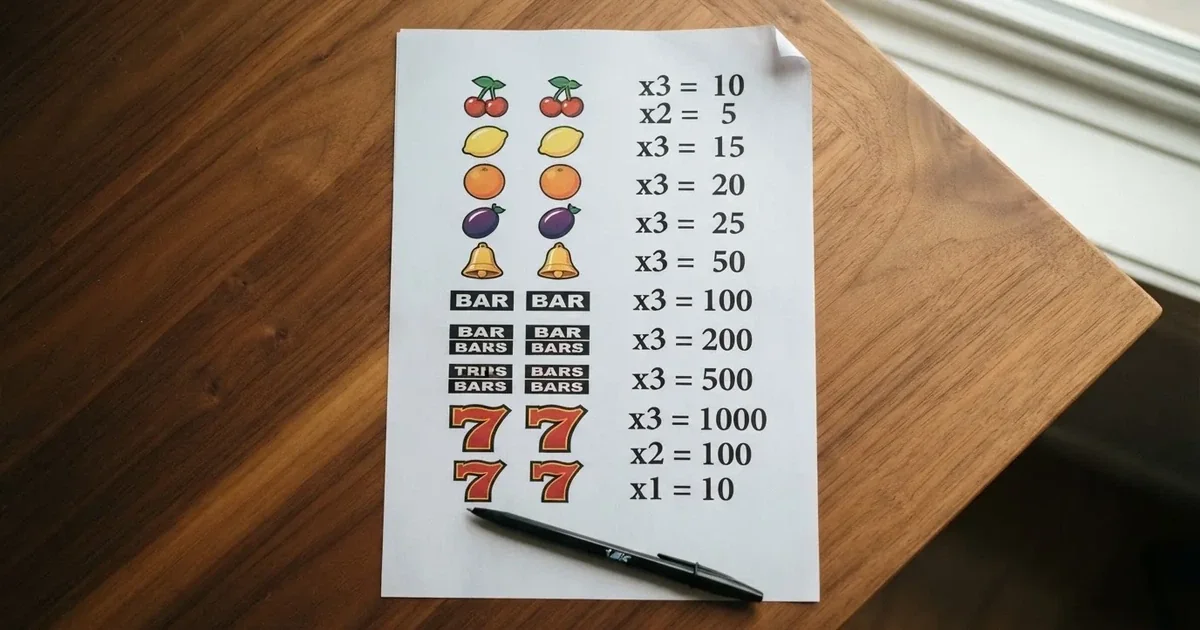
A paytable is the one document a player controls more than any other, and the catalogue page that organises them is a navigable index into that document rather than a game in itself. The standard five-reel, three-row pokies layout that dominates both pub machines and online catalogues presents a grid of fifteen symbols, pays left to right across fixed paylines on most titles, and resolves each spin against a random-number generator that is independent of every spin that came before. What changes between titles is everything around that core.
Volatility — sometimes called variance — is the descriptor that decides what the player’s session actually feels like. A low-volatility title pays frequently and in small amounts; a high-volatility title pays infrequently and in larger amounts, with long stretches of losing spins between features. The hit frequency printed in a paytable is the share of spins that produce any return at all, and it usually runs from 20% to 35% on a modern video pokie. The return to player is the long-run average of stake returned across millions of spins: in Australian land-based venues the legal minimum sits at 85% in the larger jurisdictions and reaches 90% in Western Australia. Online catalogues host a much wider range, with the bulk sitting between 94% and 96.5% and a thin upper tier of “high-RTP” titles clustered around 97% to 98%.
A few catalogue conventions are worth naming before a reader opens any of them. Megaways is a licensed reel-modifier that varies the symbol count on each spin, producing hundreds or thousands of ways to win on individual rounds rather than across a fixed payline structure. Cluster pays collapse the grid into connected regions of matching symbols rather than reading across lines. Cascading reels remove the winning combination after it pays and drop new symbols into the vacated cells, allowing a single stake to produce multiple payouts in sequence. A jackpot is either fixed at a stated amount or progressive across a network; the network version takes a slice of every stake into the pooled prize and is the mechanism behind the multi-million-dollar headlines.
The themes that fill an offshore pokie catalogue have almost no relationship to the mathematics underneath them. A title styled around ancient Egypt, outer space, fishing, Norse mythology, the candy aisle, or a branded rock band uses the same random-number logic as every other title in the catalogue; the artwork, the soundtrack, and the bonus feature names are the surface a publisher sells, and the volatility rating in the information panel is the actual information. A catalogue that hides the volatility and the RTP behind a “?” or refuses to surface them is telling the reader the publisher does not want the numbers compared.
What The ACMA Block-List Actually Shows
What follows is not a ranking and not a recommendation. Each operator below appears because the Australian Communications and Media Authority has, by its own published record, issued a formal warning under the Interactive Gambling Act 2001 over that brand for offering prohibited online casino services to Australians. The ACMA’s formal-warning function sits ahead of its blocking power; a warning is the regulator’s first public step and it names the operator entity, the brand, and the legal basis. The blocking request is the second step, and the request list — kept current on the ACMA’s website — is what internet service providers use to enforce the block at the network layer.
RocketPlay
The ACMA issued a formal warning to Pulsup Ltd over RocketPlay in March 2026, an action separate from the May 2022 warning that Dama N.V. received for six brands of which Rocketplay was one. The two warnings trail the same operator through different corporate vehicles. Brand and operator identities on offshore sites drift across the lifetime of any one URL; the regulator names the entity it has evidence against, not the trading style of the moment. Online casino games cannot be licensed anywhere in Australia, and a licence displayed on Rocketplay — Curaçao, Anjouan, or any other small jurisdiction — does not change that.
The page RocketPlay presents to an Australian reader is built for deposit and play, not for complaint handling. The withdrawal page lists bank transfer, e-wallet, and occasionally cryptocurrency; the dispute page points to the licensing regulator in the jurisdiction the operator is licensed in, applied under that jurisdiction’s laws. A player who wants help from an Australian body has no Australian body to ask.
Level Up Casino
The ACMA’s May 2022 warning to Dama N.V. covered six brands, of which Level Up was one. A second set of warnings over Dama N.V. brands followed in 2025, for different labels under the same operator. The pattern is informative: a single corporate wrapper runs multiple brands through the same cashier and the same game feed, the regulator identifies one, the operator rotates marketing onto another. A reader weighing brands as if they were separate operators is comparing shells around one balance sheet.
The brand’s own material lists BGaming among the providers appearing in its catalogue — a claim made in BGaming’s published partner list rather than independently verified. The same caveat applies as above: no licence displayed by an offshore casino makes it legal in Australia.
Woo Casino
A formal warning over Woo Casino was issued in March 2025 to Dama N.V. The month and year matter because they sit inside the period the ACMA was actively blocking operator websites at scale, and a warning over Woo is followed some weeks later by internet service provider blocking of the Woo domain to Australian customers. The brand is rarely reachable from an Australian IP address at the moment this page is read; it often reappears at a new address within weeks or months.
No Australian consumer protection applies to a balance still held by the operator if the block lands mid-session. The provider is not obligated to refund unconverted balances, lock in pending withdrawals, or recognise self-exclusion requests, because none of those rules apply outside Australian law.
Spirit Casino
Spirit Casino received its formal warning in May 2025, also under Dama N.V. The pair of warnings — Woo in March, Spirit in May — reads as the regulator working through a list of brands under the same wrapper, and the block request that follows each one targets a specific domain. A reader who finds Spirit Casino at a working address is seeing either a pre-block snapshot, a mirror the operator has stood up at a fresh domain, or an address the blocking round has not yet caught.
The marketing around Spirit Casino, like the marketing around its sibling brands, leans on the bonus architecture described above: tiered welcome packages, free spins tied to a single named title, reload bonuses with steep wagering. A reader who treats the offers as the basis for choosing a brand is reading what the operator wants them to read and missing the part the operator has no incentive to write down.
National Casino
The ACMA issued a formal warning to Consolutetish S.R.L. over National Casino in July 2025. Online casino games cannot be licensed anywhere in Australia; the licence National Casino displays is not an Australian licence and confers no rights enforceable in Australian law. The brand is listed among the subjects of published industry-watch material as an offshore provider, on the strength of what those listings report and no further.
National Casino’s standing in enforcement does not depend on what it offers today. The regulator’s record names the operator and the brand together; what changes between visits is whether the address a reader finds resolves to a page that can take a deposit, and that piece is outside any authority’s control.
Bizzo Casino
A formal warning to Consolutetish S.R.L. over Bizzo Casino was issued in July 2025. The brand had already been the subject of a 2022 warning to TechSolutions (CY) Group Limited and TechSolutions Group N.V., and the case stretches across the lifespan of an operator relationship rather than any one URL. A reader looking at Bizzo Casino and weighing whether it is a “new” or “established” brand is asking the wrong question; the relevant history is what the regulator has named, and the regulator has named the same brand twice.
Ignition Casino
The ACMA issued a formal warning to Bamboo Media over Ignition Casino in July 2025. The Australian-facing marketing around Ignition leans heavily on pokies catalogue breadth and crypto deposit options; both lean against the Australian rule. Crypto is a banned payment method for licensed Australian online wagering, and a site that asks an Australian for a Bitcoin or stablecoin deposit is signalling that the site does not consider itself bound by Australian payment law.
Instant Casino
Instant Casino received a formal warning in February 2025, to EOD Code SRL. The brand was among the first to be publicly named in the round of formal warnings the ACMA issued after the IGA’s 2017 amendments took full effect, and the operator-entity structure points to a small European wrapper rather than a long-established gambling group.
Jackbit
A formal warning to Ryker B.V. over Jackbit was issued in April 2026. The same notice names CasinOK as a second brand under the same operator. The pair is worth reading as one entry rather than two: the regulator names the entity, the entity has more than one public brand, and a reader comparing them on offer is comparing the same marketing department’s output twice.
Casino Intense
A formal warning to Sterplay Holding Ltd over Casino Intense was issued in April 2025. The brand surfaces in industry coverage of offshore operators alongside Australian-licensed venue reporting material, which is the same coverage space a reader would expect for any brand the ACMA has acted against.
Sky Crown
The ACMA has, by its own record, issued a formal warning to Hollycorn N.V. over its Sky Crown and Blue Leo casino services. The notice is among the earlier published enforcement actions against the operator and identifies both trading styles as covered by the same warning. The relevant point for a reader is not the name on the licence but the absence of any Australian licence, in either case.
The Brands The ACMA Has Formally Warned
| Brand | ACMA action and date | Operator named by the ACMA | Subject support |
|---|---|---|---|
| RocketPlay | Formal warning, March 2026 | Pulsup Ltd | — |
| Level Up Casino | Formal warning, May 2022 | Dama N.V. | listings-only (provider) |
| Woo Casino | Formal warning, March 2025 | Dama N.V. | — |
| Spirit Casino | Formal warning, May 2025 | Dama N.V. | — |
| National Casino | Formal warning, July 2025 | Consolutetish S.R.L. | listings-only (industry list) |
| Bizzo Casino | Formal warning, July 2025 | Consolutetish S.R.L. | — |
| Ignition Casino | Formal warning, July 2025 | Bamboo Media | — |
| Instant Casino | Formal warning, February 2025 | EOD Code SRL | — |
| Jackbit | Formal warning, April 2026 | Ryker B.V. | — |
| Casino Intense | Formal warning, April 2025 | Sterplay Holding Ltd | listings-only (industry coverage) |
| Sky Crown | Formal warning, published 2022 | Hollycorn N.V. | — |
The picture the table draws is one an Australian reader should hold before any of the names above. The brands market themselves as a competitive field; the regulator’s record reads as a small number of corporate wrappers running multiple brands in parallel, each brand catching a separate warning or block round, and each wrapper rotating marketing across the surviving addresses.
How The Block-List Has Grown
The blocking-rate the ACMA has run since November 2019 is the cleanest measure of how fast the offshore supply rebuilds itself after each enforcement round. The first blocking request that month covered a small group of domains. By June 2026, the cumulative count of illegal gambling and affiliate marketing websites the ACMA had asked Australian internet service providers to block was 1,751. That number is published; it does not include the affiliate-marketing-only domains, of which a separate sub-count exists.
To put the figure in motion: an 1,751-domain total built across roughly six and a half years of monthly blocking rounds averages out at a rate of better than twenty-two blocked domains per month — meaning every domain the ACMA blocks has been matched, on average, by another one ready to take its place. The 12 most recent additions named in the June 2026 round — 7Signs, ChromaBet, Donbet, Duospin, Freshbet, Slots Gem, Jacks Club, Lucky Start, Pointsbetz, Spinrise, Vinyl Casino, and Wildsino — illustrate the texture of the supply: each is a fresh brand on a fresh domain, none of them matching any prior name on the list. The rate at which a reader types an Australian-facing “best” list into a search engine is roughly the rate at which the operator shelves new names that are not yet on the block-list. That is the supply side of the market.
The H2 Gambling Capital estimate adds a number to the consequence. Australians lose about A$3.9 billion a year to illegal gambling sites, and the share of gambling going through legal Australian channels fell from 74% in 2021 to 64% in 2025 — a ten-point shift in four years across a sector whose legal alternative is wagering, lotteries, and licensed venue gaming, not online pokies. The block-list’s growth and the legal channel’s shrinkage are not the same statistic, but they describe the same drift: Australian players are playing more, not less, of the products the IGA prohibits, and the regulator’s most direct tool — domain blocking — is clearing the surface rather than the underlying demand.
What A Fair Comparison Of “Aussie” Sites Could Weigh
A fair comparison of the brands above — were such a comparison actually to license a player onshore — would weigh a different set of questions than the marketing copy suggests. The first is whether the operator displays a licence at all, which jurisdiction issued it, and whether that jurisdiction’s regulator carries an enforceable complaint path. The second is whether the games catalogue is published with the information a player can act on: return-to-player per title, volatility class, hit frequency, and the maximum exposure on any single line. The third is the actual wording of the bonus terms: wagering multiple on cash and on free-spin winnings separately, the max-bet rule while a bonus is active, the game weighting table, and the expiry on the bonus balance. The fourth is the payment rule set: which deposit routes the operator accepts, what the stated withdrawal time is per method, what the maximum withdrawal per week is, and what documentation the operator asks for at the point of cashout. The fifth is the responsible-gaming tooling: deposit limits, time-out, self-exclusion, and whether the self-exclusion actually communicates to the operator or merely to the player’s browser.
None of the brands above clears the first question, which is the one an Australian reader most needs to answer. The ACMA’s action against each of them is on the public record; the action is taken on the same legal basis; and the consequence for any reader comparing them is that the comparison is being made inside a market that the regulator has been asking providers to leave for over five years. A ranked list of brands the ACMA has warned is a list of brands in the regulator’s enforcement queue, and the difference between number one and number eleven on that queue is smaller than the difference between any of them and a venue a player could walk into on Australian soil.
Where Online Pokies Actually Sit In Australian Law
The Interactive Gambling Act 2001 makes it an offence to provide certain interactive gambling services to customers physically present in Australia. The 2017 amendments closed the live in-play betting exception and brought online casino games — defined to include online pokies — into the prohibited category. What the statute permits, and what the Northern Territory Racing and Wagering Commission and equivalent bodies in other states and territories license, is wagering on the outcome of races and sporting events placed before the event, lotteries, and keno. The NTRWC regulates fifty-two of Australia’s online bookmakers — including Sportsbet, Bet365, and Ladbrokes — for tax reasons, with a commission that meets once a month in Darwin and, per recent reporting, no full-time staff. The structure explains why “licensed” appears in marketing around Australian-facing wagering while remaining absent from any online pokies offer: the licensing regime that exists was built for wagering, and online pokies were never extended into it.
The enforcement model is administrative rather than criminal. The ACMA investigates complaints, issues formal warnings naming the operator entity and the brand, and then asks Australian internet service providers to block the relevant domains. The number of gambling and affiliate marketing websites blocked since November 2019 — the 1,751 cited above — and the 230-plus unlicensed services that have left the Australian market since the 2017 amendments took full effect are the regulator’s published totals. The blocking model is blunt because the supply is fluid: a blocked brand reappears under a new name within days or weeks in most rounds, and the round after names the new address.
The legal gambling landscape the player is actually offered is the licensed pub, club, and casino floor. Pokies on those floors are licensed and regulated state by state, with rules that vary materially across jurisdictions. New South Wales alone had 87,298 gaming machines outside casinos across 2,195 venues in June 2023, recording player losses of A$8.18 billion in the 2022-23 financial year. Queensland operated 21,122 machines in 351 venues as of October 2023; Victoria kept 26,380 outside Crown Casino across 488 venues in 2021-22, sitting beneath a statewide cap of 30,000. Western Australia’s pubs and clubs have been closed to the machines since Crown Perth opened in 1985, with Crown Perth’s own machine count growing from roughly 200 to roughly 2,500 since. Tasmania ended the Federal Group’s monopoly on its machines in November 2021, moving oversight to the Tasmanian Liquor and Gaming Commission. The minimum return-to-player set by each jurisdiction ranges from 85% in the larger markets to 87% (87% at Crown Melbourne), 87.5% in South Australia, and 90% in Western Australia.
None of that licensed machine network extends online, and that is the structural feature the market runs against. A player searching for “best aussie pokies online” is looking for a product that does not exist under Australian law, and the Australian-licensed floor is the alternative that does exist and that the framing of this topic is asking the reader to set aside.
What The Player Loses When The Protection Regime Doesn’t Apply
The Australian player-protection regime exists, but it is anchored to Australian-licensed services. BetStop, the National Self-Exclusion Register, has been live since August 2023 and binds every Australian-licensed online and phone wagering service. A self-excluded player attempting to open a new account at a licensed operator is matched to the register and refused. An offshore casino is not connected to the register, and a player who has registered with BetStop can still reach any of the offshore brands named above. The self-exclusion is a behavioural choice the operator’s own systems would also be expected to honour; BetStop enforces the choice at the network level only for licensed services.
The National Gambling Helpline at 1800 858 858 is free, 24/7, and routes to Gambling Help Online for chat-based support. The helpline and chat are not bound by the offshore-versus-licensed split; a caller asking for help at 3am on a Saturday is routed to a counsellor regardless of whether the gambling that prompted the call was on a licensed wagering app or an offshore casino. The counselling is free, confidential, and not connected to any enforcement process — calling does not trigger an ACMA action, and an ACMA action does not result in a call.
The complaints architecture collapses in the offshore case. The Australian Financial Complaints Authority hears disputes with Australian financial services providers. The state and territory casino regulators hear disputes about licensed venues. The licensed bookmakers under the NTRWC sit within an Australian regulatory framework with a complaint route to the commission. None of those bodies has standing to compel documents, refund balances, or reverse voided bonuses from an offshore operator. The recourse available to the player is whatever the operator’s licensing jurisdiction provides, applied in that jurisdiction’s courts, often without the operator maintaining a physical presence to be served in. A player who has been wronged is, in practical terms, in the position of a customer of a dissolved overseas company that does not hold an address.
Payment Rules And Why They Push Offshore Sites Out Of Step
The credit-card ban on licensed Australian online wagering has been in force since 11 June 2024. Credit, credit-related products, and digital currency are not permitted as payment methods for any Australian-licensed wagering service; the penalty for an operator accepting them is up to A$247,500. The legal deposit routes for a licensed Australian wagering service are debit card, bank transfer, PayID via Osko, and BPAY. A site asking an Australian customer for a credit-card deposit or a cryptocurrency deposit is signalling, by that single fact, that the site is operating outside the Australian regime.
PayID sits on top of the New Payments Platform and routes through the customer’s own bank via a phone number, email, or ABN. The transfer itself is free to the customer and typically settles in seconds during banking hours. The instrument is widely supported by licensed Australian wagering services because it integrates with the same banking channels the operator already verifies against for KYC, and it carries a real-world identity behind the transfer rather than an anonymous wallet. An offshore casino that accepts PayID — and many do, because their marketing targets Australian customers — is taking Australian payment rails into a service that does not have an Australian licence to operate. The PayID transfer works; the legality of the underlying service does not change because the deposit method does.
The withdrawal side of an offshore casino is where the disappointment concentrates. The marketing page names a withdrawal window, often twenty-four to forty-eight hours for e-wallets and three to seven business days for bank transfer; the practised reality is a pending period during which the operator’s payments team reviews the request, a document check that may request new verification at any point, and a per-week maximum that limits a large withdrawal to a multi-week sequence of transfers. A player who has won a meaningful amount and asks to withdraw it will usually receive it; a player who has lost and asks to withdraw their last A$200 will sometimes find the account closed mid-request, the balance voided under a “bonus abuse” rule, and the operator unreachable by the route the marketing page listed. The offshore rule set is built for the operator’s protection, and the absence of an Australian complaints body is the consequence the player carries.
How To Read The Offshore Site If A Reader Still Reaches One
A reader who reaches an offshore casino through a mirror, an affiliate link, or a redirect faces a small number of practical questions. The first is whether the operator has been publicly warned by the ACMA by name, which is the public notice function the regulator exists to perform and which a player can check against the ACMA’s website before depositing. The second is whether the operator displays a licence, which jurisdiction issued it, and whether that jurisdiction’s regulator publishes a register a player can cross-check. The third is whether the bonus terms can be read before any deposit is made, in particular the wagering multiple, the max-bet rule, and the game weighting table — a casino that hides the terms until the second deposit is asking the player to commit before the cost is visible.
The fourth is whether the payment page lists only methods that are legal for an Australian player on a licensed service, or whether it lists credit card and cryptocurrency, which are the methods a licensed Australian service cannot accept. A site that accepts both signals that the operator is not asking itself the question the law asks. The fifth is whether the responsible-gaming tooling is reachable from the account page without a deposit being made first, and whether the time-out and self-exclusion controls actually close the account or merely pause it. None of these is a check that produces an Australian licence; an Australian licence is what the law does not allow to be issued. They are checks against the gap between what an offshore operator promises and what an Australian reader can rely on.
The licensed alternative a reader who wants pokies play can actually rely on is the pub, club, or casino floor, where every machine is state-licensed and the operator is required to display the return-to-player, the maximum stake, and the responsible-gaming contact details. The experience is not the catalogue of an offshore site, and the catalogue is not available anywhere it can be lawfully delivered.
The Reform That Has Passed And The One That Is Still Waiting
The Interactive Gambling Amendment (Gambling Reform) Bill 2026 passed Parliament on 19 August 2026. The advertising and inducement measures in the package commence on 1 January 2027; a bill with a commencement date is law with a start date, not law in force on a 2026 page. The package affects the licensed wagering and lottery sector — the inducement framework, the advertising spend limits, and the messaging controls around in-play betting. The amendments do not extend the legal supply of online pokies and do not change the prohibition this page is built around. The relevant consequence for a reader is that the inducement structures offshore casinos offer, which would be unlawful for an Australian-licensed operator, will face a tightened onshore counterpart from the start of 2027 — a tightening that raises the contrast between what is and is not legal, without changing which is which.
Tasmania’s nation-leading mandatory pre-commitment cards were scheduled to come into operation later in 2025, following a delay announced in 2024; the cards bind players to a pre-set spending envelope at the machine itself, before play begins. The system is the first mandatory pre-commitment regime in Australia and the precedent other jurisdictions are watching. The reform is a state-level intervention in the licensed venue market, not in the online space.
The tax position of a recreational player who does win something offshore is the last piece. Gambling winnings of a recreational player are not assessable income in Australia — section 6-5 of the Income Tax Assessment Act 1997 treats them as windfalls — and losses are not deductible unless the person is carrying on a business of gambling. The model is the recreational gambler’s, and a player whose activity crosses into a pattern of regular, systematic, businesslike play is asking the Australian Taxation Office to define the boundary, not the operator’s marketing page.
What The Reader Leaves With
The question of a “best” list is one the law does not allow to be answered as written. The list it asks for does not exist as a legal market; the brands the list would name are the brands the ACMA has, by its own published record, acted against; and the bonus architecture, the catalogue, and the payment rails the list would compare sit outside a protection regime the reader can enforce.
A reader looking at the licence a brand displays is looking at a licence no Australian regulator has issued, and the operator behind it is one a regulator has warned. A reader looking at the bonus terms is reading the cost of the offer in time and expected loss against a marketing headline, in a market whose regulation is offshore. A reader who decides to play anyway is choosing the experience against the consequence; the choice is the reader’s, and the consequence is what the ACMA’s record, and this page, have set out.
Frequently Asked Questions
Does calling an online pokies site “Aussie” change where it is actually licensed?
No. The name on the brand or its marketing copy has no relationship to the jurisdiction that issued the licence it operates under. Australian consumer protection law does not extend to a brand that markets itself to Australians while operating from outside Australia.
Are the bonus credits and free spins on an “Aussie pokies” site legal to advertise here?
No. The Interactive Gambling Act 2001 prohibits the supply of online casino games to a person in Australia, and an inducement attached to that supply is part of the prohibited offer. A bonus banner aimed at an Australian customer is, on the regulator’s reading, evidence of the offence rather than a marketing neutral to it.
Is there a dedicated app for Aussie-branded online pokies that is legal to install locally?
No. The Apple App Store and Google Play remove apps that offer online casino games to Australian customers under their respective policies. A reader who has installed such an app has either installed it before removal or through a sideload route; the prohibition is the same in either case.
Do state gaming regulators recognise any “Aussie online pokies” brand as licensed?
No. The eight state and territory regulators license pubs, clubs, casinos, and licensed wagering services — they do not license online casino games or online pokies. A brand that claims to be licensed by an Australian regulator for online pokies is making a claim no regulator confirms.
How does an Aussie-branded online pokies catalogue differ from a licensed pub’s machines?
An offshore catalogue is wider — hundreds or thousands of titles, multiple providers, themes across every genre — but it carries no Australian licence, no Australian consumer protection, and no Australian-registered complaints body. A licensed pub’s machines are narrower, set minimum-return-to-player rules per state, and operate inside the responsible-gaming regime the law requires. The difference is the regime, not the catalogue.
Can an Aussie-branded online pokies site accept a PayID deposit and still be unlicensed?
Yes. PayID is a payment-rail mechanism, not a regulatory clearance. A site using PayID to take deposits from Australian customers is taking payments through Australian banking infrastructure while offering a service the IGA prohibits. The payment works; the underlying service remains outside Australian law.