
Low Volatility Slots in Australia: What the Law Actually Allows in 2026
Current as of 31 October 2026 · Verified against the Australian Communications and Media Authority (ACMA) register and the Interactive Gambling Act 2001
A punter searching for “low volatility slots” is usually after one practical thing: a steady drip of small wins that lets a modest bankroll last longer than it would on a high-variance title. The mechanics exist, the game design exists, the catalogue exists. What does not exist, for anyone sitting in Australia, is a legal way to spin those reels online. The Interactive Gambling Act 2001 prohibits the supply of online casino games, including online pokies, to anyone physically in Australia. No state or territory issues a licence for it. The ACMA enforces that prohibition with a steadily expanding list of formal warnings and blocking requests. This page sets out where that leaves a player who wants the experience a low volatility slot is supposed to deliver.
Table of Contents
- The mechanics of a low volatility slot
- Australian law on online slots
- What the ACMA has actually done
- Payment rules that catch offshore operators
- What a player can do under Australian law
- Brands the ACMA has formally warned
- Side-by-side record of ACMA actions
- The rate at which the blocklist has grown
- The wider catalogue of casino-table math
- Reading the research record
- What to do with this page
- Frequently Asked Questions
The mechanics of a low volatility slot
A slot machine’s volatility is the spread between the size and the frequency of its payouts. A low volatility title pays often and pays small; a high volatility title pays rarely and pays large. The reels, the paylines and the return-to-player percentage are not the same thing as volatility, though all three sit inside the same math. A 96% RTP game can be either low or high volatility, depending on how the designer distributes that 96% across winning combinations.

Charles Fey of San Francisco built the first automatic slot mechanism in the late 19th century: a three-reel machine carrying five symbols, with three Liberty Bells in a row paying the top prize of ten nickels. Bally’s Money Honey followed in 1963 as the first machine with a bottomless hopper that paid out up to 500 coins without an attendant. The first video slot was developed by Fortune Coin Co. in Kearny Mesa, California in 1976. Each step widened what the math could do. A modern video slot can run five or more reels with fifty or more symbols per reel, producing odds as high as 300 million to one against a top combination, compared with a classic three-reel machine’s roughly 1,000 possible combinations.
The volatility question asks something different from the combinations question. A low volatility slot compresses most of its payout mass into small, frequent returns: a scatter win, a small line hit, a bonus feature that retriggers often. A high volatility slot stacks most of its payout mass into rare, large returns: a free-spins round with multipliers, a progressive jackpot, a single-symbol combination that pays 5,000 times the stake. The RTP figure is the same in the abstract; the path to it is not.
That distinction matters for a player choosing between them. A low volatility slot suits a session on a small bankroll, where the cost of a long losing streak is felt more than the cost of a capped top prize. A high volatility slot suits a player who can absorb a dry spell in exchange for one meaningful payout. Neither is “better.” They are different cost shapes for different budgets.
The Australian land-based version of the same machine is called a pokie, short for poker machine. The state-by-state count of pokie-style slot machines outside casinos gives a sense of how embedded the format is in everyday venues: 87,298 in New South Wales as of June 2023, 26,380 in Victoria across 2021–22, 21,122 in Queensland as of October 2023, 11,672 in South Australia as of September 2023, and 3,587 in the ACT as of November 2023. New South Wales legalised the machines in 1956. By 2010 Australia was operating an estimated 97,103 gaming machines outside casinos, a per-capita density about five times that of the United States.
Australian law on online slots
The Interactive Gambling Act 2001, strengthened by the Interactive Gambling Amendment Act 2017, makes it an offence to provide online casino games, online pokies, or in-play betting to a person physically in Australia. The prohibition targets the provider, not the individual player. No Australian jurisdiction issues a licence for online casino gaming, which means a brand displaying a licence from Curaçao, Malta, Anjouan, or Costa Rica has no Australian authorisation behind it. The licence it shows is a foreign one, granted by a foreign regulator, enforceable in that regulator’s jurisdiction and nowhere else.
What is licensable is wagering on races and sporting events placed before the event, lotteries, and keno. In practice, online sports and racing bookmakers are licensed in the Northern Territory through the Northern Territory Racing and Wether Commission, which covers 52 of Australia’s online bookmakers including Sportsbet, Bet365 and Ladbrokes. The NTRWC has no full-time staff and meets once a month in Darwin, a quirk of how the federal framework routes Territory tax revenue through a body that is administrative rather than investigative. Its remit is wagering services; it does not reach online casino games.
Minimum age for any form of licensed Australian gambling is 18. A punter who turns 18 in a state with restrictive pokie rules is still barred by the federal IGA from playing online casino games inside the country.
What the ACMA has actually done
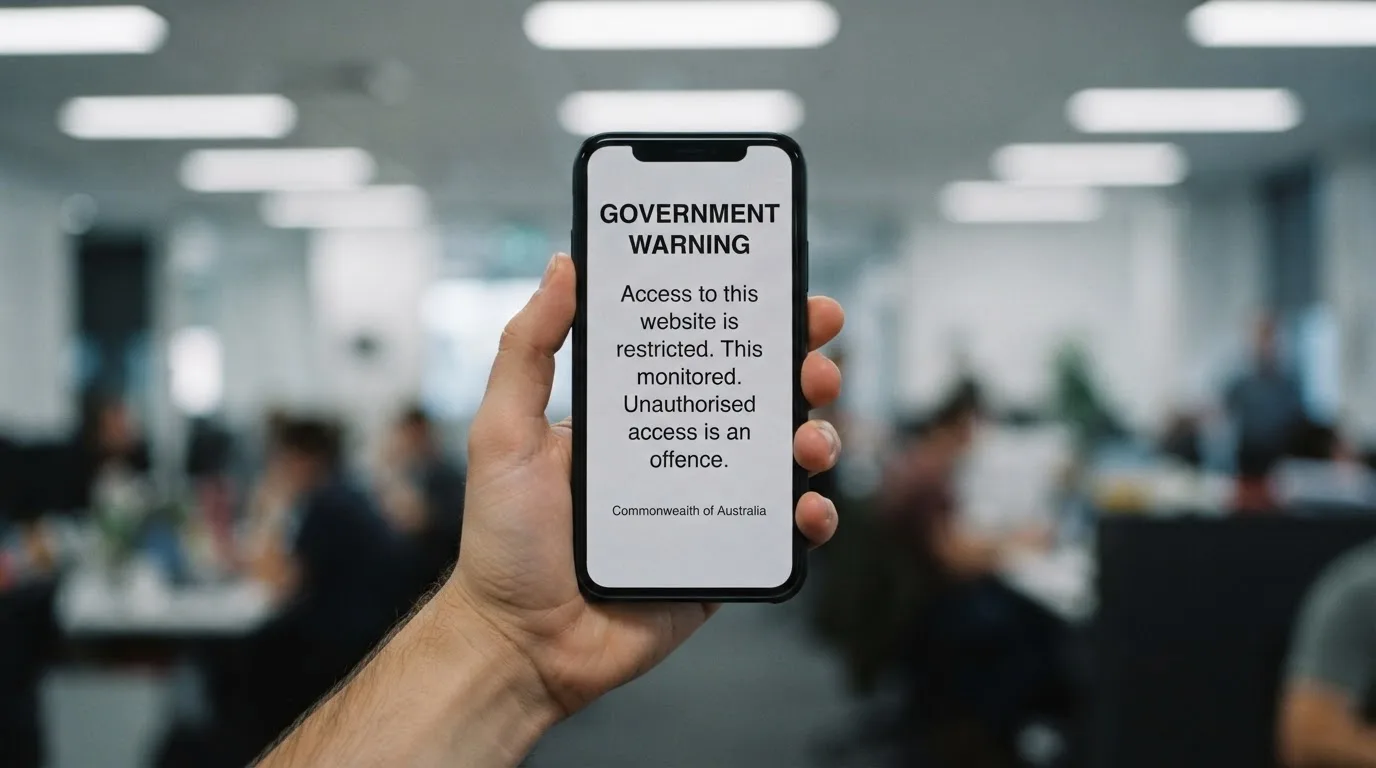
The Australian Communications and Media Authority enforces the Interactive Gambling Act. Its two main tools are formal warnings, addressed to the operator behind a service, and blocking requests, sent to Australian internet service providers asking them to render named websites inaccessible. As of June 2026, the ACMA had asked ISPs to block 1,751 illegal gambling and affiliate marketing websites since the first blocking request in November 2019. More than 230 unlicensed gambling services had left the Australian market since enforcement was strengthened in 2017.
The latest blocking round, reported on 26 June 2026, covered twelve websites: 7Signs, ChromaBet, Donbet, Duospin, Freshbet, Slots Gem, Jacks Club, Lucky Start, Pointsbetz, Spinrise, Vinyl Casino and Wildsino.
H2 Gambling Capital’s 2025 report estimates Australians lose around A$3.9 billion a year to illegal gambling sites, and that the share of gambling going through legal channels fell from 74% in 2021 to 64%. Those figures are the cost of the gap the IGA leaves open.
The formal-warning log shows how the ACMA pursues individual operators behind those services. In May 2022 it warned Dama N.V. over six brands: Bambet, Dazard, Level Up, Rocketplay, Wild Tornado and Cobra Casinos. The same operator received further warnings in March 2025 over Woo Casino and in May 2025 over Spirit Casino. In July 2025 the ACMA warned Bamboo Media over Ignition Casino and Consolutetish S.R.L. over National Casino and Bizzo Casino. Bizzo Casino had already attracted a 2022 warning directed at TechSolutions Group. In February 2025 the ACMA warned EOD Code SRL over Instant Casino. In April 2026 Ryker B.V. received a warning over Jackbit and CasinOK. In April 2025 Sterplay Holding Ltd was warned over Casino Intense. Hollycorn N.V. has been warned over Sky Crown and Blue Leo. In March 2026 Pulsup Ltd received a warning over Rocketplay.
The picture that emerges is not a series of one-off actions against fly-by-night operators. It is a continuing enforcement record against repeat corporate entities running under different brand names. Dama N.V. has been named across three separate years. Consolutetish S.R.L. and TechSolutions Group both appear in the National Casino and Bizzo Casino trail. Hollycorn N.V. has been on the warning list since 2022.
Payment rules that catch offshore operators
Australian-licensed wagering services cannot accept credit cards, credit-related products, or digital currency as payment. That ban took effect on 11 June 2024, with penalties up to A$247,500 for operators that take a prohibited payment. Legal deposit routes for licensed wagering are debit card, bank transfer, PayID/Osko and BPAY.
An offshore online casino asking an Australian customer for a credit card or a crypto deposit is operating outside the Australian rules. It is also, by definition, an operator the ACMA may already be moving against. A blocked site can leave a balance stranded; a deposit made to a prohibited payment route on a licensed Australian bookmaker would not be made at all. That distinction is the practical edge of the credit-card ban.
The Interactive Gambling Amendment (Gambling Reform) Bill 2026 passed Parliament on 19 August 2026. Its advertising and inducement measures commence on 1 January 2027, so on a page read in 2026 those provisions are law with a future start date rather than rules already in force.
What a player can do under Australian law
The honest alternatives to an offshore online casino fall into three categories, and each is built on a regulatory framework with a regulator, a complaints body and a withdrawal guarantee.
Land-based casinos are licensed and supervised by state regulators. Crown Melbourne’s blackjack and baccarat variants are approved by the Victorian Gambling and Casino Control Commission, which replaced the VCGLR as Victoria’s casino regulator on 1 July 2022. Under section 66 of the NSW Casino Control Act 1992 a casino operator must not permit a game such as baccarat to be played unless the game and its rules are approved by the regulator, with a copy of the approved rules available to patrons on request. New South Wales clubs and hotels run pokie machines under state-level harm-minimisation rules. Each state publishes its own machine register.
Licensed online wagering is limited to sports and racing, with the NTRWC licensing model described above. Lotteries and keno fall under their own state regimes.
Self-exclusion is handled through BetStop, the National Self-Exclusion Register, live since August 2023. BetStop binds Australian-licensed online and phone wagering services only; an offshore casino is not connected to it and will not honour a BetStop registration. The National Gambling Helpline is 1800 858 858, free, 24/7, with chat at Gambling Help Online.
Gambling winnings of a recreational player are not assessable income under section 6-5 of the ITAA 1997, and losses are not deductible, unless the person is carrying on a business of gambling. The ATO’s position is the authority on the boundary.
Brands the ACMA has formally warned
The brands below are not a ranking and not a recommendation. Each appears here because the ACMA itself issued a formal warning over it for offering prohibited services to Australians. The page does not endorse any of them as a place to play. The only judgement offered is whether each brand’s published profile lines up with anything in the research record beyond the ACMA notice itself.
RocketPlay
The ACMA issued a formal warning to Pulsup Ltd over Rocketplay in March 2026. The same brand had earlier drawn a warning to Dama N.V. in May 2022 as part of a six-brand group. Two formal warnings across two corporate entities, four years apart, against one brand name. It currently appears on no verifiable independent lists.
Level Up Casino
Level Up Casino was named in the May 2022 warning to Dama N.V. alongside Bambet, Dazard, Rocketplay, Wild Tornado and Cobra Casinos. The brand appears in industry listings as a BGaming-software casino; that listing is the only independent trace of the brand beyond the ACMA notice, and a listing is not an endorsement.
Woo Casino
Woo Casino drew a Dama N.V. warning in March 2025, a separate and later action from the May 2022 group warning. Two Dama N.V. warnings across two years for overlapping brand portfolios is consistent with the ACMA’s pattern of pursuing repeat corporate entities. There is no other public record of this casino outside the regulator’s own warning log.
Spirit Casino
Spirit Casino received a Dama N.V. warning in May 2025, the third Dama N.V. action in the research record. No independent industry listing for this service exists to contradict the regulator’s notice.
National Casino
National Casino drew a Consolutetish S.R.L. warning in July 2025. Wikipedia lists the brand as an online casino, which is the only independent trace beyond the ACMA notice. A Wikipedia entry is a listing, not an endorsement.
Bizzo Casino
Bizzo Casino drew a Consolutetish S.R.L. warning in July 2025 and an earlier TechSolutions Group warning in 2022. Two warnings across two operators, three years apart, point at a brand that has changed hands or changed shells at least once. It remains entirely unlisted elsewhere.
Ignition Casino
Ignition Casino received a Bamboo Media warning in July 2025. It is not featured in any independent industry directories.
Instant Casino
Instant Casino drew an EOD Code SRL warning in February 2025. This service has no footprint in independent industry media.
Jackbit
Jackbit received a Ryker B.V. warning in April 2026, paired with CasinOK. The research record carries no other listing for Jackbit.
Casino Intense
Casino Intense drew a Sterplay Holding Ltd warning in April 2025. The brand appears in listings tied to ABC News coverage and to Crown Melbourne’s baccarat pages, though those listings reflect the brand’s catalogue claims rather than any Australian endorsement.
Sky Crown
Sky Crown was named in a Hollycorn N.V. formal warning alongside Blue Leo, published by the ACMA in September 2022. Hollycorn N.V. has been on the warning list since that date. The research record carries no other listing for Sky Crown.
Side-by-side record of ACMA actions
The table below pairs each brand with the operator named in the ACMA’s formal warning, the date of that warning, and any independent listing the research record carries. Where the research carries no listing beyond the ACMA notice itself, the cell carries the article-language no-data marker, because a brand the reader cannot independently verify is a brand the reader should treat as the ACMA has already described it.
| Brand | Operator named by the ACMA | ACMA action and date | Subject support |
|---|---|---|---|
| RocketPlay | Pulsup Ltd (2026) · Dama N.V. (2022) | Formal warning, March 2026 (Pulsup Ltd); earlier May 2022 (Dama N.V.) | — |
| Level Up Casino | Dama N.V. | Formal warning, May 2022 | Listings (BGaming catalogue) |
| Woo Casino | Dama N.V. | Formal warning, March 2025 | — |
| Spirit Casino | Dama N.V. | Formal warning, May 2025 | — |
| National Casino | Consolutetish S.R.L. | Formal warning, July 2025 | Listings (Wikipedia entry) |
| Bizzo Casino | Consolutetish S.R.L. (2025) · TechSolutions Group (2022) | Formal warning, July 2025; earlier 2022 | — |
| Ignition Casino | Bamboo Media | Formal warning, July 2025 | — |
| Instant Casino | EOD Code SRL | Formal warning, February 2025 | — |
| Jackbit | Ryker B.V. | Formal warning, April 2026 | — |
| Casino Intense | Sterplay Holding Ltd | Formal warning, April 2025 | Listings (ABC News, Crown Melbourne references) |
| Sky Crown | Hollycorn N.V. | Formal warning, September 2022 | — |
The cluster pattern across the operator column is the more telling number. Dama N.V. appears three times across 2022, 2025 and 2025. Two separate shells, Consolutetish S.R.L. and TechSolutions Group, both surface against the same brand group in 2022 and 2025. A punter looking at this table should read it as evidence of the ACMA’s enforcement shape rather than as a comparison of which brand is “safer” than the others. None of them is licensed to take an Australian deposit.
The rate at which the blocklist has grown
The ACMA’s first blocking request went out in November 2019. By June 2026 the running total of blocked sites and affiliate pages had reached 1,751. That works out to roughly 1,751 over roughly 79 months, or an average of around 22 sites per month across the period. The early years of that period carried lighter numbers; the 2024–2026 stretch carried heavier ones. A useful band sits between roughly 15 and roughly 30 sites per month across the full period, with the more recent rounds sitting closer to the upper end. The condition that bounds the figure is that it counts both illegal gambling sites and affiliate marketing pages, not gambling sites alone; the affiliate share is meaningful and has grown as the ACMA extended its net to the funnel rather than only the casino.
The wider catalogue of casino-table math
A punter weighing low volatility slots against the broader casino floor eventually meets the house edges on the table games a land-based casino offers. The numbers are sharp enough to carry on their own.
Baccarat’s house edge is 1.06% on the Banker bet, 1.24% on the Player bet and 14.36% on the Tie. The variant most casinos run today, punto banco, was developed in Havana during the 1940s and runs the casino as banker at all times, with both hands played out by fixed drawing rules. Cards two through nine count at face value, ten and the face cards count as zero, and aces count as one, with hand totals taken modulo 10. Chemin de fer is a two-player French variant that emerged from baccarat banque in the late 19th century, named for the speed at which it could be played. Crown Melbourne offers Traditional Baccarat, Crown Baccarat and 2 to 1 Baccarat, all approved by the Victorian Gambling and Casino Control Commission.
Blackjack’s house edge is roughly 0.28% under liberal Las Vegas Strip rules (dealer stands on soft 17, double on any two, double after split, resplit aces, late surrender) and roughly 0.43% under Atlantic City rules. The game evolved from the English vingt-un; veintiuno appears in Cervantes’ Rinconete y Cortadillo, written around 1601–02, and formal rules were published in Britain in 1800. Card historian Thierry Depaulis dates the name “blackjack” to around 1899, with prospectors during the Klondike Gold Rush of 1896–99 credited with giving it its modern name. In Victoria, the Casino Control Act 1991 requires the VGCCC to approve any rules for table games and any change to those rules before they are introduced at the Melbourne casino. The VGCCC’s own log of approved changes to Crown Melbourne’s blackjack variants includes renaming the “Perfect Pairs” side bet to “Crown Pairs” on 23 December 2024 and introducing a “Free Bet” option with a new “Pot of Gold” side bet on 25 March 2024.
Craps carries a house edge of 1.41% on Pass and Come, 1.36% on Don’t Pass and Don’t Come, and 11.11% on Any Craps.
These figures sit beside the slot-machine framework because the comparison is the one a punter actually makes. A land-based casino blackjack table with a 0.28% house edge under liberal rules is the lowest-edge table game in the survey. A baccarat Banker bet at 1.06% is the next tier up. A craps Pass line at 1.41% runs higher still. A low volatility slot, even at 96% RTP, carries a 4% house edge; a high volatility slot at the same RTP carries the same 4% over the long run but distributes it across wider swings. The shape of the cost, not its average, is what the volatility label is pointing at.
Reading the research record
The Australian gambling data on the page comes from a small set of named sources. The 1,751-site blocklist figure, the twelve-site June 2026 round, and the H2 Gambling Capital A$3.9 billion illegal-market figure all trace to igamingbusiness.com’s coverage of ACMA reporting. The NTRWC’s 52-bookmaker remit and its monthly Darwin meeting come from ABC News coverage of the April 2026 NT reform bill. The state-by-state pokie counts trace to Wikipedia’s Gambling in Australia entry. The ACMA formal warnings trace to acma.gov.au’s formal-warning publications. The baccarat, blackjack and craps house edges trace to wizardofodds.com. The Crown Melbourne variant approvals trace to Crownmelbourne.com.au and vgccc.vic.gov.au. The NSW and Victorian casino-control statutes trace to legislation.nsw.gov.au and vgccc.vic.gov.au.
No figure on this page has been invented or rounded beyond what its source states. Where the source carries no figure, the cell carries the article-language no-data marker rather than a guess.
What to do with this page
If the reader is in Australia, the IGA leaves one honest path: land-based casinos, licensed pokie venues, and licensed wagering on sports and racing. Online casino games and online pokies are not legally available inside the country. The brands listed above are listed because the ACMA named them, not because they are a route to a low volatility session.
If the reader is looking for the gameplay experience a low volatility slot promises, the closest Australian-legal equivalent is a pokie machine in a licensed pub, club, or casino. The volatility concept applies the same way; the regulatory framework, the payout verification, and the complaints body behind it are different and stronger than anything an offshore site can offer.
If the reader is already playing on an offshore site and wants to stop, BetStop is the self-exclusion tool for Australian-licensed services. For the offshore site itself, the practical steps are the bank’s chargeback process, the card issuer’s fraud line, and the National Gambling Helpline at 1800 858 858.
Frequently Asked Questions
What does low volatility mean for a slot machine?
Low volatility means the slot is designed to pay out often and in small amounts, rather than rarely and in large ones. A punter on a low volatility title sees regular line hits, frequent small bonus features, and a session bankroll that moves up and down in small steps rather than waiting on a single large payout. The RTP figure is the same as a high volatility slot’s in the abstract; the path to it is compressed into smaller, more frequent returns.
How does low volatility differ from high volatility in slot design?
The two run on different payout distributions. A low volatility slot stacks most of its payout mass into small, frequent returns. A high volatility slot stacks most of its payout mass into rare, large returns, often through a free-spins round with multipliers or a progressive jackpot. A punter with a small bankroll who needs a long session is better served by the low volatility shape; a punter who can absorb a dry spell in exchange for one meaningful payout is better served by the high volatility shape. Neither is universally “better.” They are different cost shapes for different budgets.
Is it legal to play low volatility slots at an online casino from Australia?
No. The Interactive Gambling Act 2001 prohibits the supply of online casino games, including online pokies, to anyone physically in Australia. No Australian jurisdiction issues a licence for online casino gaming. An offshore site asking for an Australian deposit is operating outside the Australian rules and may be subject to ACMA enforcement, including blocking. The individual player is not prosecuted, but an offshore site gives no Australian consumer protection, no complaints body, and no recourse if a withdrawal is refused, and it can be blocked with a balance still on it.
Are low volatility pokies-style machines common in Australian pubs and clubs?
Yes. Pokies are embedded across Australian venues at a density of roughly 196,000 machines outside casinos nationally, with 87,298 in New South Wales as of June 2023, 26,380 in Victoria across 2021–22, 21,122 in Queensland as of October 2023, 11,672 in South Australia as of September 2023, and 3,587 in the ACT as of November 2023. The state-by-state machine registers track the counts. The volatility label applies the same way to pokie machines as it does to online slots; the difference is the regulatory framework around them.
Where can someone see how many pokies machines operate in their state?
Each state publishes its own gaming-machine register. New South Wales publishes its data through Liquor & Gaming NSW, Victoria through the VGCCC, Queensland through the Office of Liquor and Gaming Regulation, South Australia through Consumer and Business Services, and the ACT through the ACT Gambling and Racing Commission. The Wikipedia Gambling in Australia entry carries a useful summary of the state-by-state counts with their respective dates, but the state register is the authoritative source for a current number.
Does volatility affect how often a slot machine pays out, not just how much?
Yes. That is precisely what the volatility label is pointing at. A low volatility slot pays out more often and in smaller amounts; a high volatility slot pays out less often and in larger amounts. The two can share the same RTP figure, but the path to that figure, measured over a session, looks different. A punter on a tight budget usually wants the low volatility shape; a punter chasing a single large payout usually wants the high volatility shape. The choice between them is a budget choice, not a math choice.