
The honest version of the “best pokie machine to play Australia” question
A reader typing those words into a search bar usually wants a name. A specific title, ranked against the others, with a verdict at the bottom. That is the kind of answer the search results promise; it is not the kind of answer Australia is set up to give. No Australian regulator licenses an online casino game. Every site promising a “best pokie machine to play” online is doing so from offshore, the ACMA has acted against a long list of them, and the only lawful place to sit down at a pokie machine in this country is a pub, club or casino floor. So this page covers what the question can actually be answered about — how to pick a machine on the floor you can walk into, how to read its paytable, how the payout percentage is set, what the law does and does not let you do, and which offshore brands the regulator has been writing to. The house always has an edge; the writing below is aimed at making that edge visible.
Data current as of 8 November 2026, verified against the ACMA’s register of formal warnings and the most recent blocking round.
Table of Contents
- Playing pokies on a phone in Australia
- The paytable: what the screen in front of you actually says
- Live tables, table games, and where baccarat and blackjack sit
- How the ranking of online pokies is actually put together
- The lay of the land: pokies in Australia at the numbers that matter
- The law: what the Interactive Gambling Act actually prohibits
- What an Australian-facing “best pokie” site is, and what it is not
- Offshore brands the ACMA has written to
- What this page is, and what it deliberately is not
- How fast the ACMA’s blocking rate has moved, and what that pace implies
- The arithmetic a pokie machine is built on
- Reading a paytable, step by step
- Limits, pre-commitment, and the protections that travel with the venue
- Where the regulator has set the floor, state by state
- What the responsible-gambling support structure looks like
- The tax position: what a pokie win is, on a tax return
- A reader’s checklist before the first spin
- What the data does not cover
- Closing on what the page is for
- Frequently asked questions
Playing pokies on a phone in Australia
The phone-first reading of the question — “best pokie machine app,” “real pokie machine apps” — runs straight into the Interactive Gambling Act. There is no licensed Australian pokie-machine app to download, because the underlying product is not licensable here. What the app stores carry is one of two things: free-to-play social casino games that pay out nothing, and offshore real-money apps that target Australian accounts from Curaçao, Cyprus or Costa Rica and have no Australian consumer protection if a withdrawal stalls.

A browser tab on a phone behaves the same way as an app for these purposes. If the site takes Australian dollars, offers real-money pokies and is not a licensed wagering provider, the ACMA’s regulatory net reaches the operator, not the player. The IGA targets the provider; the individual punter is not prosecuted. That does not make the money safe — it means there is no Australian complaints body, no BetStop registration, no recourse when a payout is refused. A site can be blocked by an ISP request with a balance still sitting in the account.
What the phone is genuinely useful for, and the only lawful use of it for pokie play, is information before and after a session. The NSW Government’s ClubGRANTS and Liquor & Gaming NSW pages publish venue lists and self-exclusion registration. State Gaming Commissions publish machine counts and the quarterly loss data that lets a reader see what a region is actually returning. The screen in your pocket is the right place to check whether a machine is part of a voluntary removal program, whether a venue has chosen to close its gaming floor during certain hours, and whether the bet size you are about to set is one the venue’s pre-commitment system actually supports.
A handful of casino floors run their own apps. Crown Melbourne’s in-venue screens and Crown Perth’s player-rewards interface let a member track session time and spend from a phone — but those are tied to the physical venue and the card presented at the door. They do not extend play outside the building. The pattern repeats at The Star Sydney and at the larger Queensland clubs. Loyalty program, not remote play.
So the practical mobile answer is: check the regulator, check the venue, check the machine’s own compliance label. Do not download a real-money pokie app from outside the licensed channels and expect the same protections a player in a NSW pub has.
The paytable: what the screen in front of you actually says
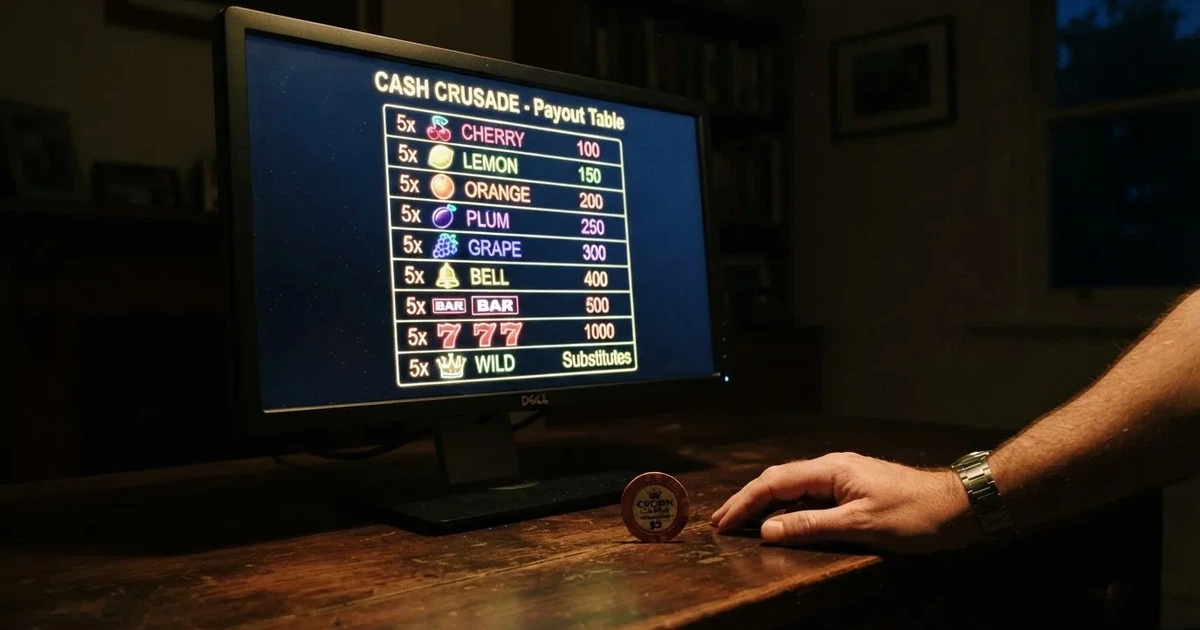
Every pokie machine in a licensed Australian venue carries a paytable — the screen or printed card that lists each symbol, each winning combination, the value of each combination at the bet you have set, and the rules of any bonus feature. It is the single document the player can read before the first spin and the document the venue’s compliance staff reads when they inspect the floor. The numbers on it are not a marketing promise; they are part of the machine’s approval.
Three things on the paytable drive most of the variation between one machine and the next.
Return to player. This is the percentage of money the machine is programmed to return over its full life cycle, expressed as a number between zero and one hundred. A machine set at 90% returns ninety cents of every dollar put through it, across millions of spins, to players as winnings. The remaining ten cents is the house edge — the venue’s and the regulator’s take. Australian jurisdictions set a minimum RTP that varies by state. New South Wales, the Northern Territory, Queensland and most of Victoria set 85% as the floor, with Crown Melbourne’s own-floor machines at 87%. The Australian Capital Territory and Tasmania set 87%. South Australia sets 87.5%. Western Australia, where pokies are restricted to Crown Perth, sets 90%. A machine cannot legally operate below its jurisdiction’s floor, and most venues run their floors somewhere between the floor and the low nineties.
Volatility. Also called variance. A low-volatility machine pays out small amounts often — a stream of small wins that keeps the balance ticking. A high-volatility machine pays out rarely but in larger bursts, with longer stretches of nothing between feature triggers. The RTP can be identical between the two and the experience completely different. A player with a small bankroll who picks a high-volatility title will see the balance vanish long before the theoretical return arrives. A player with a deeper bankroll who picks a low-volatility title will be bored before the session ends. The paytable shows volatility indirectly — through the size of the top jackpot relative to the line wins, the structure of the bonus feature, and whether the base game pays anything at all on small combinations.
Bet size and paylines. Australian pub and club machines typically run a fixed twenty-five or fifty paylines at a set credit value. The minimum bet is the line count multiplied by the smallest credit; the maximum is the line count multiplied by the largest. A multi-line machine pays on more combinations, more often, but at smaller line wins; a single-line or three-reel machine pays less often and bigger. The multi-line setup is closer to what online pokies became in offshore markets, where five reels and dozens of paylines are the standard. The math is the same in principle — more combinations, smaller individual prizes — and the player’s perception of “more action” is real, even if the long-term return sits in the same band as a tighter machine.
A reader who wants to find a payout percentage before sitting down has three paths. The first is the machine’s own information screen, usually reached by a button on the console. The second is the state regulator’s published data, which lists approved games and their RTP settings. The third is the venue itself — a club manager can usually point at which banks run which titles. None of those paths covers every machine on every floor, and none of them tells a player the actual return from the last hour’s play, which is what a session really feels like. The paytable is a programme, not a forecast.
Live tables, table games, and where baccarat and blackjack sit
A reader searching for a “best pokie machine” sometimes lands on a comparison page that quietly pivots into table games. The two products share a casino floor, and on the live-dealer side of an offshore site they can sit in the same lobby. They are not the same product, and the numbers that matter to a player are different.
Baccarat. The game on a Crown Melbourne or Crown Perth floor runs punto banco — the casino banks both hands, players bet on Player, Banker or Tie, and the dealer follows a fixed drawing rule from a six- or eight-deck shoe. The house edge is published and stable: 1.06% on Banker, 1.24% on Player, 14.36% on Tie. The Tie bet is the marketing trap — the payout looks generous, the edge makes it the worst dollar-for-dollar bet on the floor. Crown Melbourne lists three variants — Traditional Baccarat, Crown Baccarat and 2 to 1 Baccarat — under the approval of the Victorian Gambling and Casino Control Commission, which took over from the VCGLR on 1 July 2022.
The game’s history is the kind of detail a paytable never carries. Some accounts place baccarat in nineteenth-century France; others trace it to an Italian game brought into France during the reign of Charles VIII at the end of the fifteenth century. The writer David Parlett considers the game Macao its immediate precursor. Punto banco, the form played today, was developed in Havana during the 1940s. Chemin de fer — French for “railway” — is a two-player variant that emerged from baccarat banque in the late nineteenth century and is named for being quicker to play than the original. None of that changes the edge. The history changes how the game reads, not how it pays.
Blackjack. Optimal play on a liberal Las Vegas Strip rule set — dealer stands on soft 17, double on any two, double after split, resplit aces, late surrender — runs a house edge of about 0.28%. Atlantic City rules lift that to roughly 0.43%. The game is the deepest discount on the floor for a player who plays the chart. Variants change the edge materially. Spanish 21 plays without tens but adds player-favourable rules. Double Exposure deals both dealer cards face-up. Blackjack Switch lets a player swap the top cards between two hands. Super Fun 21 allows up to four splits. Each variant changes the strategy chart; the edge numbers above apply to the standard game, not the variants.
Blackjack’s modern name comes from the Klondike Gold Rush of 1896–1899, when prospectors adopted the term for a starting hand that included the ace of spades and a black jack. The card historian Thierry Depaulis dates the renaming to around 1899. Its predecessor was the English game vingt-un; a related Spanish game, veintiuno, appears in Miguel de Cervantes’ Rinconete y Cortadillo, written around 1601–1602. Formal rules were published in Britain in 1800. None of which changes the chart, and none of which the dealer is going to remind a player of.
The NSW Casino Control Act 1992, section 66, sets the framework for table games on a NSW casino floor: the operator cannot offer a game like baccarat or blackjack unless both the game and its rules are approved by the regulator, and the operator must make a copy of the approved rules available on request. That obligation is the legal reason a Crown Resorts floor is not the same as an offshore live-dealer studio streaming to an Australian IP.
How the ranking of online pokies is actually put together
Comparison pages that rank the “top ten” online pokie machines in Australia almost always do the same thing under the surface: they accept affiliate revenue from the brands they list, list ten of those brands in a sponsored order, and write a paragraph about each that recycles the brand’s own marketing copy. The mechanics of the ranking are not a secret; they are just rarely stated.
A ranking that would survive a sceptical reader has three properties. First, it names a criterion — RTP, volatility class, hit frequency, feature depth, jackpot structure — and applies that criterion consistently across the ten. Second, it gives the reader a way to verify the criterion on the machine itself, which on a pub floor means the information screen, and on an offshore site means a published paytable that the brand itself has put on the page. Third, it separates “this title is in the ranking” from “this title is a good choice for you” — which is the difference between a list and advice.
None of the offshore brands that dominate Australian-facing “best pokie” lists pass that test, because none of them publish a paytable in a form an Australian punter can verify, and because the ACMA’s formal-warning register is long enough that any ranking built around them is, in practice, a ranking of brands the regulator has acted against. The Australian reader’s honest ranking is built around licensed venues — the NSW pub and club network, the Victorian and Queensland casino floors, the Crown complexes in Melbourne and Perth, and the Tasmanian clubs whose machines now sit under the Tasmanian Liquor and Gaming Commission after the 2021 legislation that ended the Federal Group monopoly. The ranking criterion is the published RTP, the volatility band the venue reports, and the player’s own session length and bankroll.
The lay of the land: pokies in Australia at the numbers that matter
Australian pokies are the largest concentration of gaming machines per capita in the world. The country has roughly 3% of the world’s pub and club poker machines and 0.3% of the global population. In 2020–21, Australians bet close to A$150 billion through gaming machines and lost A$12.18 billion on them — a return-to-player figure of about 92% in aggregate, with state-by-state variation.
New South Wales is the largest jurisdiction by machine count: 87,298 gaming machines outside casinos across 2,195 venues as of June 2023, with player losses of A$8.18 billion in 2022–23. Queensland had 21,122 machines across 351 venues in October 2023. Victoria had 26,380 outside Crown Casino across 488 venues in 2021–22, under a 30,000-machine statewide limit that has held since. Western Australia banned poker machines in pubs and clubs when Crown Perth opened in 1985, leaving the casino floor as the only licensed home for the machines in that state. Tasmania ran its machines under the Federal Group’s monopoly from 1968 until November 2021, when legislation moved oversight to the Tasmanian Liquor and Gaming Commission.
The numbers are not a recommendation to play. They are the scale of the regulated market the rest of this page describes.
The law: what the Interactive Gambling Act actually prohibits
The Interactive Gambling Act 2001, strengthened by the Interactive Gambling Amendment Act 2017, makes it an offence to provide online casino games, online pokies or in-play betting to a person physically in Australia. No state or territory licenses those products. What is licensable is wagering on races and sport placed before the event, lotteries and keno — in practice licensed through the Northern Territory Racing and Wagering Commission, which regulates 52 of Australia’s online bookmakers, including Sportsbet, Bet365 and Ladbrokes, from a part-time commission that meets once a month in Darwin and, as reported in April 2026, has no full-time staff.
The player is not the target of the Act. The IGA’s enforcement arm is the ACMA — the Australian Communications and Media Authority. The ACMA investigates, issues formal warnings, and asks Australian internet service providers to block illegal sites. As reported in June 2026, a cumulative 1,751 illegal gambling and affiliate marketing websites have been blocked since the first blocking request in November 2019, and more than 230 unlicensed services have left the Australian market since 2017. The most recent round, reported on 26 June 2026, added 12 sites to the block list — 7Signs, ChromaBet, Donbet, Duospin, Freshbet, Slots Gem, Jacks Club, Lucky Start, Pointsbetz, Spinrise, Vinyl Casino and Wildsino. H2 Gambling Capital’s 2025 report puts annual losses to illegal sites at about A$3.9 billion, and estimates that the share of gambling going through legal channels fell from 74% in 2021 to 64%.
An offshore site gives the player no Australian consumer protection, no complaints body, and no recourse if a withdrawal is refused. A balance can sit in an account the day an ISP block lands, and the operator has no obligation under Australian law to return it.
A reform bill — the Interactive Gambling Amendment (Gambling Reform) Bill 2026 — passed Parliament on 19 August 2026. Its advertising and inducement measures commence on 1 January 2027, which means they are law with a start date, not yet in force at the time this page is written. The page is about the rules as they apply today; the 2027 changes belong to a different read.
What an Australian-facing “best pokie” site is, and what it is not
A site that promises a “best pokie machine to play” in Australia and reaches an Australian reader is one of three things, and the three are not equally good for the punter.
A licensed wagering site that has crossed the line. The operator carries a Northern Territory or other Australian licence for sports or racing, and adds an online casino or online pokies tab to the same login. The licence does not cover the casino product. The ACMA has written to several operators in this category. The breach is on the operator; the player’s account is held by the same company.
An offshore site with no Australian presence at all. Curaçao, Cyprus, Costa Rica, occasionally Malta — the licence the site displays is for a different jurisdiction and offers no protection in Australia. A withdrawal refusal falls under the licence’s dispute process, which is the operator’s own. The site may have been ACMA-warned, blocked, and quietly re-launched under a new domain in the same week.
A social casino or free-to-play app. No real money changes hands. The product is the game itself, often funded by in-app purchases and advertising. The ACMA’s regulatory interest is lower; the data the app collects is higher. None of it is a pokie machine in the Australian legal sense.
The common thread across all three is that none of them is a licensed Australian pokie machine. The “best” comparison those sites offer is between unlicensed products, and the only metric they reliably publish is the marketing one.
Offshore brands the ACMA has written to
The ACMA’s register of formal warnings is the most reliable public source on which offshore operators have crossed the line into Australian-facing real-money pokies. The list below is a sample of brands that have appeared in formal warnings, with the operator the warning named and the date the ACMA published the warning. The ACMA’s action is a finding by the regulator, not a player review — the operator’s response is not reproduced here, and an absence from the register is not a clean bill of health.
| Brand | ACMA action and date | Operator named by the ACMA | Subject support |
|---|---|---|---|
| RocketPlay | Formal warning, March 2026 (Pulsup Ltd); earlier Dama N.V., May 2022 | Pulsup Ltd / Dama N.V. | — |
| Level Up Casino | Formal warning, May 2022 | Dama N.V. | bgaming listings only |
| Woo Casino | Formal warning, March 2025 | Dama N.V. | — |
| Spirit Casino | Formal warning, May 2025 | Dama N.V. | — |
| National Casino | Formal warning, July 2025 | Consolutetish S.R.L. | en.wikipedia.org listings only |
| Bizzo Casino | Formal warning, July 2025 (Consolutetish); earlier 2022 (TechSolutions) | Consolutetish S.R.L. / TechSolutions | — |
| Ignition Casino | Formal warning, July 2025 | Bamboo Media | — |
| Instant Casino | Formal warning, February 2025 | EOD Code SRL | — |
| Jackbit | Formal warning, April 2026 | Ryker B.V. | — |
| Casino Intense | Formal warning, April 2025 | Sterplay Holding Ltd | Abc.net.au / acma.gov.au / Crownmelbourne.com.au listings only |
| Sky Crown | Formal warning, September 2022 | Hollycorn N.V. | — |
Two further warnings from the same period are worth flagging because they sit outside the eleven above. In May 2022, the ACMA’s warning to Dama N.V. covered a six-brand group: Bambet, Dazard, Level Up, Rocketplay, Wild Tornado and Cobra Casinos — meaning Rocketplay and Level Up Casino on the list above are both part of that earlier action. And Bizzo Casino’s July 2025 warning, on top of the 2022 warning to TechSolutions (CY) Group Limited and TechSolutions Group N.V., shows the operator running under fresh names and the same operator-of-record crossing the same line twice.
The pattern in the warnings — the same Dama N.V. address appearing across multiple brands, the same Curaçao-registered parent in different shells, the same warning issued months or years apart — is not a coincidence. It is the structural shape of the offshore market the ACMA is policing. The regulator’s record is public; the operator’s record is not.
What this page is, and what it deliberately is not
This page does not recommend an offshore site as a place to play. The licensed wagering channels the ACMA’s NTRWC list covers do not offer online pokies. The eleven brands above are documented as brands the regulator has warned; they are not brands a reader should sign up with. A reader who reaches this page looking for a place to deposit will not find one here — and that is the answer the law gives, not a gap in the page.
What the page does offer is the framework for choosing a pokie machine on a floor the reader can actually walk into. The minimum-RTP figures by jurisdiction. The volatility bands and what they cost a player at a given bet size. The paytable as the one document that travels with the machine and is not the venue’s marketing. The pre-commitment system Tasmania has spent the last several years building. The responsible-gambling supports that are licensed to help — BetStop, the National Self-Exclusion Register, Gambling Help Online.
The honest version of “best pokie machine to play Australia” is not a brand. It is a category — the licensed machine at the licensed venue, with the published RTP, under a state regulator that has set a floor and an enforcement body that writes to the operators that don’t.
How fast the ACMA’s blocking rate has moved, and what that pace implies
Between November 2019, when the ACMA made its first blocking request, and June 2026, the regulator asked Australian ISPs to block a cumulative 1,751 illegal gambling and affiliate marketing websites. The pace of blocking is not constant, and the publication rhythm of the formal-warning register is not constant either. The implication for a reader is that any “best offshore pokie site” list older than a year is, structurally, out of date — not because the brands have changed, but because the regulator’s record of them has.
To read the blocking rate as a band rather than a single figure: roughly 260 blocking requests a year across the period, with a single June 2026 round of 12 sites, a 2025 H2 Gambling Capital estimate of A$3.9 billion in annual losses to illegal sites, and a market share that has fallen from 74% in 2021 to 64% in 2025 for legal channels. The band is wide because the rounds are not uniform — some months the ACMA publishes no warnings, some months it publishes several — and because the underlying product set shifts as fast as the regulator can write. The condition is the date the figures are pinned to: the June 2026 round, the H2 Gambling Capital 2025 report, and the ACMA’s own register of formal warnings. Read together, they describe a regulator that is moving faster than the offshore market is exiting.
The arithmetic a pokie machine is built on
A pokie machine’s paytable is a programme. A 90% RTP means that, across the full life of the machine, ninety cents of every dollar wagered returns to players as winnings. The remaining ten cents is the venue’s gross — split with the state, taxed, and what pays the pub’s commission. A 92% machine returns two cents more per dollar than the 90% machine next to it; over a session of A$200 in wagers, the difference is A$4. That is the cost, on average, of choosing the lower-RTP machine. Over a year of regular play, the gap compounds.
Volatility is the second arithmetic. A low-volatility machine with a 90% RTP returns A$90 across a long run in small, frequent payments. A high-volatility machine with the same 90% RTP returns A$90 across the same long run in larger, less frequent payments. The short-run experience is what the player feels: the low-volatility machine pays the A$5 line win and the A$20 feature, the high-volatility machine does not pay for an hour and then pays A$400 on a single spin. The arithmetic is identical. The session is not.
A reader with a small bankroll who treats both machines as the same will end the session in the same place mathematically and in a different place emotionally. The house edge is the same; the player’s experience of the house edge is not.
Reading a paytable, step by step
The paytable screen on an Australian pub machine is reached through a button on the console, usually labelled “Info” or “Help” or “Paytable.” It is not the splash screen the machine boots into. What the screen carries, in roughly this order:
- The RTP, stated as a percentage. The state regulator’s floor is the lowest number the venue can run; the machine’s actual setting is on this screen.
- The paylines diagram, showing which symbol combinations count as wins.
- The credit value, the minimum credit, and the cost per spin at the current bet.
- The bonus feature, the trigger condition, and the feature payout — usually a free-spins round with a multiplier, or a hold-and-spin mechanic where the feature’s top prize is fixed.
- Any jackpot contribution and how the jackpot is funded — pooled across a venue’s machines, across a chain, or stand-alone.
A player who reads that screen once before the first spin has done more work than most. A player who reads it before changing the bet size has done more again.
Limits, pre-commitment, and the protections that travel with the venue
The Australian pokie market has two layers of player protection. The first is the regulatory floor — the minimum RTP, the maximum bet per spin in some states, the mandatory closing periods in others, the responsible-gambling signage on every machine. The second is the venue-level program — pre-commitment systems, voluntary exclusion registers, card-based session limits, mandatory breaks.
Tasmania is the jurisdiction furthest along on pre-commitment. The state planned mandatory pre-commitment cards for its poker machines, a system that would require a player to set a loss limit before the first spin and enforce it at the machine. The implementation of the reform has been delayed, with the latest published schedule placing the rollout in late 2025. The reason the reform matters nationally is that it is the only Australian jurisdiction with a credible plan to move pre-commitment from a venue-level option to a state-level requirement. Every other state and territory’s pre-commitment system is voluntary on the venue’s part.
BetStop — the National Self-Exclusion Register — has been live since August 2023. A player who registers excludes themselves from every Australian-licensed online and phone wagering service. The register does not bind offshore casinos, because offshore casinos are not Australian-licensed wagering services. A punter who excludes themselves from BetStop and then signs up with an offshore pokie site has excluded themselves from a market the register does not touch.
State-level self-exclusion registers — the NSW one, the Victorian one, the Queensland one — work in the same shape: a registered player is barred from every licensed venue in the state. The Crown complexes honour interstate exclusions. The mechanism is venue-staffed: a player is photographed at registration, the photograph is held in a central database, venue staff run the check at the door. The system is imperfect in the same way every staff-staffed system is imperfect, but it is the strongest consumer protection an Australian pokie player has access to.
Where the regulator has set the floor, state by state
| Jurisdiction | Minimum RTP | Notes |
|---|---|---|
| New South Wales | 85% | 87,298 machines outside casinos across 2,195 venues (June 2023); A$8.18 billion in player losses in 2022–23. |
| Northern Territory | 85% | The NT Racing and Wagering Commission regulates 52 online bookmakers, including Sportsbet, Bet365 and Ladbrokes. |
| Queensland | 85% | 21,122 machines across 351 venues (October 2023). |
| Victoria | 85% (87% at Crown Melbourne) | 26,380 machines outside Crown Casino across 488 venues (2021–22); 30,000-machine statewide cap. |
| Australian Capital Territory | 87% | — |
| Tasmania | 87% | Pre-commitment cards in rollout; monopoly ended November 2021. |
| South Australia | 87.5% | — |
| Western Australia | 90% | Pokies restricted to Crown Perth; about 2,500 machines. |
The numbers above are the legal minimums. Most licensed venues run their floors above the floor, in a band between the minimum and the low nineties, and the precise setting of any individual machine is on its information screen.
What the responsible-gambling support structure looks like
The National Gambling Helpline — 1800 858 858 — is free, available 24/7, with chat at Gambling Help Online. The helpline is the entry point for state-level support services, financial counselling, and self-exclusion registration. It is the one number a player at any machine in any state can call from the floor.
BetStop, the National Self-Exclusion Register, has been live since August 2023 and binds every Australian-licensed online and phone wagering service. A registration lasts a minimum period set by the player. The mechanism is online; the effect is at the venue and the licensed site. The register does not cover offshore casinos — those operators are not connected to the register, and a player registered with BetStop is not, by that registration alone, excluded from an offshore pokie site.
State-level gambling support services sit alongside the national helpline. Each state has its own counselling service, its own financial counselling program, and its own self-exclusion register. A player who needs to act in person rather than by phone can do so through their state’s service.
The structure is the strongest part of the Australian system. A player who uses it gets a floor on what they can lose. A player who does not use it has the regulator’s minimum RTP as their only protection.
The tax position: what a pokie win is, on a tax return
Gambling winnings of a recreational player are not assessable income in Australia — section 6-5 of the ITAA 1997 treats them as the proceeds of a private pastime, not a business activity. Gambling losses are not deductible against other income for a recreational player. The position changes if the player carries on a business of gambling — professional poker players, sports bettors who run a betting operation as a business, certain high-volume advantage players. For the typical Australian punter playing pokies in a pub, the ATO has no role in the session.
That is the model. The instruction to “check with the ATO” applies to edge cases — a player whose gambling activity approaches a business in scale, a player who has gambling-related income from a sponsorship, a player who has gambling losses they want to claim against another assessable income stream. For the typical case, the conversation with the ATO is one a punter does not need to have.
A reader’s checklist before the first spin
Three questions a reader can answer before they put a dollar in a machine, and the answer is the same in every state:
- What is the machine’s RTP, as printed on its information screen? If the screen does not show it, the machine is either an older unit pending an upgrade or a venue that has not enabled the display. Either way, it is not a machine the venue is showing transparently.
- What is the volatility band — low, medium, high — as the paytable describes it? A high-volatility machine at a small bankroll will return less of the bankroll in any single session than a low-volatility machine at the same RTP.
- What is the venue’s responsible-gambling signage, and is there a pre-commitment or session-limit option on the machine or at the cashier? A venue that has not enabled those options is a venue to leave.
A fourth question, for a reader who is choosing between an online offer and a venue: is the online offer licensed in Australia? The answer in 2026 is no, for any offer of online pokies.
What the data does not cover
A paytable is a programme, not a session. The 92% RTP is a 92% return across millions of spins; a single session of fifty spins is not the long run, and the bankroll at the end of a session is not the bankroll the RTP implies. The page describes the regulatory and mechanical framework, and the framework does not include the session-by-session experience of any individual player.
The offshore operator set is partial. The ACMA’s register is the public source, and a formal warning is the public action the regulator takes. An absence from the register is not a clean bill of health; the regulator does not warn every operator it could warn, and a brand that has not yet been warned is not the same as a brand that has been reviewed and cleared. The eleven brands listed above are the brands the ACMA has acted against as of the date the figures are current to. The list will be longer a year from now.
The licensed wagering market — the Northern Territory bookmakers — does not offer online pokies, and the comparison pages that rank “best pokie sites in Australia” do not, structurally, include any licensed Australian site for the product the page is comparing. The honest Australian answer is a venue, not a site.
Closing on what the page is for
A reader who reached this page looking for a brand to sign up with will leave without one, and that is the answer the law gives. A reader who reached it looking for the framework to choose a machine on a floor they can walk into will leave with the RTPs by jurisdiction, the volatility bands, the paytable as the document to read, the responsible-gambling supports, and the names of the offshore operators the ACMA has written to.
The “best pokie machine to play” question is, in Australia, a question about a licensed product on a licensed floor. The marketing of the offshore market is louder than the licensed market’s marketing because the offshore market is unregulated and the licensed market is regulated. The arithmetic is the same on both sides; the consumer protection is not.
Frequently asked questions
What is the difference between a low-volatility and a high-volatility pokie machine?
A low-volatility machine pays small amounts often. A high-volatility machine pays rarely, and in larger bursts when it does. The two can carry the same RTP — the long-run return is identical — but a player with a small bankroll will see their balance disappear faster on a high-volatility title, while a deeper bankroll will spend a low-volatility session waiting for a feature that may not arrive. The paytable describes the difference indirectly, through the size of the top prize relative to the line wins.
Does bet size change the odds on a pokie machine?
Bet size changes the value of each payline win and the cost of each spin; it does not change the RTP. A 90% machine returns 90% of every dollar wagered regardless of whether the dollar is one credit across twenty-five lines or five credits across the same twenty-five. Higher bets do mean higher dollar wins on the same combinations and the same dollar losses on the same losing spins. The ratio is constant.
Are mobile pokie-machine apps the same as the licensed machines in a pub or club?
No. There is no licensed Australian pokie-machine app. The Interactive Gambling Act 2001 prohibits the offering of online pokies to people in Australia; the licensed product is the floor machine. What the app stores carry is free-to-play social casino software or offshore real-money apps with no Australian consumer protection. The same brand on the phone is not the same product as the same brand on a venue floor.
How can someone find the payout percentage of a specific pokie machine before playing?
Three paths. The machine’s own information screen, reached through a button on the console, shows the RTP and the paytable. The state regulator publishes approved games and their settings, which is the second-best check. The venue itself is the third — a club manager can point at which banks run which titles. None of these paths covers every machine on every floor, and none of them describes the session-level return a player actually experiences.
Are multi-line pokie machines more likely to pay out than single-line ones?
Yes, on a per-spin basis — there are more combinations on a multi-line machine, so a higher fraction of spins land on at least one paying combination. The line wins are smaller to compensate, and the long-run RTP is set independently of the line count. The result is a flatter, busier experience rather than a higher return. A single-line machine pays less often and larger, with a similar RTP over a long session.
Who audits pokie machines in licensed Australian venues?
State regulators approve the games and their settings. Each state and territory has its own gaming commission or equivalent — the NSW Liquor & Gaming authority, the Victorian Gambling and Casino Control Commission, the Queensland Office of Liquor and Gaming Regulation, and so on. The commissions inspect machines, run compliance checks, and publish the data a player can read. Testing laboratories — independent firms accredited by the regulator — audit the maths of the games before they are approved, and the venues themselves run ongoing compliance testing.