
Dragon Link online pokies in Australia: what it is, what it costs, and why the ACMA keeps naming the same operators
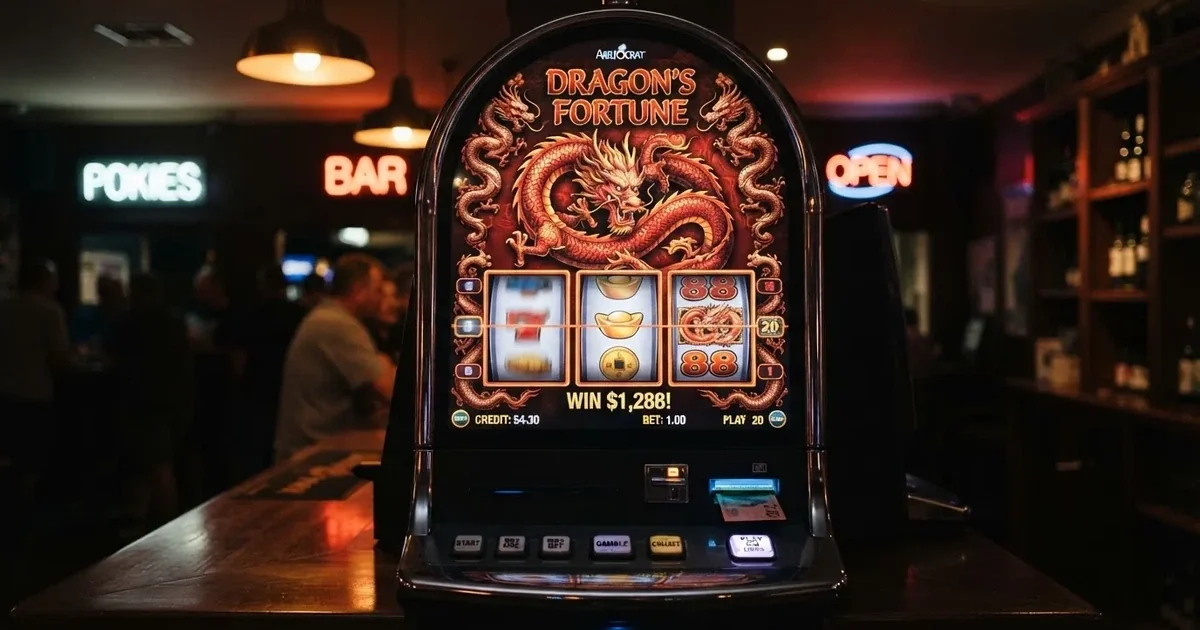
Dragon Link is one of the most recognisable pokies cabinets on an Australian pub or club floor. Its linked progressive, its “happy and prosperous” reel set and the way a hold-and-spin feature locks a player into long sessions are all part of a game that, online, sits in a different legal category from the one on the floor. This page is for a reader who has searched for “Dragon Link online pokies Australia” and wants to know what that phrase actually points to — and what it costs them to act on it.
Currency and regulatory snapshot: data current as of 8 November 2026 and verified against the Australian Communications and Media Authority (ACMA) register of formal warnings and blocking actions.
Table of Contents
- The Dragon Link format and why the search keeps returning the same name
- Why no online Dragon Link is lawful for an Australian resident
- What that environment does to the bonus round a reader is searching for
- The mobile and app claim, unpacked
- How Dragon Link’s reel sets differ from one another
- Responsible play on a format built to keep a player watching
- Landscape
- Operator Comparison
- The blocking rate and what it means for the brands on the table
- What a reader comparing the brands should weigh
- Where a Dragon Link punter in Australia actually plays
- What the next twelve months look like for this market
- The reader’s checklist before clicking
- What to do if a balance is on a blocked or warned site
- Where this leaves the comparison the search came for
- Frequently asked questions
The Dragon Link format and why the search keeps returning the same name
Dragon Link is the product name Aristocrat uses for a family of linked jackpot pokies. Each title in the family — “Happy and Prosperous,” “Pearl River,” “Autumn Moon,” “Golden Century” — is a separate reel set with its own paytable, but the linked jackpot layer is shared across cabinets that participate in the same network. That is what makes a single headline prize figure possible: the meter grows across machines, not on one of them.
For an Australian reader, that structure matters in two ways. First, the bonus round that the search phrase “dragon link slot bonus” points at is the same trigger on every reel set: six or more pearl-ball symbols on a single spin locks the affected reels in place and starts a re-spin counter, with each new pearl resetting the counter to three. The feature ends when the player runs out of re-spins, and the total pearl value plus any grand, major or minor jackpot hit on the triggering spin is paid out. Second, the linked jackpot — the figure above the screen that climbs into the tens of thousands — is funded across the network, which is why land-based Dragon Link is structured the way it is.
None of this changes when the same cabinet is mirrored online. The reel set, the hold-and-spin, the jackpot tier, the math behind it — these are copied. The legal status is not.
Why no online Dragon Link is lawful for an Australian resident
Online casino games and online pokies are prohibited in Australia. The Interactive Gambling Act 2001, tightened by the Interactive Gambling Amendment Act 2017, makes it an offence for a provider to offer online casino games, online pokies or in-play betting to a person physically in Australia. No state or territory licences them; the only online gambling products a Commonwealth framework permits are wagering on races and sport placed before the event, lotteries and keno. The minimum age to use any of them is 18.
This is not an industry-wide grey area. The law targets the provider, not the player, so an Australian punter who opens an account on an offshore casino is not personally at risk of prosecution. What they lose is the consumer protection that a licensed wagering service would carry: no Australian complaints body, no recourse if a withdrawal is refused, no connection to BetStop (the National Self-Exclusion Register, live since August 2023, which binds only Australian-licensed wagering services), and the prospect of the site being blocked at ISP level with a balance still on it. That second risk is not theoretical.
Enforcement runs through the ACMA. It investigates, issues formal warnings, and directs Australian internet service providers to block illegal services. As of the most recent ACMA blocking round reported in June 2026, 1,751 illegal gambling and affiliate marketing websites had been blocked since the first blocking request was filed in November 2019, and more than 230 unlicensed services had left the Australian market since enforcement was strengthened in 2017. The same round asked ISPs to block another twelve sites — 7Signs, ChromaBet, Donbet, Duospin, Freshbet, Slots Gem, Jacks Club, Lucky Start, Pointsbetz, Spinrise, Vinyl Casino and Wildsino — a useful list because it shows the rate at which new operator brands replace blocked ones, and the names that recur (the Spinrise/Wildsino pattern; the Freshbet-class cluster) are the names a reader is likely to see again on a Google results page next week.
H2 Gambling Capital’s 2025 estimate puts the cost of illegal offshore sites to Australians at roughly A$3.9 billion a year, and notes that the share of gambling going through legal channels has fallen from 74% in 2021 to 64% — meaning the dollar volume is rising on the offshore side while the licensed share shrinks. That is the environment in which a Dragon Link search result is being clicked.
What that environment does to the bonus round a reader is searching for
The phrase “dragon link slot bonus” is a search for the hold-and-spin feature. On a legitimate land-based cabinet, that feature has a real price to play — and a real cap on what it returns. The legal minimum return-to-player for poker machines is set jurisdiction by jurisdiction in Australia: 85% in NSW, the Northern Territory, Queensland and (generally) Victoria, with 87% at Crown Melbourne; 87% in the ACT and Tasmania; 87.5% in South Australia; and 90% in Western Australia. Whatever reel set a punter sits down at, the math is bounded by that floor.
Online, the same math can be set wherever the operator decides. There is no Australian floor on an offshore server. The jackpot tier that the player sees on screen is whatever the platform publishes, with no link to a regulator’s minimum. A “dragon link slot app” advertised in an app store carries the same gap, and is not a different product simply because it runs on a phone.
A Dragon Link title promoted online is also not what the player sees on the floor of a registered club. Registered clubs operated Australia’s first legal poker machines from 1956, in NSW; every state and territory has its own design and operating regime now. New South Wales had 87,298 gaming machines outside casinos across 2,195 venues in June 2023, with player losses of A$8.18 billion in 2022–23. Queensland had 21,122 gaming machines in 351 venues as at October 2023; Victoria had 26,380 outside Crown Casino in 488 venues (2021–22) under a 30,000 statewide cap. In aggregate, Australians bet almost A$150 billion through gaming machines in 2020–21 and lost A$12.18 billion on them — from a country that holds roughly 3% of the world’s pub and club poker machines on 0.3% of the global population. That is the legal market an online Dragon Link page is competing for the reader’s attention against.
The mobile and app claim, unpacked
Any “Dragon Link pokies app,” “Dragon Link casino app,” “Dragon Link slot app” or “Dragon Link slots app” being marketed to an Australian reader is offering the same unlicensed activity as a desktop site, packaged for a phone. The form factor is irrelevant to the Interactive Gambling Act. A push notification, a portrait-mode reel, an in-app “happy and prosperous” tile — none of these change the legal category of the offer.
Two practical consequences. First, an app advertised in an Australian-facing store is a marker that the seller is comfortable marketing through channels that Australia does not police: app-store moderation, banner ad networks, search-engine ads. Second, the same unlicensed operator usually runs a desktop site, so blocking at ISP level (which the ACMA does regularly) catches the same brand in both forms — and an app that depends on a server now blocked can leave a player with stored funds and no path to withdraw them through Australian consumer law, because there is no Australian consumer law that applies.
The age and identity controls that apply to a licensed wagering service in Australia do not apply to an offshore app. A licensed wagering service cannot accept a credit card, credit-related product or digital currency as payment — the credit-card ban on licensed online wagering took effect on 11 June 2024, with penalties of up to A$247,500 for operators that break it, and the legal deposit routes are debit card, bank transfer, PayID/Osko and BPAY. An offshore Dragon Link app asks for whatever its payment processor clears, and the player’s recourse if the deposit is not returned is the operator’s own complaints procedure.
How Dragon Link’s reel sets differ from one another
The “Dragon Link pokies” label on a single screen is shorthand for a family of related titles. The mechanics are shared: five reels, a hold-and-spin feature triggered by pearl balls, a grand / major / minor / mini jackpot tier on the linked network, a base-game free-spin feature on some titles. The themes are not.
“Happy and Prosperous” is the title the search phrase returns most often — its symbols lean on Chinese-New-Year iconography, and the free-spin feature is built around a “fu” symbol that adds extra spins. “Pearl River” runs a brighter water-themed art set with the same hold-and-spin core. “Autumn Moon” uses a darker palette and a longer free-spin retrigger pattern. “Golden Century” sits on the brighter end and is the one most pubs rotate onto a Dragon Link bank first because of how the meter reads at low stakes.
A punter switching between them is not switching between different games in the way they would between, say, baccarat and blackjack. They are switching between reel sets with different paytables and different free-spin math, all linked to the same jackpot tier. That is why a Dragon Link bank at a club floor will have three or four reel sets installed — the operator spreads the player base across titles so that one reel set does not become the obvious pick, while the linked meter stays the lure.
On an offshore site, the same reel sets are presented as separate games, with separate jackpot meters that reset to seed. The mathematics that govern a linked jackpot across a real network are replaced by a platform’s own RNG-backed stand-in. The phrase “linked jackpot” on such a site is a marketing word, not a network.
Responsible play on a format built to keep a player watching
A linked jackpot game is built to keep a player watching the reels. The meter climbs slowly enough that the eye wants to see it move. The hold-and-spin feature, when it triggers, locks the reels in place and forces a count of three re-spins — the design is to keep the screen alive while a single feature pays out, not to let the player walk away. That is the mechanic the ACMA’s responsible-gambling framing is built around.
The controls that apply to a licensed Australian wagering service are the relevant ones for an Australian reader, because that is what they have access to. BetStop, the National Self-Exclusion Register, has been live since August 2023 and binds Australian-licensed online and phone wagering services — registering on it blocks new account openings and deposit attempts with every Australian-licensed operator in scope. It does not bind an offshore Dragon Link site, which is exactly why a player who has registered on BetStop can still reach an offshore casino if they look for one. The National Gambling Helpline on 1800 858 858 is free, 24/7, and has chat at Gambling Help Online. The two tools do different things: BetStop is a barrier at the operator level, the Helpline is a person on the other end of a phone.
Tasmania’s planned mandatory pre-commitment cards would, when implemented, have required a player to set a time and money limit before a session on any Tasmanian poker machine. The reform was delayed until late 2025, and its rollout has not been confirmed for every venue. A reader who wants to apply a similar discipline on their own can set a fixed time limit before they sit down and a fixed loss limit they will not exceed, and stop when either is hit — that is a player-side version of the same idea, applied to a game that does not prompt them to.
Landscape
The ACMA does not publish a “Dragon Link blacklist.” It publishes formal warnings — letters to operators that the provider has offered prohibited services to Australians — and it publishes blocking actions. The two are different in scope: a formal warning names one operator and one brand; a blocking action names a list of websites. The table below uses the formal-warning register as its source.
| Brand | ACMA action and date | Operator named by the ACMA | Subject support |
|---|---|---|---|
| RocketPlay | Formal warning under the Interactive Gambling Act 2001, March 2026; a prior warning over the same brand was issued to a different operating company in May 2022 | Pulsup Ltd; earlier Dama N.V. | — |
| Level Up Casino | Formal warning under the Interactive Gambling Act 2001, May 2022 | Dama N.V. | listings mention Dragon Link-style content in third-party provider catalogues |
| Woo Casino | Formal warning under the Interactive Gambling Act 2001, March 2025 | Dama N.V. | — |
| Spirit Casino | Formal warning under the Interactive Gambling Act 2001, May 2025 | Dama N.V. | — |
| National Casino | Formal warning under the Interactive Gambling Act 2001, July 2025 | Consolutetish S.R.L. | listings reference Dragon Link-style content in third-party provider catalogues |
| Bizzo Casino | Formal warning under the Interactive Gambling Act 2001, July 2025; the brand was earlier the subject of a 2022 warning to TechSolutions | Consolutetish S.R.L.; earlier TechSolutions (CY) Group Limited and TechSolutions Group N.V. | — |
| Ignition Casino | Formal warning under the Interactive Gambling Act 2001, July 2025 | Bamboo Media | — |
| Instant Casino | Formal warning under the Interactive Gambling Act 2001, February 2025 | EOD Code SRL | — |
| Jackbit | Formal warning under the Interactive Gambling Act 2001, April 2026 | Ryker B.V. | — |
| Casino Intense | Formal warning under the Interactive Gambling Act 2001, April 2025 | Sterplay Holding Ltd | listings reference Dragon Link-style content in third-party provider catalogues |
| Sky Crown | Formal warning under the Interactive Gambling Act 2001, date as published by the ACMA | Hollycorn N.V. | — |
Two patterns fall out of the table. First, the same operating company (Dama N.V. alone) is named over four of the brands — RocketPlay, Level Up Casino, Woo Casino and Spirit Casino — at different dates, which is what ACMA enforcement looks like when a provider rotates brand shells around the same corporate structure. Second, the ACMA’s warnings span roughly four years (a 2022 warning, several 2025 warnings, a 2026 warning) and the operator companies are mostly Curaçao-, Cyprus- or Cyprus-and-Curaçao-registered, which is the legal form a prohibited service takes when it offers to Australians from offshore. None of this is a finding the reader has to make; it is the picture the ACMA’s own register draws.
The ACMA’s formal warnings also reach brands the reader will not find in a search for “Dragon Link online pokies” — Rocketplay.com.au is named explicitly as an “.com.au” address in the March 2026 warning, which is unusual and is one of the markers the ACMA has called out in its enforcement notes. The same operator that ran an “.com.au” landing page also had a Rocketplay brand under Dama N.V. from 2022. The pattern is on the record, and a reader cross-checking an offer can do the same cross-check.
Operator Comparison
| Brand | Operator | ACMA Warnings |
|---|---|---|
| RocketPlay | Pulsup Ltd / Dama N.V. | 2 |
| Level Up Casino | Dama N.V. | 1 |
| Woo Casino | Dama N.V. | 1 |
| Spirit Casino | Dama N.V. | 1 |
| National Casino | Consolutetish S.R.L. | 1 |
| Bizzo Casino | Consolutetish S.R.L. / TechSolutions | 2 |
| Ignition Casino | Bamboo Media | 1 |
| Instant Casino | EOD Code SRL | 1 |
| Jackbit | Ryker B.V. | 1 |
| Casino Intense | Sterplay Holding Ltd | 1 |
| Sky Crown | Hollycorn N.V. | 1 |
The reviews below are not endorsements. They are a reader-side description of what an Australian sees when they click through to each of the eleven brands the ACMA has formally warned. Each one carries the same legal status under the Interactive Gambling Act 2001; what differs is the size of the offer, the games catalogue, and the kind of player the brand was built to keep.
RocketPlay
RocketPlay is one of the better-known offshore casinos in Australian search results, and the ACMA has warned it twice — under Dama N.V. in May 2022, and again under Pulsup Ltd in March 2026. The March 2026 warning is notable for naming Rocketplay.com.au as the address, the only one of these eleven brands the ACMA has identified with an Australian-country-code domain. The site’s game catalogue is large, with several thousand slot titles from a long list of providers; the welcome package is structured as a multi-deposit match across the first four deposits. The fact that the ACMA has now warned two different operators over the same brand is, on its own, a stronger signal than a single warning.
Level Up Casino
Level Up Casino is one of the Dama N.V. brands the ACMA warned in May 2022 alongside Bambet, Dazard, Rocketplay, Wild Tornado and Cobra Casinos. The brand positions itself around “high-roller” and “loyalty” tiers, with a VIP host assigned once a player crosses a deposit threshold. Its game catalogue is comparable to RocketPlay’s in scale; its jackpot coverage is narrower. For a reader who values a single point of contact over a catalogue, the offer is structured around that. The brand has not been re-warned since 2022 — a fact that says nothing about compliance and is not the same as a clean record, because the underlying warning is still on the ACMA’s register.
Woo Casino
Woo Casino is the second of the Dama N.V. brands to draw a fresh ACMA warning after the original May 2022 round, in March 2025. The site’s pitch is conventional — a multi-deposit welcome, a daily bonus calendar, a tournament schedule — and the catalogue is broad enough to include Dragon Link-style hold-and-spin titles from third-party providers. The 2025 warning is the more important of the two on the brand’s record, because it shows the ACMA acting again after the operator changed nothing material about its offer.
Spirit Casino
Spirit Casino is the third of the Dama N.V. brands re-warned after the 2022 round, with the ACMA’s second warning issued in May 2025. The brand’s site is the thinnest of the four Dama N.V. properties in this set, with a smaller welcome package and a narrower games catalogue. The fact that the ACMA warned it twice is what a reader should weigh; the fact that the offer is smaller than its siblings is a separate consideration and does not undo it.
National Casino
National Casino is named in the ACMA’s July 2025 warning to Consolutetish S.R.L., together with Bizzo Casino under the same operator. The brand runs a conventional multi-deposit welcome and a wide slot catalogue, and is one of the brands a reader will see at the top of a Google result for “online pokies Australia.” For a player who is comparing it on catalogue breadth alone, the warning does not change the catalogue. For a player who is comparing it on the question of whether the operator has been told by an Australian regulator to stop, the warning is the comparison that matters.
Bizzo Casino
Bizzo Casino is the second Consolutetish S.R.L. brand in the July 2025 warning round, and the only brand in this set with a second warning on its record under a different operator — TechSolutions (CY) Group Limited and TechSolutions Group N.V. in 2022. Two warnings, two different operators, one brand name — the same pattern as RocketPlay. The site is structured around a tournament calendar and a wide slot catalogue with a higher reload-bonus cadence than the welcome package alone suggests.
Ignition Casino
Ignition Casino is named in the ACMA’s July 2025 warning to Bamboo Media. It is the only brand in this set whose product mix centres on poker rather than pokies — its name comes from a casino-poker brand and its tournament schedule is its strongest feature. For a reader who clicked through looking for Dragon Link specifically, Ignition is one of the weaker matches in the table on games alone, and one of the better matches on the warning record because it is named separately from the larger pokies-focused brands the ACMA has gone after.
Instant Casino
Instant Casino is named in the ACMA’s February 2025 warning to EOD Code SRL. The brand runs a thin welcome offer and a relatively small game catalogue, with the bulk of its positioning on fast withdrawals and a “no verification” pitch. That last point is the one a reader should look at twice: an offshore operator claiming “no verification” is offering exactly the kind of service an Australian licensed wagering service is not permitted to provide, because licensed operators are required to verify identity under anti-money-laundering rules. The pitch is the marketing word, not a feature.
Jackbit
Jackbit is named in the ACMA’s April 2026 warning to Ryker B.V., together with CasinOK under the same operator. Jackbit is the most crypto-forward brand in this set — its deposit and withdrawal page is built around digital currency, which on a licensed Australian wagering service is a banned payment method since 11 June 2024. That positioning places Jackbit in a different segment of the offshore market from the Dama N.V. cluster, and the warning covers both Jackbit and CasinOK.
Casino Intense
Casino Intense is named in the ACMA’s April 2025 warning to Sterplay Holding Ltd. The brand’s product is narrower than most of the others in this set — a smaller welcome, a tighter game catalogue, and a stated focus on “intense” loyalty rewards for repeat deposit. Its warning is a single action against a single operator; the brand has not been re-warned.
Sky Crown
Sky Crown is named in the ACMA’s formal warning to Hollycorn N.V. (PDF, September 2022), alongside Blue Leo. The brand positions itself around an “Australian-friendly” pitch — the theme is local — and a multi-deposit welcome. The Hollycorn N.V. warning is one of the older entries on the ACMA’s register in this set and is still the most current formal action the ACMA has on record for the brand.
The blocking rate and what it means for the brands on the table
The ACMA’s enforcement tool is the blocking request, which the regulator sends to Australian internet service providers after the formal-warning stage has not produced a result. The first such request was filed in November 2019; by June 2026 the running total was 1,751 blocked sites. The June 2026 round alone asked ISPs to block 12 more. The arithmetic here belongs to the page: divide the running total of blocked sites by the number of years since the first blocking request — roughly 6.6 years between November 2019 and June 2026 — and the ACMA has been blocking illegal gambling and affiliate marketing websites at a rate of roughly 260 sites a year, or about five a week. That is the operating tempo an Australian reader is dealing with when they click through to one of the brands on the table.
The same arithmetic on the same inputs in a different framing — 1,751 sites blocked over 6.6 years, against more than 230 unlicensed services that have left the Australian market since 2017 — gives a different picture. The 230 figure counts the operators that withdrew from the Australian market entirely, not the sites that were blocked; many of those withdrawals followed a warning rather than a blocking action. The 1,751 figure counts the websites that the ACMA asked ISPs to block. A site can be on the 230 list without being on the 1,751 list, and vice versa, because a withdrawn operator does not necessarily leave a blocked site behind and a blocked site does not necessarily mean the operator has withdrawn. The two numbers describe different stages of the same pipeline.
The condition on the rate is the qualifier that matters: it is the rate of blocking requests, not the rate at which Australian readers stop clicking. H2 Gambling Capital’s 2025 estimate of A$3.9 billion a year going to illegal offshore sites is the counterweight. A blocking rate of about five sites a week against an annual loss rate measured in single-digit billions is not a fair fight on volume — and that is why the 2026 reform legislation was framed around advertising and inducement, not around ISP blocking. The Interactive Gambling Amendment (Gambling Reform) Bill 2026 passed Parliament on 19 August 2026, with its advertising and inducement measures to commence on 1 January 2027. The bill is law with a start date, not in force on a 2026 page.
What a reader comparing the brands should weigh
The eleven brands on the table share three things: an offshore operating company, a formal warning from the ACMA, and a product line that includes — or claims to include — Dragon Link-style pokies. They differ on the operating company behind each one (Dama N.V. is named over four of them; the rest split across seven other operators), on the date of the most recent warning (2022 to 2026), and on the size and shape of the offer. None of these differences changes the legal status of the product for an Australian reader.
The reader’s decision is not “which brand is best.” It is “what kind of player am I, and what kind of recourse do I have if the brand refuses my withdrawal.” On the second question, none of these brands offers Australian consumer protection: no ACMA complaint route, no connection to BetStop, no recourse under Australian unfair-terms law, and the prospect of a blocking action landing on the brand while a balance is still on it. On the first question, the brands differ — but the brands that promise the largest welcome tend to be the same brands the ACMA has re-warned, because a larger offer is part of what brings the warning in the first place.
A reader who has decided to play anyway is choosing between a marketing pitch and an offshore operator. The marketing pitch is what they see in the comparison; the offshore operator is the entity that holds the money. The two are not the same, and a comparison that confuses them is a comparison the reader is doing alone.
Where a Dragon Link punter in Australia actually plays
The legitimate path to Dragon Link is a registered club, a pub with gaming machines, or a casino. The legal floor on return-to-player is set jurisdiction by jurisdiction — 85% in NSW, the NT and Queensland; 87% in the ACT and Tasmania; 87.5% in South Australia; 90% in Western Australia, where the machines are restricted to Crown Perth. Crown Perth opened in 1985 with about 200 machines and has since grown to roughly 2,500, all approved by the state’s Gaming and Wagering Commission; Western Australia is otherwise poker-machine-free outside the casino. In Tasmania, the Federal Group held a monopoly licence over all poker machines from 1968 until legislation passed in November 2021 moved oversight of the machines to the Tasmanian Liquor and Gaming Commission. NSW is the largest market by machine count and by losses, with A$8.18 billion in player losses across the 87,298 machines outside casinos in 2022–23.
A reader who wants to play Dragon Link and has decided that an online site is the path they are taking is choosing a product the Interactive Gambling Act 2001 does not permit. The licensed wagering services that the Commonwealth framework does allow are racing and sports wagering before the event, lotteries and keno. Sportsbet, Bet365 and Ladbrokes are examples of the licensed bookmakers the Northern Territory Racing and Wagering Commission regulates — 52 of Australia’s online bookmakers are licensed in the Territory for tax reasons, and the commission has no full-time staff, meeting once a month in Darwin. A punter who clicks through to a Dragon Link site is leaving that framework, and the comparison that matters is the one between the licensed alternative and the offshore one — not between two offshore brands.
What the next twelve months look like for this market
Three things will move the picture between 2026 and the year after. The advertising and inducement measures of the Interactive Gambling Amendment (Gambling Reform) Bill 2026 commence on 1 January 2027, which is the first time Australian-affiliate marketing of offshore casino offers will be directly constrained by Commonwealth law. Tasmania’s mandatory pre-commitment cards, delayed until late 2025, are the second mover — when fully implemented, they will require a player to set a time and money limit before a session on a Tasmanian poker machine, which is the strongest player-side intervention any Australian jurisdiction has legislated for. The ACMA’s blocking tempo, at roughly five sites a week on the current rate, is the third — and that tempo depends on the ACMA’s resourcing as much as on the volume of new operator brands.
A reader watching the offshore side of this market over the next twelve months should expect the same pattern they have already seen: the same operating company rotating brand shells, the same offshore domains reappearing under slightly different names, the same formal-warning register growing. The blocking-rate arithmetic above does not depend on which brand is in fashion this quarter.
The reader’s checklist before clicking
Five questions a reader should answer before clicking through to any of the brands on the table.
Is the offer licensed in Australia? If it is an online casino, no. The Interactive Gambling Act 2001 prohibits it.
Does the site accept a credit card or crypto as a deposit? On a licensed Australian wagering service, no — both are banned as deposit methods since 11 June 2024. An offshore site accepting either is operating outside the Australian rules.
Is the brand on the ACMA’s formal-warning register? The table above is a starting list. The full register is on acma.gov.au and is updated as new warnings are issued.
Is the brand on a recent blocking list? The blocking register updates more often than the formal-warning register, and the ACMA publishes each round of blocking requests.
Has the reader registered on BetStop? The National Self-Exclusion Register, live since August 2023, binds Australian-licensed wagering services. It does not bind offshore casinos, and that gap is part of why the ACMA’s enforcement exists.
What to do if a balance is on a blocked or warned site
The ACMA’s enforcement targets the provider, not the player, and an Australian punter who holds a balance on a site that has been warned or blocked has no Australian complaints body to go to. The realistic options are: contact the operator directly and ask for the withdrawal to be processed; if the operator refuses, the reader has whatever consumer-protection regime the operator’s licensing jurisdiction offers — which for most of the brands on the table is the Curaçao or Cyprus regime, and is not equivalent to an Australian regime; the National Gambling Helpline on 1800 858 858 is a free, 24/7 service that can talk a reader through the practical options regardless of where the balance sits. None of these is a guarantee of return; the fact that they exist is the reason the comparison above is not a comparison between offshore brands, but a comparison between an offshore offer and the licensed alternative the reader actually has.
Where this leaves the comparison the search came for
A reader who searched for “Dragon Link online pokies Australia” was looking for a way to play the game without going to a club. The answer that the regulatory record gives is: there is no lawful way to do that. The Interactive Gambling Act 2001 makes the offer prohibited, the ACMA’s enforcement makes it transient, and the licensed alternative (a registered club, a casino, or one of the 52 NT-licensed online bookmakers for wagering products) is the place the game is actually available. The licensed wagering services do not offer online casino games, and a punter who wants the hold-and-spin feature on a linked jackpot cabinet is choosing a venue, not an app.
That is the frame in which the table above should be read. The brands on it are described as the ACMA described them, not as a reader’s menu. A punter looking at one of them has, on the ACMA’s own record, been told by an Australian regulator that the brand’s offer to Australians is prohibited. The licensed alternative is the venue with the cabinet.
Frequently asked questions
Is it legal to play Dragon Link online pokies for real money in Australia?
No. The Interactive Gambling Act 2001 prohibits the provision of online casino games and online pokies to a person in Australia. The individual player is not prosecuted — the law targets the provider — but no state or territory licenses an online casino game. An offshore site offering Dragon Link is offering a prohibited service, regardless of which licence the site displays.
What triggers the bonus round on a Dragon Link pokies machine?
Six or more pearl-ball symbols on a single spin lock the affected reels in place and start a re-spin counter. Each new pearl during the feature resets the counter to three. The feature ends when re-spins run out, and the total pearl value plus any grand, major or minor jackpot hit on the triggering spin is paid out. The trigger is the same on every Dragon Link reel set; only the free-spin math and the symbol set differ.
Is Dragon Link available at regulated land-based venues in Australia?
Yes. Dragon Link cabinets are installed in registered clubs, pubs with gaming machines, and casinos around the country. State-by-state regulation sets the design and operating rules and a minimum return-to-player — 85% in NSW, the NT and Queensland, 87% at Crown Melbourne and (generally) in Victoria, 87% in the ACT and Tasmania, 87.5% in South Australia, and 90% in Western Australia, where the machines are restricted to Crown Perth.
How does the linked jackpot feature on Dragon Link differ from a standalone jackpot?
A linked jackpot pools a small percentage of every wager across every cabinet on the same network into one meter. A standalone jackpot is funded only on one machine. The headline prize figures on a Dragon Link bank are the network figure, which is why the meter climbs into the tens of thousands. The same reel set in an offshore online site does not have a network; the jackpot is whatever the platform publishes.
Does a Dragon Link app on a phone offer a different game to the desktop version?
No. A Dragon Link app is the same product as a desktop site under the Interactive Gambling Act 2001 — both are offering a prohibited online casino game to a person in Australia. The form factor does not change the legal category of the offer. The reel set, the hold-and-spin feature and the jackpot tier are the same; what differs is the screen.
What separates the different Dragon Link reel sets from each other?
Each reel set has its own paytable and its own free-spin feature. “Happy and Prosperous” leans on Chinese-New-Year iconography and a “fu” symbol that adds free spins. “Pearl River,” “Autumn Moon” and “Golden Century” use different art sets and different retrigger patterns. The hold-and-spin core and the linked jackpot tier are shared across all of them, which is why a Dragon Link bank at a club has three or four reel sets installed side by side.