
What Real Time Gaming means for an Australian player in 2026
Real Time Gaming is one of the longer-running slot studios in offshore online gambling. The brand sits behind a large catalogue of pokies and table games carried by Curaçao-licensed offshore sites — the same sites that have come up in formal warnings from the Australian Communications and Media Authority year after year. This page sets out what those RTG-branded titles are, the legal position of offering them to Australians, the ACMA’s published enforcement record against the offshore operators that carry them, and what an Australian player can in fact access today.
Data current as of 8 November 2026 and cross-checked against the Australian Communications and Media Authority’s published formal warnings and blocking notices.
Table of Contents
- Cluster 4 — RTG-branded titles and what their paytables actually do
- Cluster 5 — How a shortlist of RTG-facing operators is actually assembled
- The ACMA’s published record — eleven operators
- Cluster 1 — RTG in the Australian landscape
- Cluster 2 — How the Interactive Gambling Act covers RTG-style offshore supply
- Cluster 3 — Responsible gambling supports relevant to an RTG-facing player
- The reader’s actual position in 2026
- Frequently asked questions
Cluster 4 — RTG-branded titles and what their paytables actually do
The studio behind the brand
Real Time Gaming began as a software house in Atlanta, Georgia in 1998, moved all of its development to Heredia, Costa Rica between 2007 and 2008, and was acquired in January 2007 by Hastings International, a Curaçao-registered company. The catalogue it carries today is the one Curaçao-licensed offshore casinos distribute under the RTG label. RTG itself does not let casino operators alter payout settings on its slots and video poker games, and the studio caps its own liability by restricting maximum bets so that any single progressive jackpot payout stays at or below A$50,000.

The studio’s history is a useful warning about how a single jackpot can move a product off the market. In 2004 a player won $1.3 million from a $1,000 deposit on Caribbean 21, an RTG table game, at the Hampton Casino. RTG responded by capping Caribbean 21’s maximum bet at $5 and then removing the game from its portfolio altogether. That is what an “operator-side” cap looks like when the supplier takes the loss: the game is gone, not the bonus conditions eased.
Paytables and mechanics
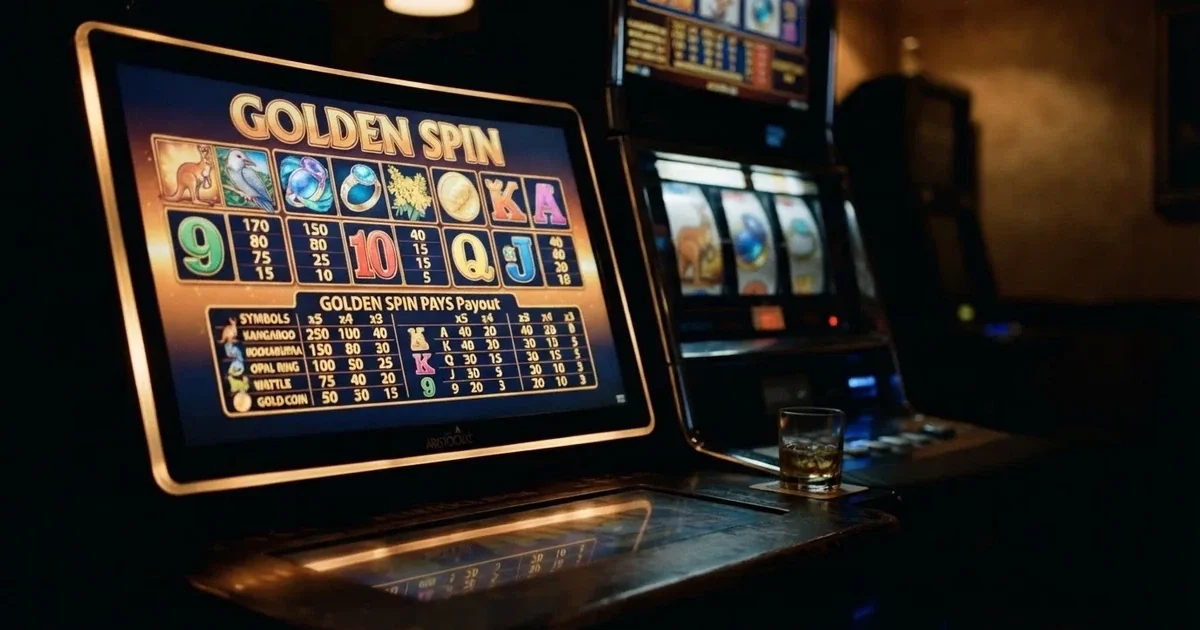
RTG titles come with a paytable screen at the top of every game window, and the numbers it shows are the only thing a player can read before the first spin. The studio’s standard mechanics — paylines, scatter pays, free-spin retriggers and a feature buy on a handful of titles — are visible on that screen; the underlying return-to-player percentage is published by the studio as a single figure rather than as a range. RTG’s own house rules prevent the offshore operator from dialling the RTP up or down to suit its margin, which means the figure on the paytable is the figure the game actually pays over the long run.
Two facts about the broader offshore catalogue are worth keeping beside any RTG figure. Betsoft’s Good Girl Bad Girl 2 carries a published RTP of 96.22%, a “Very High” volatility tag and a 15.59% hit rate on a 5-reel, 20-payline layout. The Slotfather, a Betsoft title live since December 2012, runs at 95.69% RTP with medium volatility and an 8.17% hit rate across 30 paylines. These figures come from the studio’s own game pages, not from affiliate marketing copy, and they illustrate the kind of variance a player should expect from a non-RTG title in the same offshore catalogue.
A second studio worth knowing
1spin4win is a slot provider founded in 2021 by a team with fifteen years of iGaming experience. The studio is headquartered at Scharlooweg 39, Willemstad, Curaçao, holds a Curaçao gaming licence and lists a catalogue of more than 190 online slots built in HTML5 for low-bandwidth connections. Its website reports more than 1,000 partnerships with online casinos and aggregators, and states its total bet sum grew 46% in the first half of 2025 against the first half of 2024. A studio of that size is the kind of supplier that shows up behind RTG-lookalike lobbies, sometimes labelled RTG and sometimes labelled under its own brand.
The Australian onshore alternative
Aristocrat Leisure Limited, headquartered in North Ryde in Sydney, is the largest gambling-machine manufacturer in Australia and the second-largest slot-machine manufacturer in the world behind International Game Technology. Founded in 1953 by Leonard Ainsworth and listed on the Australian Securities Exchange in 1996 under the ticker ALL, Aristocrat reported 2025 revenue of A$6.30 billion, normalised net profit after tax and amortisation of A$1.55 billion, and 7,400 employees. The company has administrative and research headquarters in North Ryde and marketing and development offices in South Africa, Russia and the United States.
Aristocrat’s onshore product is the electronic gaming machine on a club or casino floor — the “pokie” that millions of Australians walk past every week. Its online arms are Product Madness (social casino games) and Aristocrat Interactive, the latter formed in April 2024 by combining the Anaxi unit with the newly acquired NeoGames group, which includes Aspire Global, BtoBet and Pariplay. The Aristocrat Interactive suite sits behind licensed wagering and lottery products in regulated markets, not behind an offshore RTG-style casino.
A reader comparing RTG-branded offshore slots with the Aristocrat cabinet on the local pub floor is not comparing the same product twice. The pokie on the floor is regulated by a state or territory gaming authority, pays a published return, and sits inside venue-level responsible-gambling duties. The RTG slot on an offshore site is none of those things — the next sections of this page are about why.
Cluster 5 — How a shortlist of RTG-facing operators is actually assembled
Why a shortlist of offshore sites exists at all
Any list of “RTG casinos” that returns a search result is a list of Curaçao-licensed offshore operators that carry RTG titles in their lobby. There is no Australian-licensed RTG casino, because no Australian licence covers online casino games. The ordering of such a list is, in practice, an editorial decision made by an affiliate publisher rather than a regulator’s view of which sites are safe. The criteria that actually separate one entry from another, when research is honest about it, are narrow: the licence the operator displays, the date of any regulator action against it, the studio whose software it carries, and whether its payment terms accept the routes that Australian law has restricted.
The criteria that matter and the ones that don’t
A “best RTG casino” comparison in 2026 rests on four checks rather than on the marketing claims the sites publish about themselves. First, the Australian legal status: the site may hold a Curaçao or Anjouan licence and still be unlawful to serve Australians, and that is the only legal status that matters locally. Second, the ACMA record: every formal warning is published by name on the regulator’s site, with the operating company behind it. Third, the studio actually carried in the lobby: an “RTG casino” listing that turns out to be a Betsoft or Pragmatic Play lobby with one RTG-branded section is not the same product. Fourth, the payment route: a site that asks for credit card or crypto deposits is, in the Australian frame, operating outside the rules that bind a wagering service licensed here.
What does not separate one entry from another in any meaningful way is the bonus headline. Affiliate marketing pages run “300% up to A$3,000 + 200 free spins” style banners as a category, and the figures they carry are not from the operator’s own terms page. The deposit terms, the wagering multiple and the maximum cashout are where the real cost shows up, and none of those are the same number as the headline.
The shape of the comparison on this page
The eleven entries below are not a ranking. Each is an operator the ACMA has acted against for offering prohibited online casino services to Australians. The order is the order the regulator’s published record gives. The verdict at the close of each block is the page’s own judgement of the brand in the Australian context — not a recommendation to play, which the law does not allow the operator to lawfully provide, and which this page does not provide either.
The ACMA’s published record — eleven operators
The comparison below is drawn from the Australian Communications and Media Authority’s published formal warnings. Each entry names the operating company behind the brand as the ACMA records it, the date of the warning, and what the brand’s own publicly listed software suppliers say about its RTG exposure.
| Brand | ACMA action and date | Operator named by the ACMA | Subject support |
|---|---|---|---|
| RocketPlay | Formal warning, March 2026 | Pulsup Ltd (Rocketplay) | — |
| Level Up Casino | Formal warning, May 2022 | Dama N.V. | RTG presence reported by Wazdan listings only |
| Woo Casino | Formal warning, March 2025 | Dama N.V. | — |
| Spirit Casino | Formal warning, May 2025 | Dama N.V. | — |
| National Casino | Formal warning, July 2025 | Consolutetish S.R.L. | RTG presence not confirmed by studio listings |
| Bizzo Casino | Formal warning, July 2025; prior 2022 | Consolutetish S.R.L.; earlier TechSolutions | — |
| Ignition Casino | Formal warning, July 2025 | Bamboo Media | — |
| Instant Casino | Formal warning, February 2025 | EOD Code SRL | — |
| Jackbit | Formal warning, April 2026 | Ryker B.V. | — |
| Casino Intense | Formal warning, April 2025 | Sterplay Holding Ltd | RTG presence reported by third-party studio listings only |
| Sky Crown | Formal warning, September 2022 | Hollycorn N.V. | — |
Two patterns jump out of the regulator’s record rather than out of any marketing page. First, one operator — Dama N.V. — appears against three of the eleven brands across 2022, 2025 and 2025. The ACMA’s formal warning process is meant to be the step before an ISP blocking request; a name that recurs is a name whose enforcement file is open. Second, the 2025 and 2026 entries carry the newer operating companies (Pulsup, Consolutetish, Bamboo Media, EOD Code, Ryker B.V.), which is consistent with a market in which the front brand is renewed around a fresh Curaçao shell while the underlying software supplier remains the same.
RocketPlay
The ACMA’s March 2026 formal warning names Pulsup Ltd as the operator of Rocketplay, with a separate May 2022 warning against Dama N.V. covering the same brand under its earlier ownership. The site has been the subject of two regulator actions on opposite sides of the Australian market’s enforcement ramp-up. No studio listing confirms an RTG-specific catalogue beyond the brand’s own marketing copy. The site’s offshore status is unambiguous: it does not display an Australian licence, because none exists, and it has been on the receiving end of two formal warnings for offering prohibited services.
Verdict: the brand’s place in this comparison is the regulator’s record, not a product case. A reader weighing it against an onshore Aristocrat cabinet or a locally licensed wagering service is weighing two different regulatory universes.
Level Up Casino
The May 2022 formal warning against Dama N.V. covers Level Up Casino alongside five other Dama brands. Third-party software listings (Wazdan’s published game distribution catalogue) name Level Up as carrying Wazdan titles; the listing does not on its own confirm an RTG-branded lobby. The ACMA action is the published fact, and the studio exposure is what the supplier’s own listing says it is.
Verdict: a brand that sits on the ACMA’s formal-warning list and whose RTG exposure is only as solid as a third-party distributor’s listing is one a player cannot verify from either side.
Woo Casino
The March 2025 formal warning against Dama N.V. over Woo Casino is one of two 2025 actions against the same operator, with Spirit Casino the other. No studio listing for Woo Casino in the research record confirms an RTG-branded catalogue. The site is offshore and operates under a Curaçao licence by its own statement.
Verdict: Woo Casino’s ACMA record is fresh enough that any reader who treats the warning as background will see the same operator again in the next entry.
Spirit Casino
The May 2025 formal warning against Dama N.V. over Spirit Casino is the second of the two 2025 Dama actions. No studio listing for Spirit Casino confirms an RTG-branded catalogue. The site’s regulatory record is recent; its product record is unverified.
Verdict: a brand with a fresh regulator action against it and no independently listed RTG catalogue is, on the evidence available, a marketing re-skin rather than a software re-launch.
National Casino
The July 2025 formal warning against Consolutetish S.R.L. covers National Casino alongside Bizzo Casino. Studio listings from Betsoft and Pragmatic Play name National Casino as a partner for those two studios; the RTG exposure is not separately confirmed in the research record. The ACMA action is on the regulator’s published list; the product mix is what the studios say it is.
Verdict: a brand whose RTG status is unconfirmed even by the studios whose names do appear beside it is best read as a multi-studio lobby rather than as an RTG-specific casino.
Bizzo Casino
The July 2025 formal warning against Consolutetish S.R.L. over Bizzo Casino follows a 2022 formal warning against TechSolutions (CY) Group Limited and TechSolutions Group N.V. for the same brand. That is two regulator actions across four years for one brand, with the operating company changing between them. The product side has no confirmed RTG listing in the research record.
Verdict: the same brand appearing under two different operating companies in the regulator’s file is the clearest example in this set of the offshore shell-reskin pattern.
Ignition Casino
The July 2025 formal warning against Bamboo Media over Ignition Casino is the ACMA’s named action. Ignition is a long-running offshore brand that, in other markets, has been distributed as a poker-and-casino lobby. The research record does not confirm an RTG-branded catalogue on the Australian-facing instance.
Verdict: a brand with an offshore history longer than most on this list but no confirmed RTG exposure in the regulator file or studio listings is one a reader should treat as a name rather than a software case.
Instant Casino
The February 2025 formal warning against EOD Code SRL over Instant Casino is the ACMA’s named action. The research record carries no studio-side confirmation of an RTG-branded catalogue for this operator.
Verdict: the warning is the regulator’s published record; the absence of a studio-side RTG confirmation is what it is.
Jackbit
The April 2026 formal warning against Ryker B.V. covers Jackbit alongside CasinOK. The research record carries no studio-side confirmation of an RTG-branded catalogue for this operator.
Verdict: a fresh regulator action and an unconfirmed studio exposure leaves a reader with the regulator’s record and nothing more.
Casino Intense
The April 2025 formal warning against Sterplay Holding Ltd over Casino Intense is the ACMA’s named action. Third-party listings (1spin4win’s published partner catalogue and the UK Gambling Commission’s public register) name Casino Intense as a partner; the research record treats the RTG exposure as a third-party listing only and not as a direct studio confirmation.
Verdict: a brand whose RTG presence appears only in third-party distributor listings is one a reader should not take as confirmed without the studio’s own statement.
Sky Crown
The September 2022 formal warning against Hollycorn N.V. covers Sky Crown and Blue Leo. The research record carries no studio-side confirmation of an RTG-branded catalogue for either brand.
Verdict: Sky Crown’s place in this comparison is the regulator’s record. The product side is what the brand’s own lobby says it is, and that is not research-grade evidence.
Cluster 1 — RTG in the Australian landscape
The split between offshore and onshore
Australia does not license online casino games. State and territory authorities regulate the electronic gaming machines in clubs, pubs and casinos; the Northern Territory Racing and Wagering Commission licenses wagering services and online bookmakers, including Sportsbet, Bet365 and Ladbrokes, for tax reasons. The NTRWC runs without full-time staff and meets once a month in Darwin. The commission’s wagering licences cover racing and sports betting placed before the event, not online slots, table games or in-play products. What an Australian can lawfully access online is wagering, lotteries and keno.
What an Australian cannot lawfully be offered online is the RTG-branded casino product — the slots, table games and progressive jackpots that the offshore sites list under the RTG label. The Interactive Gambling Act 2001, strengthened by the Interactive Gambling Amendment Act 2017, makes the supply of those games to a person physically in Australia an offence. The IGA targets the provider, not the individual player, but it does give the regulator the power to direct Australian internet service providers to block the offering site.
The arithmetic of the ACMA’s blocking record
The Australian Communications and Media Authority reported in June 2026 that a total of 1,751 illegal gambling and affiliate marketing websites had been blocked since the first blocking request in November 2019, with more than 230 unlicensed gambling services having left the Australian market since the enforcement regime was strengthened in 2017. Working from those two figures, the cumulative blocking rate between November 2019 and the June 2026 cut-off comes out to between 200 and 280 sites per year over the roughly seven-year window — a steady cadence rather than a one-off sweep.
A single month’s round, also reported in June 2026, asked Australian ISPs to block 12 more sites in one batch: 7Signs, ChromaBet, Donbet, Duospin, Freshbet, Slots Gem, Jacks Club, Lucky Start, Pointsbetz, Spinrise, Vinyl Casino and Wildsino. A monthly round of that size against a known offshore pipeline is, on the regulator’s own cadence, the shape of enforcement rather than an exception. The blocking rate is the cumulative figure; the monthly round is the working figure; the trend between them is the one the reader should keep.
The money behind the supply
H2 Gambling Capital’s 2025 estimate puts Australian losses to illegal gambling sites at about A$3.9 billion a year, with the share of gambling going through legal channels falling from 74% in 2021 to 64%. The drop in legal-channel share is the part that matters for the reader: it is not that legal gambling has shrunk, it is that the illegal supply has grown faster than the legal one. The A$3.9 billion figure is an estimate, not an audited number, and H2 Gambling Capital’s methodology is its own; the share movement is the figure the regulator and the industry treat as the trend signal.
Why the offshore brand is not a service
An offshore RTG-facing site is, in the Australian frame, three things at once: unlawful to be supplied to an Australian, unbound by Australian consumer law, and outside any Australian complaints or dispute-resolution body. The Interactive Gambling Act’s enforcement hits the provider. The site gives the player none of the protections a wagering service licensed under the Northern Territory or an Australian state gives: no dispute resolution, no responsible-gambling duty beyond the site’s own terms, no guarantee that a balance will be paid out, no recourse if a withdrawal is refused. A blocking order can land with funds still on the account.
The Aristocrat onshore contrast
Aristocrat’s Australian footprint — North Ryde headquarters, 7,400 employees, A$6.30 billion in 2025 revenue — is the size of the onshore slot-machine industry in this country. Aristocrat’s electronic gaming machines operate under state and territory regulation: a return-to-player figure published by the manufacturer and audited by the regulator, venue-level responsible-gambling duties, and a complaints path through the state gaming authority or the Australian Competition and Consumer Commission. The Aristocrat Interactive arm, formed in April 2024 around the Anaxi and NeoGames units, is the company’s regulated online real-money product, and it sits behind licensed wagering and lottery services in regulated markets rather than behind an offshore RTG-style casino.
The contrast is not “offshore RTG versus onshore Aristocrat”; it is “no Australian licence at all” versus “Australian-licensed wagering, lotteries and keno plus state-regulated EGMs.” The reader’s choice in Australia is, on the supply side, between the licensed wagering product and the prohibited casino product — not between two flavours of casino.
Cluster 2 — How the Interactive Gambling Act covers RTG-style offshore supply
The prohibition framework
| Service Type | Legal Status in Australia | Licensing Authority |
|---|---|---|
| Online casino games | Prohibited | None |
| Online pokies | Prohibited | None |
| Sports/Racing betting (pre-event) | Licensed | State/Territory |
| Lotteries and Keno | Licensed | State/Territory |
The Interactive Gambling Act 2001 makes it an offence to provide an “interactive gambling service” to a person physically in Australia. The Interactive Gambling Amendment Act 2017 strengthened the prohibition: in-play betting on sports, online casino games and online pokies (online slot machines) are prohibited interactive gambling services and cannot be licensed.
Who the Act targets
The IGA targets the provider, not the individual player. An Australian who opens an account with an offshore operator and plays RTG slots is not, on the face of the Act, committing an offence. The provider is. That distinction matters because the enforcement tools — formal warnings, civil penalty proceedings, directions to ISPs to block sites — all run against the operator. The player is the one left with the consequences the regulator cannot reach: no Australian consumer law cover, no complaints body, no guarantee a withdrawal will be honoured.
What a formal warning means
A formal warning from the ACMA is a published step in the regulator’s enforcement process. It is not a blocking order, and it is not a fine. It is a written notice to the operator naming the service, the legal basis for the regulator’s view that the service is prohibited, and the consequences of continuing to offer the service to Australians. A second warning, or a warning followed by a blocking direction, is the regulator’s way of escalating. The eleven operators in this comparison sit at different points in that escalation. RocketPlay has two formal warnings across two different operating companies. Woo Casino and Spirit Casino are fresh 2025 warnings against the same operator. Sky Crown’s September 2022 warning sits in the older end of the file.
The credit-card and crypto payment ban
Since 11 June 2024, credit cards, credit-related products and digital currency have been banned as payment for licensed online wagering, with penalties of up to A$247,500 for operators. The legal deposit routes for a wagering service licensed in Australia are debit card, bank transfer, PayID/Osko and BPAY. A site asking an Australian for a credit card or a crypto deposit is, by that single fact, operating outside the Australian rules — whether or not the brand presents itself as RTG-facing.
The payment ban is a clean way for a reader to identify a site that is not part of the Australian frame. A licensed wagering service will not ask for a credit card. An RTG-facing offshore site, by default, will.
What 2026 reform does and does not change
The Interactive Gambling Amendment (Gambling Reform) Bill 2026 passed Parliament on 19 August 2026. Its advertising and inducement measures commence on 1 January 2027. The Bill is law with a start date — not yet in force on a page read in 2026. The page does not rely on those provisions; the Interactive Gambling Act 2001 in its current form is enough to ground the prohibition on online casino supply to Australians.
What the tax position is
Gambling winnings of a recreational player are not assessable income under section 6-5 of the Income Tax Assessment Act 1997, and losses are not deductible. The exception is a person who carries on a business of gambling, which is not the model for a recreational player. The reader’s tax position on any offshore winnings is the same as on a lottery win: not assessable, losses not deductible, and the ATO is the body to confirm the position in any individual case.
Cluster 3 — Responsible gambling supports relevant to an RTG-facing player
BetStop and what it covers
BetStop, the National Self-Exclusion Register, has been live since August 2023. It binds Australian-licensed online and phone wagering services — the Northern Territory-licensed bookmakers and the state-lottery products. It does not bind an offshore RTG-facing casino. A player who has registered with BetStop is excluded from the licensed wagering supply in Australia; the same player’s account at an offshore site is unaffected because the offshore site is not connected to the register.
The distinction is the single most important one in this section. BetStop is the right tool for someone who wants to step back from the Australian-licensed wagering supply. It is not a tool against the offshore RTG-facing supply, and it does not stop a player from opening a new account with an offshore site.
Gambling Help Online and the National Gambling Helpline
Gambling Help Online is the national online counselling and information service for problem gambling in Australia. The National Gambling Helpline is 1800 858 858, free, 24/7, with chat available through Gambling Help Online. Both are free of charge and confidential. Neither is bound to the offshore supply; both will work with a player regardless of which product the player is using.
State and territory self-exclusion
State and territory gaming authorities run their own self-exclusion registers for the EGM floor — the club, pub and casino pokies. The registers vary by state, and they apply to the onshore venue supply rather than to an offshore online account. A player who wants to step back from the pub pokies as well as from licensed wagering needs to register with both: BetStop for the wagering supply and the relevant state register for the EGM floor.
What an offshore site does and does not provide
An offshore RTG-facing site has no obligation under Australian responsible-gambling law, no duty to offer self-exclusion that connects to an Australian register, no requirement to publish a return-to-player figure audited by an Australian authority, and no complaints body behind it. The site’s own responsible-gambling page is the site’s own policy. It may be thorough; it may be minimal; the reader cannot verify it without testing it.
A reader who has been playing offshore
A reader who has been playing at any of the operators in the comparison above is reading a page that names those operators and the regulator action against them. The Gambling Help Online service and the National Gambling Helpline exist for exactly that case. A reader who wants to stop the offshore supply as well as the licensed one needs to ask the offshore site for self-exclusion on its own terms, and to use BetStop and the state EGM register for the Australian-licensed part of the supply. None of those three steps substitutes for the other two.
The reader’s actual position in 2026
An Australian reader comparing RTG-branded offshore slots with what the country does license ends up comparing two unequal categories. The licensed supply — wagering, lotteries, keno and the state-regulated EGM floor — is regulated by the Australian Communications and Media Authority, the Northern Territory Racing and Wagering Commission and the state and territory gaming authorities. The offshore RTG-facing supply is prohibited under the Interactive Gambling Act 2001, subject to formal warnings from the ACMA, and may be blocked by Australian ISPs at any time.
The eleven operators in this comparison are the ACMA’s published record, not a recommendation. The first thing to take from that record is the operator name’s tendency to recur under a fresh Curaçao shell; the second is the freshest 2025 and 2026 actions against new operating companies; the third is the absence of any Australian-licensed “RTG casino” in the regulator’s file. The arithmetic of the ACMA’s blocking cadence — between 200 and 280 sites blocked per year over the seven years to June 2026, with a 12-site round in the June 2026 month alone — is the rate at which the regulator is moving against the offshore supply that carries RTG-style products.
A reader who wants to play RTG-style slots in the legal Australian frame cannot. The reader’s legal options are wagering with a licensed bookmaker, keno and lotteries under state rules, and the EGM products on the licensed pub, club and casino floor. A reader who has been playing offshore and wants to step back has BetStop for the licensed wagering side, the state EGM register for the venue floor, and the offshore site’s own self-exclusion for its own product, with Gambling Help Online and the National Gambling Helpline (1800 858 858) available for the counselling side.
Frequently asked questions
Is RTG legally available to players in Australia?
No. The Interactive Gambling Act 2001, as strengthened by the Interactive Gambling Amendment Act 2017, makes it an offence to provide online casino games — including RTG-branded slots — to a person in Australia. No state or territory licenses the product. The ACMA’s enforcement record against offshore RTG-facing operators is the visible consequence.
What kinds of games does RTG make?
RTG’s catalogue spans online pokies (slots), table games, video poker and progressive jackpot titles, distributed through Curaçao-licensed offshore operators. The studio’s own house rules cap maximum bets so that any single progressive jackpot payout stays at or below A$50,000, and the studio does not let operators alter the RTP figure on its games.
Are RTG games offered at land-based venues in Australia?
No. Australian venues carry Aristocrat and other onshore manufacturers’ electronic gaming machines, which operate under state and territory regulation with a published return-to-player figure. RTG-branded games are an offshore online product only and have not been licensed for an Australian venue floor.
How can Australians check whether an RTG title is fair before ever considering play?
The studio publishes a return-to-player figure for each title on its paytable screen; that figure is the long-run return over many spins and is not a guarantee of any individual session’s outcome. An Australian player cannot take an RTG title to an Australian regulator for testing, because the product is not licensed here. The studios that do publish independently audited RTPs — Betsoft’s published figures on its game pages are an example — do so on the studio’s own terms, not under an Australian framework.
Why do offshore sites keep advertising RTG games to Australian visitors?
The offshore supply targets Australia because the demand is there. H2 Gambling Capital’s 2025 estimate puts Australian losses to illegal gambling sites at about A$3.9 billion a year, with the share of gambling going through legal channels falling from 74% in 2021 to 64%. The Australian market’s size, and the gap between the prohibited casino supply and the licensed wagering supply, is what the offshore sites are pricing into their marketing spend.
What should an Australian do if they see an RTG game promoted by an unlicensed site?
The site is operating in breach of the Interactive Gambling Act 2001 by offering prohibited services to Australians. The ACMA’s enforcement process runs against the operator, not the player. A player who wants to stop the offshore supply can ask the site for self-exclusion on its own terms, and can use BetStop for the licensed wagering side and the state EGM register for the venue floor. Gambling Help Online and the National Gambling Helpline (1800 858 858) are free, confidential and available 24/7.